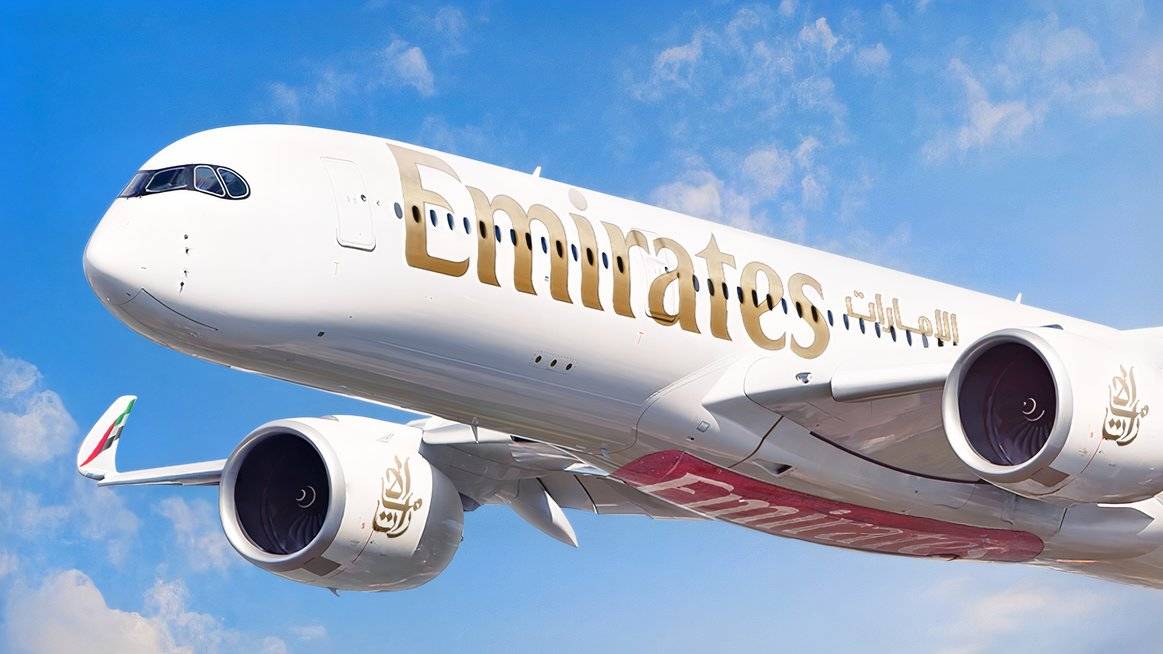
 Emirates is probably one of the few airlines that has successfully built its global identity around ultra-long-haul flying while operating a large fleet of just two aircraft types for quite some time: the Boeing 777 and the Airbus A380. From Dubai, the airline has spent decades stitching together one of the world’s most expansive long-range networks, operating nonstop routes that regularly exceed 14, 15, and even 16 hours.
As both the Boeing 777 and the A380 have started to age, Emirates prepares for the next phase of fleet renewal. The long-awaited Boeing 777X is still undergoing testing and certification, so the airlines must wait. That’s when the Airbus A350 appeared on the radar, attracting Emirates’ attention. The airline has ordered the following subvariants – 900 and, at the same time, was considering the -1000 variant. The Airbus A350-1000 has emerged as one of the most compelling candidates to support this long-haul strategy.
With Boeing’s 777X program facing repeated delays and the Airbus A380 production line closed, Emirates is at a pivotal moment in fleet planning. The airline has already committed heavily to the Airbus A350-900, but discussions about the larger A350-1000 have intensified in recent years. Understanding why the Airbus A350-1000 matters requires looking beyond simple specifications and into how Emirates flies, how it makes money on ultra-long routes, and how the A350-1000 could complement, rather than replace, the aircraft already in the fleet.
Airbus’ “Long-Range Leader” And Why It Matters To Emirates

Airbus consistently refers to the A350 as the industry’s “long-range leader,” a phrase that goes beyond marketing rhetoric. As we have previously covered, this designation reflects the aircraft’s ability to combine extended range with strong payload performance and competitive seat counts, even on the world’s longest routes. The A350-1000, as the largest member of the family, embodies that philosophy. For an airline like Emirates, which prioritizes both reach and scale, this positioning is immediately relevant.
The A350-1000 was designed to sit at the upper end of the twin-engine widebody market, offering capacity that approaches smaller four-engine aircraft while retaining the efficiency advantages of a modern twin. With a range approaching 8,700 nautical miles (16,112 kilometers) and the ability to operate efficiently on routes exceeding 15 hours, the aircraft directly targets missions that historically required either the Boeing 777-300ER or the Airbus A380. Airbus’s emphasis on aerodynamic efficiency, composite structures, and optimized cruise performance allows the A350-1000 to maintain low fuel burn even at high weights — a crucial factor for ultra-long-haul operations.
Airbus’ long-range claims are backed by in-service performance across multiple airlines, not just theoretical projections in the marketing materials. The A350-1000’s Rolls-Royce Trent XWB-97 engines were developed specifically to deliver the thrust required for long-range, high-gross-weight operations. For Emirates, which regularly operates from Dubai’s hot and humid environment at near-maximum takeoff weights, this performance margin is essential. However, the airline remains skeptical about engine reliability, calling it “defective”, due to a shorter maintenance cycle than that of the Airbus A350-900. In the interview with Simple Flying in 2023, Clark said the following:
“If the engine did what we wanted it to do and Rolls-Royce knows what we want it to do, and so does Airbus, then we would re-enter [the Airbus A350-1000] into the assessment for our fleet.”
That is why its smaller sibling, the Airbus A350-900, is gaining momentum in Dubai, as it meets the airline’s expectations and its engine, the Rolls-Royce Trent XWB-84, performs as expected.
Emirates’ Ultra-Long-Haul Strategy And Fleet Pressures

Emirates’ route network is fundamentally shaped by geography. Dubai’s location makes it an ideal hub for linking Europe, Asia, Africa, Australasia, and the Americas, but many of these city pairs require extremely long nonstop sectors. Historically, Emirates has relied on the Boeing 777-300ER and Airbus A380 to serve these markets, but both fleets are now aging. Currently, the airline faces growing pressure to modernize without compromising its ability to move large numbers of passengers over long distances.
The Boeing 777-300ER remains a workhorse, but it’s aging, and, according to planespotters.net, its average age has already reached 13 years, with the oldest 777 aircraft in service (777-200) being about 18 years old. Its fuel efficiency no longer matches that of newer designs. Meanwhile, the A380, though beloved by passengers and well-suited to high-density routes, lacks the flexibility and operating economics increasingly demanded by today’s market. In addition, they are no longer in production, so there is no possibility of ordering new ones to replace the oldest airframes. Emirates’ frustration with the delays to the Boeing 777-9 has only intensified the need for a credible alternative that can step into long-haul roles without significant compromise. That’s when Emirates’ President, Sir Tim Clark, mentioned that the Airbus A350-1000 was still on the table, partially due to significant delays in the 777X program.
This context explains why Emirates’ interest in the A350-1000 has never fully disappeared, even during periods of hesitation. The aircraft offers a way to preserve Emirates’ long-haul scale while improving fuel efficiency, reducing emissions, and enhancing operational flexibility. In many respects, it represents a natural evolution rather than a radical departure from the airline’s established model, given that it has already been operating the A350-900 successfully for about two years.

Emirates’ Massive Fleet Commitment: All The Aircraft Still To Be Delivered
Emirates is going through a period of huge upheaval and modernization in its fleet with over 300 aircraft on order.
The Role Of The A350-900 In Emirates’ Fleet

Before understanding the A350-1000’s potential role, it is important to examine the A350-900, which Emirates has already begun integrating into its fleet. The airline has ordered dozens of A350-900s and has publicly outlined plans to deploy them across a wide range of medium- and long-haul routes. This aircraft represents Emirates’ first major step into the A350 family.
Configured with a modern three-class cabin, the A350-900 allows Emirates to right-size capacity on routes that do not justify an A380 or a high-density 777-300ER. It is particularly well-suited to long-thin markets, secondary cities, and routes where premium demand exists, but overall volumes are lower. The aircraft’s efficiency also makes it attractive for markets with volatile fuel economics or seasonal demand fluctuations.
Importantly, Emirates has also explored ultra-long-range operations with the A350-900. As mentioned on the Emirates website, the airline has evaluated using a specifically retrofitted ULR variant of the A350-900 for missions that push beyond traditional long-haul boundaries, including services to Australia that rival some of the world’s longest commercial flights, and, at the same time, to replace Boeing 777-200LR on its long yet not densely packed routes.
How The A350-1000 Might Complement The A350-900

Rather than replacing the A350-900, the A350-1000 can be considered as a complementary platform within Emirates’ future fleet. Although both aircraft share a common type rating and systems architecture, they are optimized for different missions. This distinction can allow Emirates to fine-tune capacity and range across its network.
The A350-900 excels on routes where efficiency and flexibility matter more than sheer capacity. The A350-1000, by contrast, adds roughly 40–60 additional seats in typical configurations while maintaining similar range performance. This makes it ideal for high-demand ultra-long routes where Emirates currently relies on larger aircraft but wants better fuel efficiency and lower per-seat costs.
Full Comparative Overview Of Emirates’ Widebody Fleet + Airbus A350-1000 option
|
Aircraft Type |
Typical Range |
Typical Passenger Capacity |
Fuel Efficiency (Relative) |
Primary Role |
|
Airbus A380-800 |
~8,200 nm (15,186 kilometers) |
480–615 |
Low (four-engine) |
High-density trunk routes |
|
Boeing 777-300ER |
~7,370 nm (13,649 kilometers) |
360–420 |
Moderate |
Long-haul backbone |
|
Boeing 777-9 (future) |
~7,285 nm (13,492 kilometers) |
400+ |
High |
Next-gen long-haul |
|
Airbus A350-900 |
~8,500 nm (15,742 kilometers) |
300–350 |
Very High |
Medium to long-haul, thin routes |
|
Airbus A350-1000 (in theory) |
~8,700 nm (16,112 kilometers) |
350–410 |
Very High |
High-demand ultra-long haul |
Operationally, the two variants offer significant synergies. Pilots can transition between the A350-900 and A350-1000 with minimal additional training, and maintenance commonality reduces complexity and cost. For Emirates, which operates large, standardized fleets, this commonality can be a strategic advantage that supports scale without sacrificing flexibility.

Big Bus Deal: Emirates Looks To Order At Least 30 A350-1000s
Emirates considers a game-changing order despite past criticisms.
Economics, Efficiency, And Passenger Comfort On Ultra-Long Routes

Ultra-long-haul routes magnify every variable in airline operations, turning small inefficiencies into major cost drivers over flights that can last 16 or even 17 hours. Fuel burn, crew utilization, maintenance reliability, and aircraft performance margins all become significantly more important as stage lengths increase. The Airbus A350-1000 was designed with precisely these challenges in mind, positioning it as a strong candidate for airlines like Emirates that routinely operate at the outer limits of commercial aviation.
From a pure operating economics perspective, the A350-1000 offers a substantial advantage over older-generation widebodies. This aircraft can deliver fuel burn reductions of approximately 20–25% compared with legacy aircraft such as the Boeing 777-300ER, depending on mission profile and configuration. On ultra-long-haul routes, where fuel represents the single largest operating cost, these savings are magnified dramatically. Lower fuel consumption also directly reduces carbon emissions, supporting Emirates’ broader sustainability commitments while improving per-seat economics on some of its longest and most expensive routes.
However, ultra-long-haul success is not measured solely by economics. Passenger experience becomes increasingly central as flight times extend well beyond traditional long-haul thresholds. Emirates has built its global brand around premium service, and the A350-1000 aligns closely with those expectations by offering a cabin environment specifically optimized for long-duration travel. On flights that span half a day or more, comfort features become decisive elements of the overall product.
The Airbus A350’s Airspace cabin provides tangible benefits for passengers on extended journeys, including a lower cabin altitude, improved humidity levels, and significantly reduced cabin noise compared with older widebody aircraft. These factors help reduce fatigue, dehydration, and jet lag, particularly on overnight ultra-long routes. For Emirates, which invests heavily in premium economy and business class experiences, these cabin characteristics reinforce its positioning as a carrier focused on comfort as much as connectivity, as already seen in the -900 variant’s operations.
Finally, the A350-1000’s wider cabin cross-section can allow Emirates greater flexibility in interior layout, supporting spacious premium cabins, larger galleys, and improved crew rest facilities. Crew welfare is a critical but often overlooked component of ultra-long-haul operations, as well-rested crews directly influence service quality and safety on extended sectors. Over time, these design advantages can contribute to a more consistent onboard experience across Emirates’ longest routes.
Strategic Timing And The Path Forward

Timing plays a critical role in fleet decisions, and the A350-1000’s appeal to Emirates has grown as external pressures mount. Boeing 777X delays, evolving environmental regulations, and shifting passenger demand all point toward the need for efficient, flexible long-range aircraft. In this context, the A350-1000 increasingly looks like a strategic hedge as much as an operational solution.
Reports suggest Emirates is evaluating an order of at least 30 A350-1000s, potentially positioning the type as a core component of its ultra-long-haul fleet. Such a move would allow the airline to scale capacity precisely where needed while reducing reliance on older aircraft.
Ultimately, the A350-1000 aligns with how Emirates has always operated: flying far, flying big, and doing so with a strong emphasis on passenger experience. As the airline looks toward the 2030s, this aircraft might serve as a bridge between today’s fleet and tomorrow’s network ambitions, making it a near-perfect fit for Emirates’ longest and most demanding routes.
About the Author