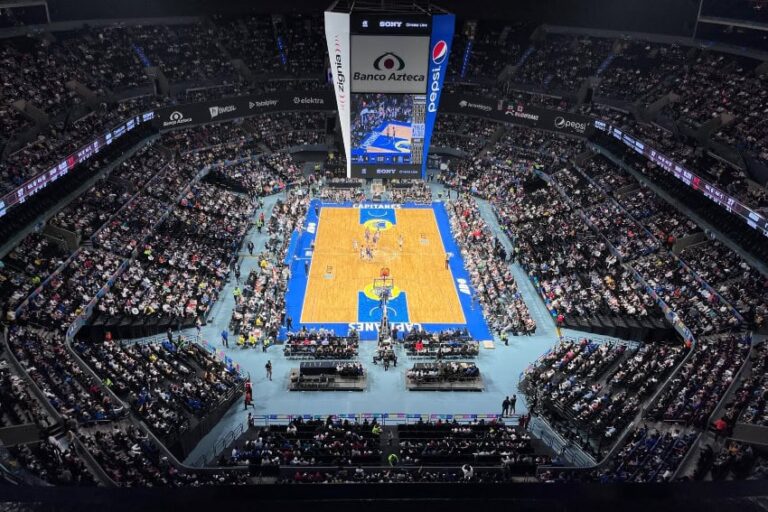
BERLIN — It was two hours before tip-off inside Uber Arena, where two favorite sons first played as professionals before shipping off to America for major college basketball and then the NBA.
Rap music had just started pumping through the arena’s loudspeakers as the first players for the Orlando Magic and Memphis Grizzlies took the court for their pre-game shooting. An NBA record (for any game, anywhere in the world) 62 countries were represented among ticket buyers; the roughly 14,000 tickets were sold out within minutes.
Ostensibly, the interest in this particular game was generated by the return to Berlin of Franz and Moritz Wagner, who are Magic teammates, German national teamers, and brothers who grew up together in Berlin. Their Orlando team ended up winning, 118-111 over the Grizzlies, and Franz shined with 13 of his 18 points in the fourth quarter. They both played as pros in this arena for the local team, Alba Berlin, before going to Michigan and then to the big league in the States.
It was a massive deal last year when the NBA brought the San Antonio Spurs and Indiana Pacers to Paris for two games, so Parisian and global star Victor Wembanyama could host the league for a few days in his city. That was the idea, on the surface, for this year’s Global Games series, times two, because there are two Wagners. It didn’t hurt that a third Magic player, Tristan da Silva, was born in Munich, or, if you really want to get crazy, that Memphis coach Tuomas Iisalo lived in Berlin for a time as a boy and also coached two teams in Germany’s pro league.
But this year’s Global Games schedule is different, for two reasons. One, for the first time, there are two games in Europe in different cities; the Magic and Grizzlies will play again Sunday in London. And secondly, Berlin and London are both squarely on the NBA’s radar as potential sites for anchor teams in a new European league.
Which is why Axel Schweitzer and Marco Baldi were at Uber Arena so early on Thursday, sitting with The Athletic in the, as of 6 p.m. local time, empty VIP lounge behind one of the baskets, talking about the moment before them.
Schweitzer, principal owner and president of Alba Berlin, and Baldi, his vice president and chief executive, have for years been working toward this moment. Not the return of the Wagners, which was nice, but to be “in” on a new European league backed by the NBA.
And they appear to be on track to make it happen.
“To me, they are an exemplar of how a top tier club should be run and organized,” NBA commissioner Adam Silver said Thursday in Berlin. “(With) their tremendous youth programs, they have deep fan support. They’ve created enormous enthusiasm around the game. Look no further than the Wagner brothers, who were developed, as part of the Alba Berlin ecosystem. So, they are the model of the type of club that we would like to see in a potential European league.”

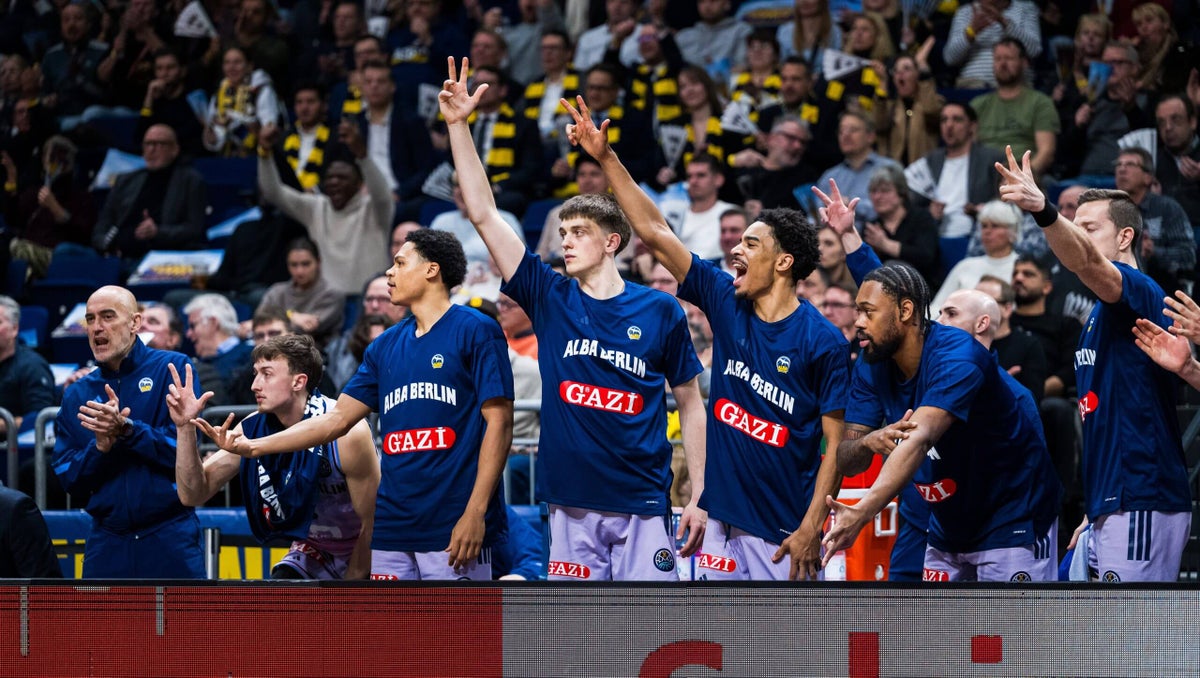
Franz Wagner, now member of the Orlando Magic along with his brother Mortiz, celebrates with his Alba Berlin teammates in the 2019 file photo. The Wagners are the most luminous example of Alba Berlin’s ability to prepare athletes for professional basketball in Europe and the U.S. (Moritz Eden/City-Press via Getty Images)
With an endorsement like that, from the NBA commissioner trying to build (along with FIBA, the international governing body for basketball) a new competition for European-based clubs, it would be almost unfathomable if somehow Alba Berlin wasn’t in the league.
That’s not the attitude Schweitzer and Baldi take about their prospects in public, but they also know they’ve worked for years to put themselves in this position. This week, not only hosting the NBA at Uber Arena for a game, but attending receptions with Silver Wednesday in Berlin, was just the latest step for the Alba club that produced the Wagners.
The NBA is targeting an October 2027 launch date and its list of preferred cities for anchor teams include Berlin, London, Paris, Rome, Milan, Munich, Barcelona, Madrid, Athens, Istanbul, Manchester (England) and Lyon, France. Silver and FIBA, with the help of financial firms JP Morgan Chase and the Raine Group, are courting the deep pockets of public investment funds from the Middle East, including those that currently finance the world’s best soccer teams, and other soccer giants like FC Barcelona and Real Madrid.
Alba, which has played in Europe since 1990, doesn’t quite fit that mold. They aren’t backed by an oil-rich country or a soccer conglomerate. But Alba may have the strongest grassroots basketball program of any pro team in the world. It has employees in most Berlin schools, and virtually any child who picks up a basketball in the city will be coached by an Alba employee. Alba’s program has produced more than 70 pros, in the NBA and in Europe, including the Wagners. Unlike other established pro clubs in Europe, Alba builds its program almost entirely from local residents.
Either as a result, or, as an aside, Alba Berlin averages about 10,000 fans for its home games, making it among the top-drawing clubs on the continent.
“We believe what we are seeing now is a dramatic change to the basketball landscape in Europe that will have an impact for at least the next decade,” Schweitzer said, overlooking the court early Thursday evening. “Our main goal is that Alba Berlin still exists in 100 years … and we are really, really excited by what’s happening, what’s in front of our eyes.”
If Alba’s identity in the community and talent development are its two most important virtues to the NBA, a separate but also important factor is that the club is no longer in the EuroLeague. This is perhaps a confusing concept to the casual American sports fan who is used to the NBA and not versed in European soccer, but on this continent teams play in their domestic leagues and then, if they can, an international competition they qualify for through either license agreements or by winning domestically. Silver’s planned European league would seek to replace the EuroLeague as the continent’s highest international competition.
For the first time in 25 years, Alba Berlin this season is not competing in the EuroLeague or its second division competition, the EuroCup. To be clear, Alba’s final season in the EuroLeague, last year, was a disaster. The club finished in last place out of 18 teams. But its basement dwelling was almost beside the point – Alba had all but decided to break away in anticipation of the NBA’s call by this time last year, if not before.
Alba Berlin was never an “A” license holder in the EuroLeague, which means it was never a permanent member. There are 13 of them, and though most have re-signed license agreements with the EuroLeague for the next decade, European sources believe there is an out clause in those agreements worth roughly $10 million, which could allow those clubs to join Silver’s venture. To that end, Silver said Thursday he’d had discussions with Real Madrid owners (an “A” license holder), and said NBA Hall of Famer Tony Parker, who is majority owner of the ASVEL club (near Lyon), is on a board of former players advising him on Europe. But the EuroLeague is also threatening legal action against the NBA and FIBA if they try to recruit teams under contract.
Alba Berlin’s path to any NBA-backed venture isn’t nearly as messy. Alba had held a “B” license, which meant it could compete in the EuroLeague but not participate in revenue sharing. After 24 years playing in either the EuroLeague, or EuroCup, Alba chose this year to play internationally in a league sponsored by FIBA, with an eye toward joining the NBA’s new venture.
“EuroLeague is not financially sustainable for the licensed clubs, and especially for the non-licensed clubs,” Schweitzer said. “I’m not saying it’s good or bad (for everyone), but for us, with the NBA and the potential to tap into the market … we feel it’s possible to achieve much more than what’s been in reach.”
Another potential hurdle Silver’s venture faces is the need for new arenas in several of his targeted markets, either because current facilities are insufficient, or, in the case of Paris, because the current pro team, Paris Basketball, is entrenched in the city’s arenas and a potentially new team sponsored by soccer giant PSG might have to build its own arena. That is not the case in Berlin, where Uber Arena, built in 2008 by the architects who built Crypto.com Arena in Los Angeles, is spacious, modernized, and, obviously, fit to host an NBA game as it did Thursday night. The announced crowd for Thursday night’s NBA game was 13,738 fans; and the arena is said to have room for 17,000 patrons for concerts.
Then, there is the matter of cost. Neither the banks, nor the NBA and its partner FIBA, have disclosed to potential teams for the new league what it will cost to join. But the buy-in is expected to be substantial – which is partially why Middle Eastern sovereign wealth funds and European soccer conglomerates are desired partners. Neither Schweitzer nor Baldi would disclose potential investors for Alba, but two European basketball sources described the interest in pumping Berlin’s pro club with an infusion of capital is “substantial,” and one said “investors are lining up outside the door.”
While Alba Berlin is not for sale, those sources said, the club is seeking, and would welcome, new partners to meet the costs of joining the NBA’s European league.
“You take your destiny in your own hands,” Baldi said. “We weren’t waiting for someone to come. And now suddenly someone comes, and it changes the picture. We stuck to our values and remained true to ourselves. What needs to be built and what everyone wants to build is a new league, and it’s more than a league – I would say a new universe.
“We are ready to contribute with our capacities, and with all our values.”
About the Author