Series: Open Knowledge Fellowship 2025
For most residents of Mumbai, the word ‘bandstand’ evokes the popular image of Bandra’s seaside promenade, fondly referred to as just the ‘bandstand’ in the neighbourhood. But for an older generation, it also recalls the city’s once-ubiquitous spaces for live music – structures that stood in gardens, maidans, and neighbourhood parks. As Mumbai grows into an increasingly dense concrete landscape, its few green spaces feel precious. It makes one think : how did bandstands – a distinctly colonial import – find its way into this city’s maidans and gardens? And how did it become a melting pot for music, culture and community?
While they appear as simple leisure structures today, bandstands were part of a broader colonial blueprint that sought to organise public life, create visible symbols of British civic culture, and introduce new forms of recreation that aligned with Victorian values.
This essay traces the journey of the bandstand from Victorian Britain to colonial Bombay, and its influence in shaping civic life in the city.
A Short History Of Bandstands
The story of Mumbai’s bandstands begins not in India, but in the pleasure gardens of 18th- and 19th-century London. These elite spaces, like London’s Vauxhall Gardens and Chelsea’s Ranelagh, were cultural hubs for dining, dancing, fireworks, hot-air balloon launches, and promenade concerts. It was within these bustling pleasure grounds that the concept of a dedicated music pavilion took shape.

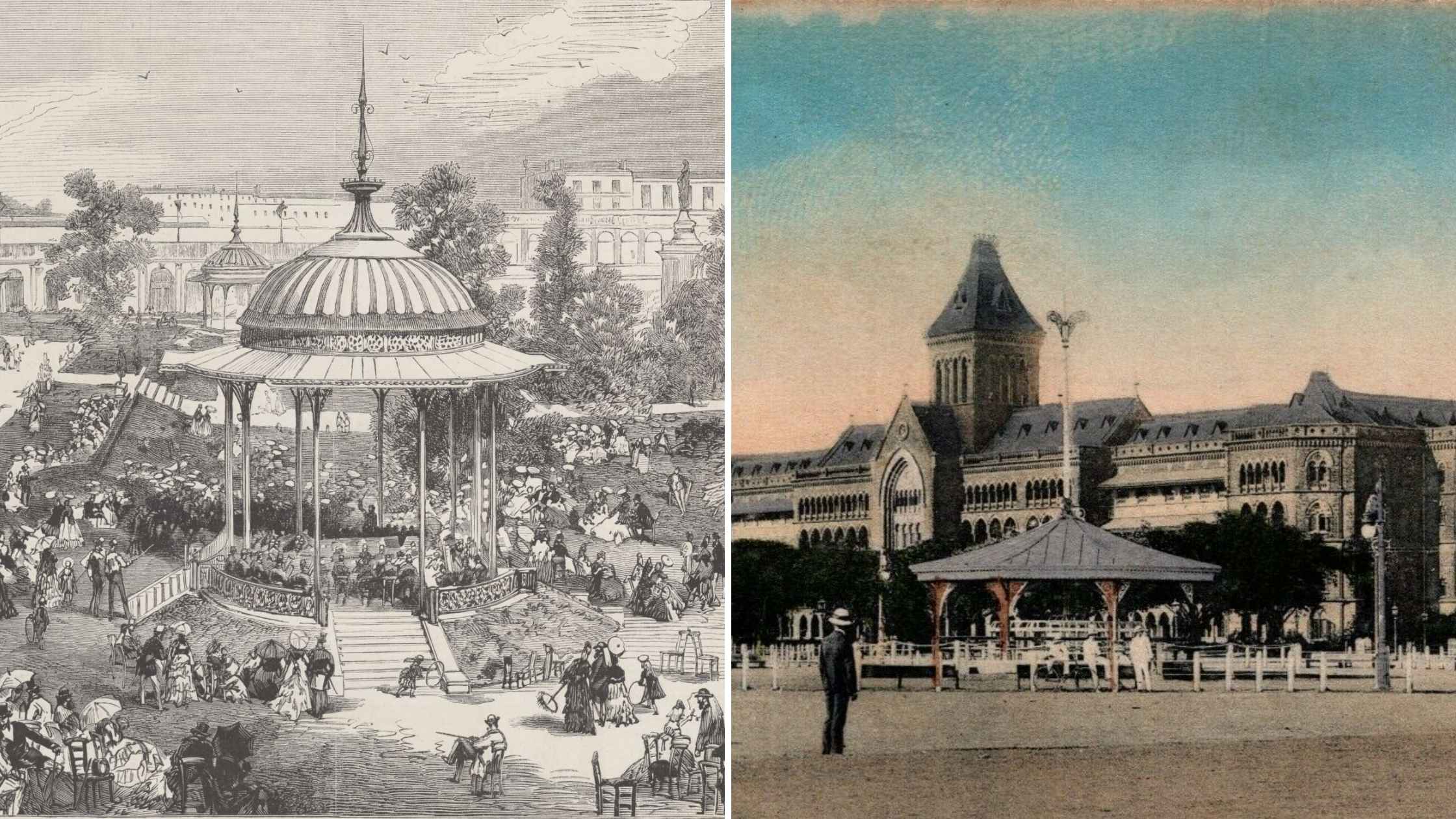
It is believed that the first domed bandstand, then known as a “band house”, was built in the South Kensington gardens of the Royal Horticultural Society (1861).

The structure, supported by cast-iron pillars reflected the era’s fascination with industrial materials. Parks themselves, were built as antidotes to the drudgery of industrialisation – offering the youth, space for movement and recreation. The centre of attraction in many of these parks was the bandstand. Its ornate design, often featuring what Victorians considered “oriental” motifs, reflected the Empire’s expanding encounters with places like India. Rooted in the Victorian impulse to “civilise” urban environments and create orderly leisure, bandstands flourished in Britain’s municipal parks.
Here, military and civic brass bands performed melodic concerts that drew large crowds. They symbolised both order and pleasure – structures that organised sound, spectacle, and social gathering.
From their inception, then, bandstands were instruments through which the British exported their own ideals of urbanity, discipline, and cultural hierarchy to the places they governed. Music in public parks became a gentle form of soft power and an audible reminder of the empire’s presence, tastes, and authority.
Colonial Mumbai and Music at the Bandstands
When the British arrived in Bombay (now Mumbai), the archipelago’s natural harbour and mercantile promise offered a blank canvas for a certain cosmopolitanism. With the islands’ reclamation came the buildings, the promenades, the gardens and at their heart, stood the bandstand – a symbol of ‘home’ for British reisdents in a distant colony.


Mumbai’s first bandstand was likely erected at Cooperage Gardens in 1867 by the Esplanade Fee Fund Committee, only six years after the one in South Kensington.

Another early bandstand stood at Byculla, inside the Victoria Gardens (now Jijamata Udyan). British journalist James Mackenzie Maclean described it as a “rustic bandstand” where the Governor’s band and Her Majesty’s 20th Regiment Native Infantry performed regularly. Newspapers such as The Times of India would carry the evening’s musical selections, listing composers, marches, and waltzes, with each performance likely ending in a rendition of God Save the Queen. The programming was effectively a soundscape of Empire.
Although the instruments and repertoire were foreign, the audiences they attracted were strikingly diverse: British residents, as well as migrants from across India. Yet this seemingly inclusive space also reflected the hierarchies of colonial life.
Rejuvenating Third Spaces
Govind Narayan beautifully illustrates the bustling scene at the bandstand close to Apollo Bunder or Wellington Pier in 1883:
Just a little ahead of the Palo Bunder, there is a very entertaining place called the Band Stand on the Camp Maidan. It is open on all sides and is only large enough to accommodate performers. Benches are provided on the lower side for the accompanying orchestra. Benches are also provided all around for spectators. At about five in the evening, the performers gather at this place. As these people are employed by the Governor and play English instruments at his residence, they are known as the Governor’s Band. These players are from the white regiment and play beautiful new tunes three times every week for the entertainment of the public. Many people throng the location at this time. It is the favoured location of the English for an evening stroll with their families. Hundreds of their vehicles are parked here at that time. As there is also a pleasant breeze at this time of the day, the whole atmosphere turns magical. The English are equally keen on ensuring the health of their bodies and the peace of their minds. The Bandstand wasn’t segregated by race or by class: British and Indian, rich and poor, everyone could be found there.
(Narayan, ed. Murali, 255-256)
Narayan’s account highlights not only the diversity of the crowd at the bandstand, but also the British emphasis on physical and mental well-being, a much needed maxim in today’s modern life. These open maidans and gardens functioned as early third spaces- places outside of home and work, where communities could gather, socialise, and unwind. Yet it was the music at these bandstands which added an extra layer of leisure and entertainment.
As Bombay industrialised and drew migrants to its textile mills, the city’s perimeters expanded. These bandstands in maidans and gardens, offered free recreation to its citizens urban life and living conditions. What respite and joy it must have been, to listen to music under swaying green leaves of a tree or beside the Arabian sea.
The restorative role of nature and music is undeniable, as affirmed in the book, ‘Musicophilia’, by the British neurologist Oliver Sacks: “In forty years of medical practice, I have found only two types of non-pharmaceutical “therapy” to be vitally important for patients with chronic neurological diseases: music and gardens.”
As the decades rolled on, bandstands appeared in new promenades and gardens at Chowpatty beach, Hanging Gardens in Malabar Hill, Parsi Colony in Dadar and King’s Circle Garden.
Repurposing and reviving Mumbai’s bandstands and creating communities
Post Independence, with the rise of radio, and later, the arrival of television, the popularity of bandstands in the city dwindled. Yet, the structures endured, and in recent decades, there have been efforts to restore and revive these.

In early the 2010s, The Bombay Chamber of Commerce and Industry initiated the ‘The Bandstand Revival Project’ to revive the communal experience of music at bandstands. The project provided a platform for diverse musicians to share their talent, replacing the good old military music with the likes of indie rock and classical Hindustani music. In 2018, the Municipal Corporation of Greater Mumbai (MCGM) along with the Oval-Cooperage Residents Association (OCRA), restored and reopened the Cooperage bandstand for the public. Fresh programming has included live music by National Center for Performance Arts (NCPA), stand-up comedy and dance performances. More recently Mumbai Bookies – a book club has turned the bandstand into a silent reading hub. The renewed popularity of these events underscores the city’s ongoing need for accessible public spaces.
Even as the physical structure of the bandstands remains the unchanged, the bandstand has evolved to accommodate local sensibilities, nurturing talent and communities.
In the 19th century, the bandstands and public parks in Bombay reflected the colonial state’s vision for the mental and physical well-being of its subjects; their desire to shape the city’s public life and civic culture. Today though, they serve as a democratised civic stage, where the city’s diverse communities shape the soundscape on their own terms.
Notes & References
click to expand
Acharya, Pratip. 2025. “Mumbai’s Oldest Bandstand, Now a Weekend Hub for Readers” The Indian Express. January 13, 2025. https://indianexpress.com/article/cities/mumbai/mumbai-oldest-bandstand-weekend-readers-hub-9776398/.
Fernandes, Naresh. 2012. Taj Mahal Foxtrot. New Delhi: Lustre Press, Roli Books.
MacLean, James McKenzie. 1893. A Guide to Bombay : Historical, Statistical and Descriptive. 18th Edition.
Mohta, Payal. 2013. “The last gig of the bandstand revival project this summer is at Dadar Chowpatty this Saturday”. DNA. November 21, 2013 https://www.dnaindia.com/mumbai/report-the-last-gig-of-the-bandstand-revival-project-this-summer-is-at-dadar-chowpatty-this-saturday-1836957
Ranganathan, M, ed. 2008. Govind Narayan’s Mumbai: An Urban Biography from 1863. Anthem Press.
Rustomfram, H, Nikharge, S. ed. 2013. “The Enduring Legacy of a People’s Park: Rani Bagh Then and Now”. Rani Bagh 150 Years: Veermata Jijabai Bhosale Udyan and Zoo. India: OUP India.
Rabbitts, Paul. 2018. “Guest blog: A long-lost love affair? Paul Rabbitts writes about the Victorian bandstand.” London Gardens Trust blog. https://londonparksandgardens.wordpress.com/2018/10/01/guest-blog-a-long-lost-love-affair-paul-rabbitts-writes-about-the-victorian-bandstand/
Rabbitts, Paul. n.d.. “The History of the Bandstand.” Pavilion of Music. https://www.pavilionsformusic.co.uk/the-history-of-the-bandstand
About the Author