For millions of people living along India’s vast and varied coastline, the sea is both a source of livelihood and a persistent risk. It feeds families and fuels trade, but it also brings cyclones, high waves, powerful swells and severe erosion.
Accurate, location-specific forecasts of these sea-state conditions are essential for coastal communities, mariners, and planners and such forecasts depend on sustained, high-quality wave observations. Over the past two decades, a quiet transformation has been taking place just offshore.
Anchored in nearshore waters and rocking with the waves are instruments that do far more than measure the sea — they connect scientists, fishers, ports and policymakers in a unique partnership built on trust.
The Wave Monitoring Along Nearshore (WAMAN) buoy network of the Indian National Centre for Ocean Information Services (INCOIS) is behind this transformation. Now in its 18th year, the network’s 17 buoys, spread along India’s coastline, have become a critical source of real-time information on wave height, direction and energy. These data feed forecasts, support early warnings and strengthen coastal decision-making.
What makes WAMAN unique is that it is a community-owned coastal observation system — one of the first of its kind in the Indian Ocean region with active participation from local communities, making forecasting both more effective and more sustainable.
“We realised very early that nearshore observations would not survive unless coastal communities saw value in them. Sustained observations require sustained trust,” says director T. M. Balakrishnan Nair, who has led the project.
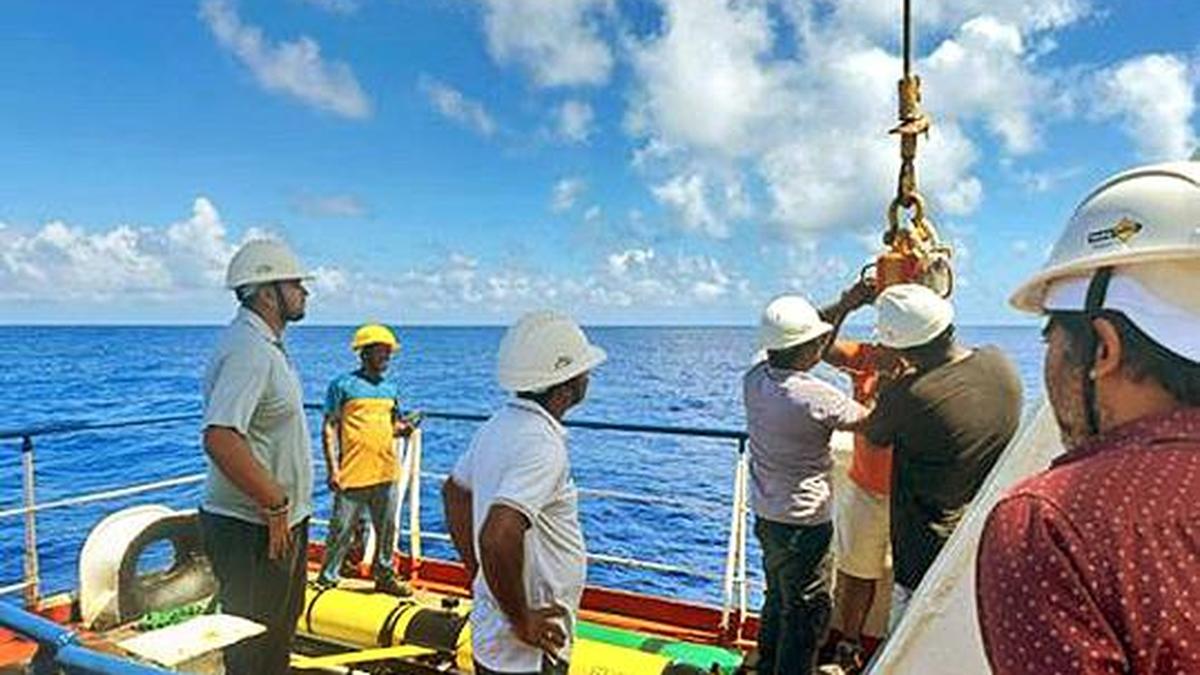
Deploying and maintaining wave buoys in nearshore waters is challenging due to logistical constraints and without community support, vandalism or damage can be an added risk. Recognising that technology alone would not be enough, INCOIS scientists took deliberate steps to bring local stakeholders on board.
“We roped in fisher communities, harbour authorities and other stakeholders, explaining how wave forecasts improve potential fishing zones, enhance safety at sea and support daily decisions. The idea was to help them see the moored buoys as shared assets serving their needs, rather than remote scientific instruments,” explains Mr. Nair.
Real-time data from WAMAN buoys, transmitted via satellite, began feeding operational wave models for India as well as regions such as Seychelles and Mauritius. The forecasts enabled early warnings during high-wave and swell events.
As information returned to shore in local languages, its value became immediately clear. ”When fishing families understood that wave information could tell them when to go to sea and when to stay back, the relationship transformed,” he says.
Today, operational marine services reach nearly one million fishers across India and in countries such as Sri Lanka, Maldives, Seychelles, Comoros, Mozambique and Madagascar. Dissemination happens directly and through partnerships with organisations, including the M. S. Swaminathan Research Foundation, the Reliance Foundation and RIMES.
But new challenges emerged. The buoys, acting as fish aggregation devices, naturally attracted vessels. This sometimes led to damaged equipment, entangled nets, cut mooring lines or even antennas removed and buoys used as temporary anchors. Marine growth added weight and affected data quality, necessitating regular retrieval and cleaning. Occasionally, rough weather or cyclones caused buoys to detach from their moorings and drift away.
Once again, INCOIS turned to coastal communities. Village knowledge centres were equipped with high-frequency receivers. Web interfaces delivered forecasts and warnings in local languages. Fishers shared updates through public address systems and notice boards.
The Fisher Friend mobile app introduced an offline alert system: as a boat approached within 200 metres of a buoy, a loud alarm warned crews away. Automated systems began sending round-the-clock SMS alerts on buoy drift or data failures to fishing boats, the Coast Guard and marine police, often triggering community-led search and recovery missions.
WhatsApp groups formed organically, with fishers reporting buoy positions while at sea. Additional lights improved visibility at night. Deployment sites were chosen carefully to reduce interference while ensuring accessibility. The results are striking. Between 2007 and 2024, only two buoys were lost, drift incidents declined sharply and data availability consistently exceeded 90%, inform scientists.
Designed for operational forecasting, WAMAN has also evolved into one of the most valuable long-term wave datasets in the Indian Ocean region. Researchers use it to refine numerical models, validate satellite observations, and study how wave patterns are shifting with climate variability.
Ports across India now rely on WAMAN’s real-time data for vessel movements, port calls and navigation safety. The shipping industry uses the information to demarcate ‘Inland Vessel Limit’ (IVL) zones that shape both commerce and coastal safety.
The model has drawn international interest, especially from Indian Ocean rim nations struggling to sustain coastal observation systems over time. “Many countries have the technology to deploy buoys. What they often struggle with is sustaining them. WAMAN shows that sustainability comes from aligning observations with user needs and fostering local ownership,” says the director.
Under the Ministry of Earth Sciences, INCOIS is now extending the WAMAN approach through collaborations with RIMES, the Indian Ocean Rim Association and the Global Ocean Observing System. These efforts align with global initiatives such as the UN’s ‘Early Warnings for All’, where reliable ocean observations are fundamental to preparedness.
INCOIS has since been recognised by the World Meteorological Organization as a Regional Specialised Meteorological Centre for wave forecasting and global ocean prediction. But for Mr. Nair, success lies elsewhere.
“When communities become custodians of the observing system, the ocean is watched more closely and more responsibly than ever before. When a fisherman calls to inform us that a buoy has drifted or stopped transmitting, that is real success. It shows the system has moved beyond institutional ownership to ownership by society,” he adds.
Published – January 31, 2026 01:04 am IST
About the Author