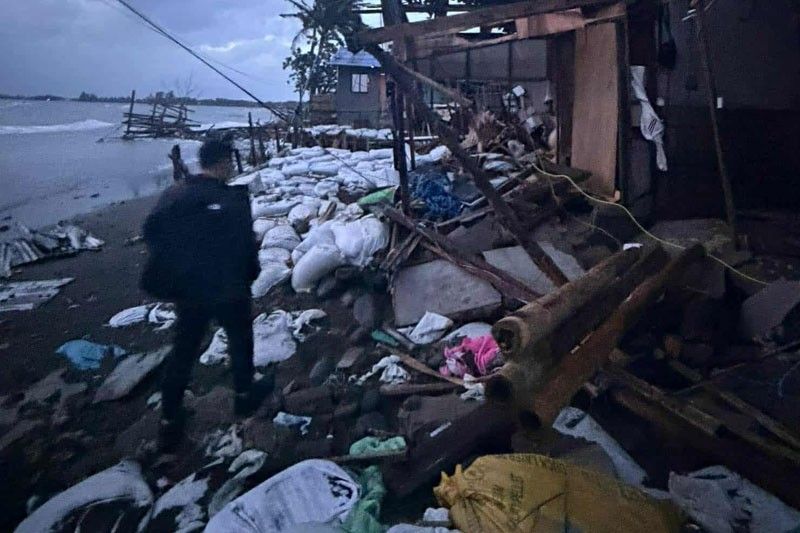
MANILA, Philippines — Super Typhoon Uwan (Fung-wong) blew out of northwestern Philippines yesterday after setting off floods and landslides, knocking out power in entire provinces, killing at least four people and displacing more than 1.4 million others.
As of 4 p.m. yesterday, Uwan was spotted by the Philippine Atmospheric, Geophysical and Astronomical Services Administration (PAGASA) moving farther away from the Ilocos Region.
The typhoon’s center was located 175 kilometers west of Sinait, Ilocos Sur, packing maximum sustained winds of 120 kilometers per hour near the center and gustiness of up to 150 kph. It was moving northwest at 10 kph.
Uwan lashed the northern Philippines while the country was still dealing with the devastation wrought by Typhoon Tino (Kalmaegi), which left at least 224 people dead in central provinces on Tuesday before pummeling Vietnam, where at least five were killed.
Office of Civil Defense (OCD) deputy administrator Bernardo Alejandro IV said the reported deaths are subject to validation.
Uwan slammed ashore in northeastern Aurora province on Sunday night as a super typhoon with sustained winds of up to 185 kph and gusts of up to 230 kph.
The 1,800-kilometer-wide storm weakened as it raked through mountainous northern provinces and agricultural plains overnight before blowing away from the province of La Union into the South China Sea, according to state forecasters.
More than 1.4 million people moved into emergency shelters or the homes of relatives before the typhoon made landfall, and about 318,000 remained in evacuation centers yesterday.
Fierce wind and rain flooded at least 132 northern villages, including one where some residents were trapped on their roofs as floodwaters rapidly rose. About 1,000 houses were damaged, Alejandro and other officials said, adding that roads blocked by landslides would be cleared as the weather improved yesterday.
“While the typhoon has passed, its rains still pose a danger in certain areas” in northern Luzon, as well as Metro Manila, Alejandro said. “We’ll undertake today rescue, relief and disaster-response operations.”
Confirmed deaths
While reports of casualties have yet to be verified, according to the OCD, Central Luzon police director Brig. Gen. Ponce Rogelio Peñones Jr. confirmed a drowning victim in Bulacan identified as Raine Bernardo, a resident of Barangay Balasing, Santa Maria town.
A landslide in Sitio Balangabang West in Kayapa, Nueva Vizcaya left twins dead and three others injured yesterday. The fatalities were identified as five-year-old twins Jess Carl and Kobi James Paulino. Injured were their parents Victor Paulino, 39, Coleene Paulino, 40, and their eight year-old daughter Arendelle.
One person drowned in flash floods in Catanduanes, and a woman died in Catbalogan City in eastern Samar province when her house collapsed on her, officials said.
President Marcos declared a state of national emergency on Thursday due to the extensive devastation caused by Tino and the expected damage from Uwan.
Tropical cyclones with sustained winds of 185 kph or higher are categorized in the Philippines as a super typhoon to underscore the urgency tied to more extreme weather disturbances.
The Philippines has not called for international help following the devastation caused by Tino, but Defense Secretary Gilbert Teodoro said the United States, the country’s longtime treaty ally, and Japan were ready to provide assistance.
Authorities announced that schools and most government offices would be closed until today.
More than 325 domestic and 61 international flights were canceled over the weekend up to yesterday, and more than 6,600 commuters and cargo workers were stranded in ports after the coast guard prohibited ships from venturing into rough seas.
The Philippines is hit by about 20 typhoons and storms each year. The country also has frequent earthquakes and has more than a dozen active volcanoes, making it one of the world’s most disaster-prone countries.
Still flooded
Entire villages lay submerged and scores of towns remained without electricity yesterday as Uwan left the country.
Uwan, with a footprint that spanned nearly the entire archipelago, slammed into the eastern seaboard as a super typhoon on Sunday evening, uprooting trees and swamping towns in its path.
Cleanup efforts were underway yesterday from Cagayan province in the far north to hard-hit Catanduanes island more than 1,000 kilometers to the south.
In Cagayan, provincial rescue chief Rueli Rapsing said a flashflood in neighboring Apayao province had caused the Chico River to burst its banks, sending nearby residents scrambling for higher ground.
“We received reports around six in the morning … that some people were already on their roofs,” he said.
While most had been rescued, video verified by AFP showed that some were still trapped. More than 5,000 people were safely evacuated before the overflowing Cagayan River buried the small city of Tuguegarao about 30 kilometers away.
“Tuguegarao is under water now,” Rapsing said.
Schools and government offices across the main island of Luzon were closed yesterday. That included Manila, where residents were cleaning up after a night of heavy rain and strong wind.
In Aurora province, rescue worker Geofry Parrocha said officials were assessing the damage.
“We’re seeing many damaged houses and some of our main roads were not passable due to landslides,” he told AFP from Dipaculao town, where power had yet to be restored.
“We couldn’t mobilize last night because the rain was heavy and the volume of water was high.”
Ground shaking
In Samar, rescuer Juniel Tagarino said the body of a 64-year-old woman who had been trying to evacuate was pulled from under debris and fallen trees in Catbalogan City.
“The wind was so strong and the rain was heavy… According to her family members, she might have forgotten something and gone back inside her house,” Tagarino said.
Storm surges sent waves hurtling over streets and floodwaters inundated homes in some areas of Catanduanes.
“The waves started roaring around 7 a.m. When the waves hit the seawall, it felt like the ground was shaking,” resident Edson Casarino, 33, said.
Video verified by AFP showed a church in Virac town surrounded by floodwaters that reached halfway up its entrance.
There was also major flooding in southern Luzon’s Bicol region, where verified video showed streets transformed into raging torrents of water.
The Philippine National Police said it has rescued 10,912 people at the height of Uwan’s onslaught.
PNP spokesman Brig. Gen. Randulf Tuano said a total of 21,682 police personnel were deployed across Regions 2, 4A, 4B, 5 and 8, which were among the hardest hit by the typhoon.
“Our personnel conducted 62 search-and-rescue operations and successfully rescued 10,912 people from various provinces,” Tuano said in Filipino. “We continue to coordinate with local governments to ensure a quick response to our affected countrymen.”
Among those rescued were a ship captain and 14 crew members of cargo ship MV El Felecity that ran aground in Lemery, Batangas on Sunday. The ship, carrying Vibro sand, came from Zambales and was on its way to Barangay Wawa, in Nasugbu, Batangas.
Brig. Gen. Vina Guzman, director for police community relations, said police personnel have been deployed to provide security at evacuation centers.
“The directive of our acting PNP chief is to protect and secure evacuees. We have police personnel assigned to evacuation centers, and there are also women’s desks present in each one,” Guzman said.
She added that women’s desks were on alert for possible abuse and exploitation in affected areas.
“During emergencies, there are cases of violence or trafficking, so it’s important that we protect women and children from those who might take advantage of the situation,” she said.
The onslaught of Uwan also left more than a hundred tourists stranded at tourist sites in different parts of the country, according to the Department of Tourism.
The DOT said 35 tourists were stranded in Batanes, 50 in Caraga region in Mindanao and another 76 in the Mimaropa region in Luzon. It said the tourists were safe in their respective accommodations.
Meanwhile, the Department of Education said an initial amount of P78.1 million is needed to repair and clean up 312 schools and 1,182 classrooms that sustained minor damage due to Uwan.
“DepEd remains committed to ensure the safety and well-being of learners and personnel and continues to coordinate with partners to restore learning continuity in affected areas.” — Mark Ernest Villeza, Evelyn Macairan, Artemio Dumlao, Ramon Efren Lazaro, Ghio Ong, Ed Amoroso, Pia Lee-Brago, AFP,
About the Author