Famed author and University of Chicago alumna Susan Sontag, AB’51, once wrote: “I write—and talk—in order to find out what I think.”
A new course in the College is allowing first-years to put that idea into practice as part of “Inquiry, Conversation, Argument,” or ICA.
The course serves as the first change to the Core curriculum writing requirement in over 25 years.
“Inquiry, Conversation, Argument offers students an opportunity to approach writing as a process that both generates and communicates ideas,” said Abigail Reardon, senior instructional professor in the College and executive director of the UChicago Writing Program.
In ICA, students learn to read complex texts critically, formulate and revise arguments, conduct academic research, and become thoughtful critics of their own and others’ writing.
“As the course name suggests, the class begins from the premise that meaningful argument—evidence-based, interpretive argumentation, that is—can only occur in the context of intellectually responsible conversation. Conversation between readers, writers, and other interlocutors,” Reardon explained. “And such conversation, in turn, needs to start with curiosity. Conversation and ideation emerge from good-faith, open-ended inquiry.”
This approach is especially vital now, with ICA launching in the era of generative artificial intelligence. Reardon, who served on last year’s AI and Education working group convened by President Paul Alivisatos and Provost Katherine Baicker, noted how this is the perfect moment for the new Core writing course to be implemented.
“With technology rapidly changing the ways we communicate and create, the ability to inquire, converse and argue with clarity and integrity remains at the heart of what makes us human—and at the heart of a UChicago education.”
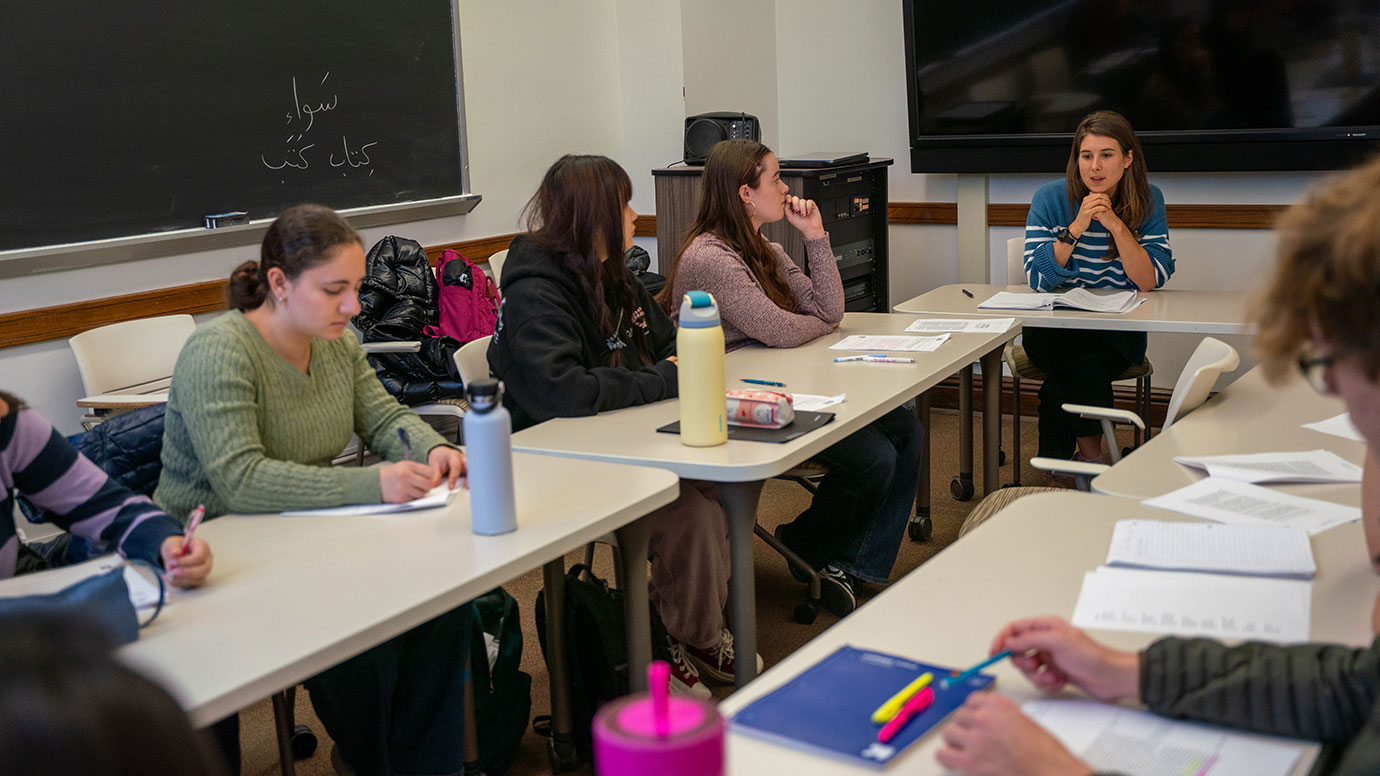
About 20% of the class of 2029 is enrolled in an ICA section this academic year, with the goal of increasing that number to include all first-year students by 2027-2028. While the previous version of the writing requirement met just three times each quarter as part of the Humanities Core, ICA is designed to provide a more coherent, interdisciplinary curricular arc for a better student experience. In each class, students read and write a variety of textual genres from a range of disciplinary perspectives. Students also learn from University librarians who inform the newest generation of UChicagoans how to properly research with the tools and academic resources available to them.
“The Inquiry, Conversation, Argument course extends the powerful traditions of the UChicago Core by asking students to consider foundational habits of thinking that apply to all areas of study,” said Melina Hale, dean of the College. “I’m enthusiastic to see how the course enriches student learning across majors and minors.”
While the learning goals and assignments are consistent across all sections, each class is framed around its own question posed to students. It’s something that gives the course one of those unique educational twists that UChicago has become known for.
“The content of each individual section is designed by an Instructional Professor and is geared toward their own expertise and interests,” said Reardon. “We have instructors with backgrounds in classics, political theory, literary criticism, and music history among others. Instructors invite students to join a genuine shared intellectual project right from the start.”
What kind of future does invention imagine?
One such question, posed by Assistant Instructional Prof. Bill Hutchison, is: “What kind of future does invention imagine?”
When planning his section, Hutchison wanted to ask something that students would not be able to answer right away.
“I wanted to give students something that would keep unfolding the more they worked with it,” he said. “It fits the spirit of the new writing curriculum—writing as inquiry, as experimentation, as a way of discovering what you think rather than just presenting it. I wanted the question to open a door for them and invite them in, and then we built the necessary trust through thinking and writing together to walk through it.”
An assignment had students view musician Janelle Monae’s “Dirty Computer: An Emotion Picture” and animator Don Hertzfeld’s “World of Tomorrow.” Hutchison led a lively discussion after with students posing their own follow-up questions that helped the class delve more deeply into the material. It was an entirely new experience for first-year Ina Jashinsky.
“Never have I received such vivid comments,” she said. “Getting feedback from classmates during discussion, but especially on my writing, pushed me to think harder about my arguments and forced me to clarify ideas that I thought made sense but needed more work. People asked questions that made me realize I was not digging deep enough or that I was making assumptions I had not thought through.”
One might ask how viewing a piece of media would make someone a better writer. For Hutchison, the answer is simple.
“Each medium teaches students something slightly different—images push them to grapple with ambiguity; film asks them to track how form produces meaning; and textual analysis gives them argumentative rigor,” said Hutchison. “When all these tasks come together around a single orienting question and its texts, they can learn a kind of flexible critical thinking that they can take anywhere. They can see the world and talk about it with greater clarity; good writing means their own thoughts show up to them with even greater clarity.”
Why do we read?
Assistant instructional professor Lizzie Mundell-Perkins tasked her students with figuring out: “Why do we read?” It was a question she thought fit the spirit of the course.
“ICA students are themselves readers—not only of the texts we’re discussing, but also of each other’s writing,” said Mundell-Perkins. “As a writing instructor, I emphasize that good writing requires a robust and flexible theory of mind. I chose this topic to place understanding the reader—their experiences and values—at the heart of the class and its philosophy of writing.”
Students were asked to read “Text and Context” by essayist George Steiner and make arguments based on his work during a class discussion. This allowed them to hone their comprehension and interpretive skills and led to debates on whether formal education was necessary to be a good reader and writer. The students then dove into constructive criticism on their peers’ claims of significance which were tied to their research topics.
First-year Jessica Raman believes the course has already made her a better writer.
“In class, we spend time discussing the content of our course readings and the author’s argument, but we also spend a fair bit of time talking about how the author makes their argument, and any nuances of the argumentative technique that we think are interesting,” said Raman. “In the past, I’ve been more focused on the content of my essays. Now, I have a stronger appreciation for and understanding of how argumentative technique can influence how an argument is received by readers.”
The evolution of writing at UChicago
With other students talking about how the workshop format has elevated the way they think about writing and revising, Reardon knows that this is just the start of the evolution of writing at UChicago.
“This is a foundational class that is ideally going to situate students to meet the writing and thinking demands of other classes they take while at UChicago—both in the Core and in their majors.”
As ICA is phased in as the new Core writing requirement, the College is also preparing to revitalize the Writing Program as a whole. New programs and classes will focus on writing in the Core, disciplines and beyond the academy while a new experiential writing lab will comprise the Chicago Center for Writing, which the College is preparing to launch by the start of the 2026-27 academic year.
“This class and the launch of a new Center for Writing are such great opportunities for students in the College,” said Reardon. “I’m excited by the University’s recognition of the value of writing as a human enterprise and our collective commitment to the central role it plays in critical inquiry and free expression.”
—This story was originally published on the University of Chicago College website.
About the Author