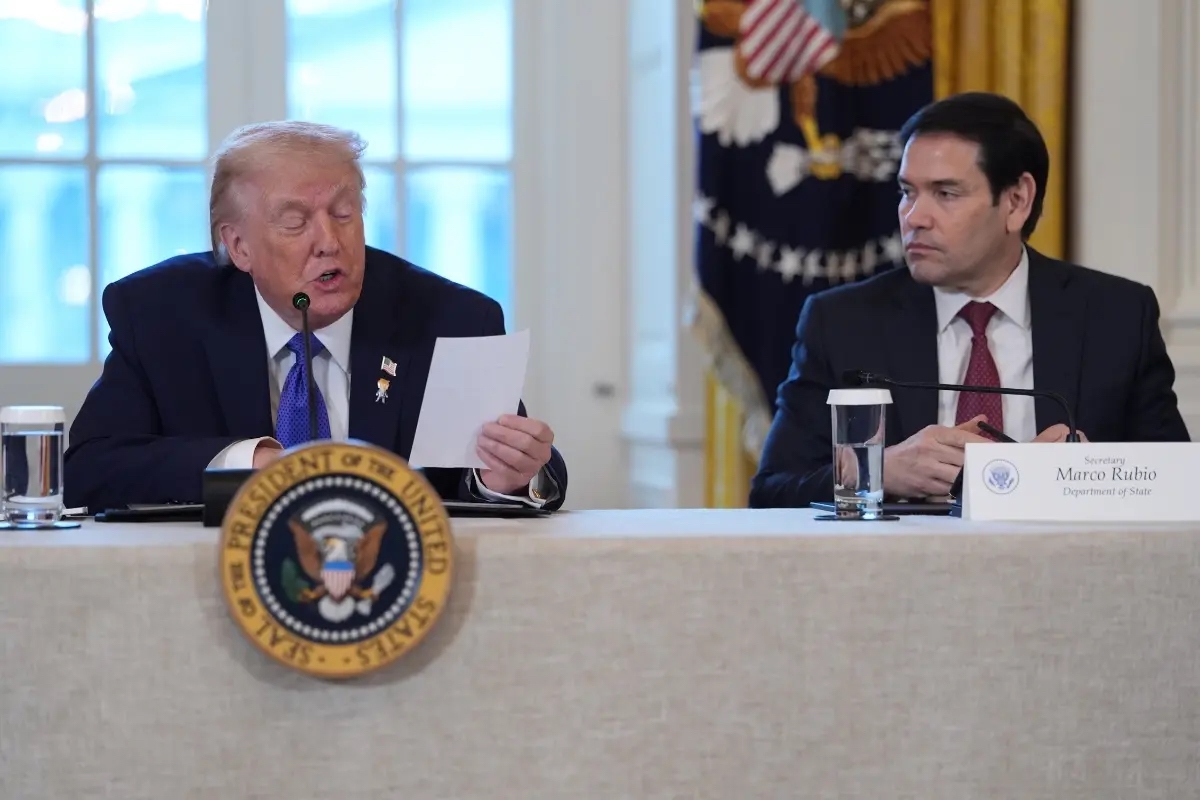

The United States designated the Muslim Brotherhood’s branches in Egypt, Jordan and Lebanon as terrorist organizations on Tuesday, according to a statement released by the US State Secretary Marco Rubio.
The decision places the groups into two distinct categories, with the Lebanese chapter landing in a more serious classification than the Egyptian and Jordanian branches. However, all three were linked to supporting Hamas against Israel since the beginning of its genocidal war on Gaza in October 2023.
The designation classifies the group’s Lebanon branch as a Foreign Terrorist Organization (FTO) and its secretary general, Mohammed Fawzy Taqqosh, as a Specially Designated Global Terrorist (SDGT). Washington also designated the Muslim Brotherhood in Egypt and Jordan “as SDGTs for providing material support to Hamas.”
The move comes nearly two months after US President Donald Trump signed an executive order to begin the process.
The presidential order gave the secretaries of state and the treasury, along with the attorney general and the national intelligence director, 30 days to submit a joint report on the designations. It also set a 45-day deadline for taking all necessary measures to finalize the designation process.
Cairo welcomed the decision in an official statement on Tuesday, while state-aligned TV hosts celebrated the designation — echoing their earlier praise of Trump’s November executive order, which launched the process.
In its statement, the Foreign Ministry commended the “efforts undertaken by the US administration under President Donald Trump in combating international terrorism and confronting terrorist organizations,” and described the move as “fully consistent with Egypt’s firm stance toward the Muslim Brotherhood terrorist group.”
In response, the Muslim Brotherhood said the step was “divorced from reality and uncorroborated by any evidence” in a statement on its website. The group also indicated its intention to “pursue all appropriate legal avenues to challenge this decision and to protect the rights of the organization and its members.” A source close to the group told Mada Masr the organization is currently considering several legal options to appeal the decision.
The source added that the Muslim Brotherhood is in the process of selecting a law firm to represent it in the legal proceedings it intends to undertake to challenge the decision in the US.
Meanwhile, the source ruled out any significant practical impact from the designation, given the collapse of numerous of its institutions amid the Muslim Brotherhood’s internal divisions in recent years, and the selection last month of a new leadership consisting mostly of new faces with no prior public profile.
According to the source, the practical implications are limited to a small group of well-known figures who recently retired from organizational work.
Before President Abdel Fattah al-Sisi’s ascent to the presidency in 2014, the government formally designated the Muslim Brotherhood as a terrorist organization in December 2013.
The long-term conflict between the Egyptian government and the Muslim Brotherhood escalated following the Armed Forces’ ouster of former President Mohamed Morsi — a longtime member of the organization — in June 2013, after which the dispersal of the Rabea al-Adaweya sit-in took place.
According to government figures, 607 protesters and eight security personnel were killed in the dispersal, but other organizations reported a significantly higher civilian death toll.
Three branches, two terrorism classifications
After prolonged demands and pressure from Egypt and the United Arab Emirates, an informed American researcher working on Egyptian advocacy issues in the US explained to Mada Masr that Trump attempted to designate the group as a terrorist organization during his first presidential term.
He was unsuccessful due to objections by his previous advisors, who deemed the evidence insufficient. This changed in his second term after he managed to “overpower the departments of justice, state and other [official] institutions,” as the source put it, allowing Trump to finally impose his will.
However, the classification of the group’s Lebanon chapter differed from its branches in Egypt and Jordan.
According to the fact sheet issued by the US State Department, the designation accorded to the Lebanese chapter was based on the reactivation of the Fajr forces in Lebanon following Hamas’ attack on Israel on October 7, 2023, and allegations that the group had launched missiles toward northern Israel in cooperation with Hezbollah.
The fact sheet also included other evidence pertaining to the Fajr forces, including a reference to one of the attacks launched by the Israeli military in March 2024 against members of the group who were allegedly preparing to carry out attacks against Israel. The sheet also included the Lebanese military’s dismantling of a “covert military training camp that included [the Lebanese Muslim Brotherhood] and Hamas militants,” under the leadership of Taqqosh in July 2025.
Under this designation, the group’s branch in Lebanon was placed within a narrower, stricter legal framework with a higher political cost for its members. The FTO designation entails immigration restrictions; prohibiting any person in the US or subject to its jurisdiction from providing the group with any material or financial support; and criminalizing any dealings with the organization or its members.
In comparison, Washington designated the group’s Egypt and Jordan chapters as SDGT.
The decision to include Egypt’s Muslim Brotherhood branch was based on its alleged coordination with Hamas to carry out potential terrorist activities against Israeli interests in the Middle East in 2025, according to a statement issued by the US treasury and state departments.
Furthermore, the statement tied the decision to Hamas leaders’ efforts to exploit tensions in the Middle East and work with the Egyptian chapter to “undermine and destabilize the Egyptian government, accepting Hamas funding to do so.”
The Trump administration also accused the Muslim Brotherhood’s Egyptian chapter of supporting Hamas fighters in 2024 by sending personnel to fight in Gaza, and claimed that a Muslim Brotherhood member in Saudi Arabia had “raised funds for Hamas and transferred the money to Hamas militants before returning to Egypt.”
Israel has repeatedly claimed that weapons are being delivered to the Gaza Strip via Egypt, pointing to the allegations to justify its ongoing occupation of the Philadelphi Corridor.
In Jordan, the US administration accused the group’s branch of providing material support to Hamas since last year, alleging its members were involved in recruitment and illegal fundraising operations as well as with foreign parties to manufacture rockets, explosives and drones.
Egyptian and Jordanian branches’ designation
Washington based its classification of the Muslim Brotherhood in Egypt and Jordan as an SDGT on an executive order issued by President George W. Bush in 2001, days after the September 11 attacks. At the time, Bush signed the executive order to give Washington an effective tool to “impede terrorist funding,” declaring a national emergency to confront the “unusual and extraordinary threat to the national security, foreign policy and economy of the United States,” according to the US State Department.
The executive order makes it easier to add individuals or groups to terrorism lists, because it is simpler to implement and requires fewer conditions than an FTO designation. The FTO label — applied to the group’s Lebanese branch — requires stricter criteria.
The executive order on which the decision was based authorizes the US government to identify and freeze the assets of foreign individuals and entities involved in terrorist acts, or who pose a significant risk of committing such acts. It also allows the US to take such action against anyone who provides support, services, or assistance to terrorists and terrorist organizations listed under the order, or who is associated with them in any way, including affiliated entities, front organizations, agents, and partners.
The executive order also authorizes the secretaries of state or the treasury, in consultation with each other and the attorney general, to designate individuals and entities based on the criteria mentioned above.
Once an individual or entity has been designated by either secretary, the Treasury’s Office of Foreign Assets Control initiates asset-freezing measures — such as freezing the assets of that individual or entity in the US, or in the possession or control of US persons — including notifying US financial institutions of the freeze order and directing them to freeze the assets of the designated individual or entity.
The designation notice is also published in the US Federal Register.
Additionally, the Office of Foreign Assets Control adds the individual or entity to its list of SDGTs and publishes a notice of the addition on its website.
The designations remain in effect until they are revoked, or until the executive order expires or is terminated in accordance with US law.
The consequences of being listed as an SDGT are mainly financial and commercial, such as the prohibition of financial and commercial transactions and the imposition of penalties on violators, as well as asset freezes — including for any entities owned by the organization or by listed individuals who own more than 50 percent of their shares.
Lebanese branch designation
In contrast, the designation of Hezbollah as an FTO was based on legislation passed by Congress in 1996 to designate foreign terrorist organizations under the Antiterrorism and Effective Death Penalty Act. At that time, the law added a new section to the Immigration and Nationality Act (INA) concerning the designation of FTOs.
The provision grants the secretary of state the authority to designate any organization as an FTO based on three criteria are met, but requires Congress to be notified before the designation is made.
The criteria are as follows: firstly, the organization must be foreign to the US. Secondly, it must have either engaged in “terrorism” as defined in the INA and the Foreign Relations Authorization Act, or has the capacity and intent to engage in such activities. Finally, such activities have to pose a security threat to US citizens, national defense, foreign relations or the economic interests of the country.
The INA defines “engaging in terrorist activity or terrorism” as maintaining the capacity and intent to carry out specific illegal or violent acts, such as kidnapping or assassinations, regardless of ideological motives or stated goals. In contrast, the Terrorism Regulation Act defines “terrorism” as politically motivated violence committed against civilian targets by subnational groups or covert agents.
About the Author