In May, a man named Ismail Terlemez was arrested in Belgium as the result of a corruption probe run by agents from the FBI and the U.S. Defense Department’s investigative arm. The indictment alleged that Terlemez, who worked in NATO’s procurement office in Brussels, had received bribes from a co-conspirator in 2019 and 2020 as part of a scheme to rig the bidding for NATO contracts. The investigators were sure that they had Terlemez, a Turkish citizen, dead to rights.
But then, in July, the U.S. Justice Department announced that it was dropping all charges against Terlemez—who had left NATO to found a well-connected Turkish defense company—and he was freed. We don’t have any direct evidence that the decision was politically motivated, but the timing struck observers as suspicious. The Justice Department action came just two weeks after U.S. President Donald Trump met Turkish President Recep Tayyip Erdogan during a NATO summit in The Hague.
In May, a man named Ismail Terlemez was arrested in Belgium as the result of a corruption probe run by agents from the FBI and the U.S. Defense Department’s investigative arm. The indictment alleged that Terlemez, who worked in NATO’s procurement office in Brussels, had received bribes from a co-conspirator in 2019 and 2020 as part of a scheme to rig the bidding for NATO contracts. The investigators were sure that they had Terlemez, a Turkish citizen, dead to rights.
But then, in July, the U.S. Justice Department announced that it was dropping all charges against Terlemez—who had left NATO to found a well-connected Turkish defense company—and he was freed. We don’t have any direct evidence that the decision was politically motivated, but the timing struck observers as suspicious. The Justice Department action came just two weeks after U.S. President Donald Trump met Turkish President Recep Tayyip Erdogan during a NATO summit in The Hague.
It’s not hard to imagine Trump deciding that he ought to do a favor for his friend Erdogan. True, Washington and Ankara have had their differences in recent years, sometimes involving contentious trade issues. But the two leaders actually have plenty in common. Both like to combine business with politics, often cutting in members of their own families. Trump has his son-in-law Jared Kushner; Erdogan’s son-in-law Berat Albayrak, just like Kushner, is a walking conflict of interest who actually served for a time in government. Trump wants to build a new ballroom for the White House using donations from his political supporters; Erdogan built himself a monumental presidential palace that also attracted controversy for its financing.
Like Trump, Erdogan scourges his enemies with lawsuits, accusations of treason, and demagogic social media posts. “Whenever they have a problem with Erdogan, they ask me to call because they can’t speak to him,” Trump told a Politico interviewer recently, without specifying who “they” were. “He’s a tough cookie. I actually like him a lot. I think, actually, you know, look, he’s built a strong country, strong military.” Forget human rights. Who wouldn’t do a favor for a guy like that?
By now we’ve seen plenty of cases where the Trump administration has been happy to oblige its friends overseas—including, remarkably, through pardoning the ex-president of Honduras, who had been convicted of trafficking 400 tons of cocaine to the United States, at a moment when Washington is conducting an undeclared war against alleged Venezuelan narco-traffickers. It is striking that several of the most high-profile pardons and dismissed cases issued for Americans—including outgoing New York Mayor Eric Adams and Texas Democratic Rep. Henry Cuellar—also involved dealings with overseas influence-peddlers. (Cuellar and his wife were indicted last year on charges of accepting payoffs from organizations and individuals linked with the government of Azerbaijan, while Adams was accused of accepting illegal gifts from Turkish officials.)
Trump’s tolerance for acts of border-crossing cronyism has family roots. Two of his sons are actively engaged in business ventures, ranging from real estate to cryptocurrency, that directly involve Saudi Arabia, Oman, Qatar, and the United Arab Emirates. Kushner’s investment fund, Affinity Partners, notoriously received $2 billion from the Saudis, who are now funding his attempt to help Paramount stage a hostile takeover of Warner Bros. Discovery.
The norms that long dictated how presidents should deal with their business interests while in office look quaint in retrospect; Trump has swept them all away. The Trump Organization, which oversees the family’s investments, pledged in January to refrain from doing business with foreign governments but effectively eschewed any restrictions on collaboration with private entities overseas. Forbes estimates that Trump has earned some $3 billion since his return to office. (I’m not sure if this amount includes the Boeing 747 gifted to Trump by the Qataris.) A large chunk of it can be traced back to his cozy relationships with the Gulf.
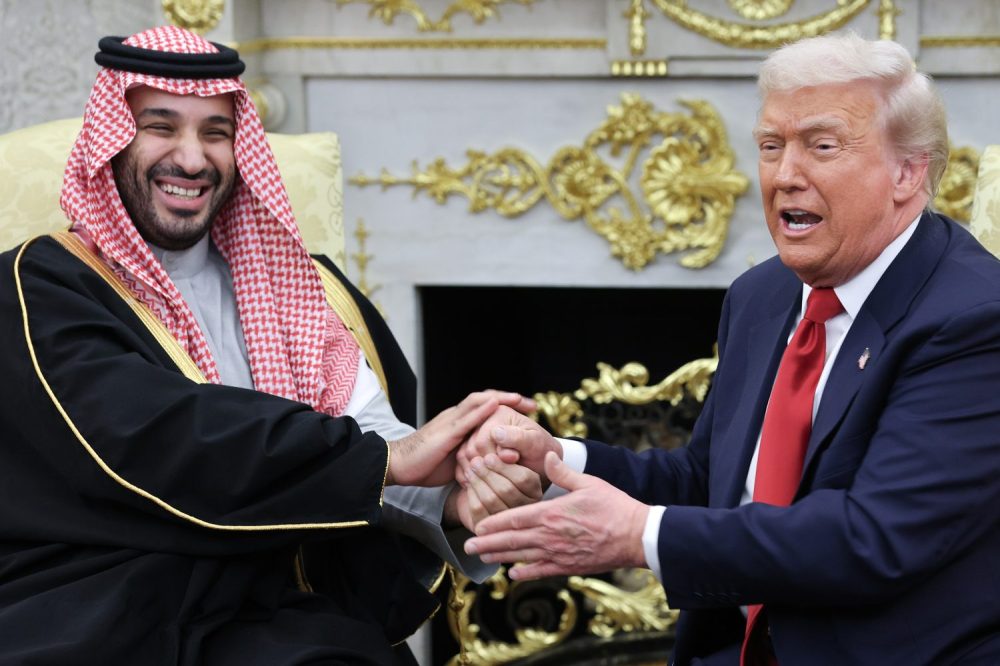
It’s not just the money. Trump clearly finds the Gulf monarchies especially simpatico—presumably because, like him, they don’t care about those fancy distinctions between public and private assets. It’s all in the family. Potentates such as Saudi Crown Prince Mohammed bin Salman can do what they want with government property; no one’s going to bring them to account. The crown prince famously overrode the management committee of his kingdom’s sovereign wealth fund to approve its massive investment in Kushner’s fund—presumably because he could see that doing so would give him privileged access to a future U.S. administration.
It turns out to have been a good bet. The crown prince’s visit to Washington in mid-November brought lavish promises of investment in the U.S. economy—up to nearly $1 trillion worth, by the principals’ own estimate. In return, the Saudis got a promise of coveted F-35 fighters—with nary a word about their dismal human rights record.
And this is how the administration justifies its cozy relationship with its overseas business partners: Everything that the president does is for the public interest, officials say.
White House press secretary Karoline Leavitt bridled a few months back when reporters asked about the administration’s obvious conflicts of interest in its dealings with the Gulf. “I think it’s frankly ridiculous that anyone in this room would even suggest that President Trump is doing anything for his own benefit,” she said. “He left a life of luxury and a life of running a very successful real estate empire for public service, not just once but twice.” Trump, she claimed, “actually lost money for being president.” If that were ever true, it certainly isn’t now.
The National Security Strategy that was recently released by the administration places economic concerns in the forefront—with barely a mention of democracy or human rights. Contrary to the administration’s claims of past neglect, helping American businesses gain new markets has almost always been a goal of U.S. foreign policy—as it is for most countries.
The question is by what means. This administration has broken with decades of settled practice on corruption issues—by pausing enforcement of the Foreign Corrupt Practices Act, for example, which was set up to prevent U.S. firms from engaging in graft during business dealings overseas. The rationale for such policies was clear: Corruption brings risks. It erodes accountability, fosters inefficiency, and imposes higher costs on taxpayers (for example, when procurement officials favor higher bids in return for kickbacks). It encourages other forms of criminality (such as those promoted by the former Honduran president). It prevents transparency and honest bookkeeping (see Enron).
But there are particular risks when the ethos of pay-to-play is applied to foreign policy. Though your friends might choose to play along, shrewd enemies can leverage your greed against you.
We see this dynamic at work in the administration’s utterly oblivious dealings with the Kremlin. Moscow has cleverly shifted its approach to make Kirill Dmitriev, an investment banker with a Harvard University MBA, its primary point of contact with Steve Witkoff, the former real estate mogul acting as Trump’s point man on the Russia-Ukraine war. Russian President Vladimir Putin, the KGB-trained manipulator, is staging a master class in diplomatic seduction, playing on the envoy’s romantic notion that the urge to make money transcends all. Lately, Witkoff (whose sons are also busily cashing in on his newfound status) has been joined at the negotiating table by Kushner, an equally ardent believer in the utopian proposition that economic incentives can fix any international misunderstanding.
Commentators sometimes equate Trump and Putin—but the Russian dictator actually couldn’t be more different. For Putin, economic issues take a back seat to his geopolitical imperatives. He didn’t launch a war with Ukraine because he wanted to make his oligarchs rich; he believes with every fiber of his being that it’s his destiny to rebuild the Russian Empire. He’s a man on a messianic mission who made a conscious choice to invade his southwestern neighbor, and so far, no one has convinced him he needs to stop. But he’s executed a sharp cold reading of Trump and Witkoff, and he knows that they’re piqued by the opportunity to cash in on Russia’s vast natural resources. So, as recently documented in an impressive piece of reporting by the Wall Street Journal, that’s exactly what he’s been dangling.
Perhaps Trump, Witkoff, and the rest of them will one day understand their mistake. But it’s likely that they’ll just go on being blinded by the dollar signs. Unfortunately, it’s the rest of us who will end up having to pay the bill.
About the Author