
By Vibha Kapoor.
2025 marked a turning point for education reform in India. Policies discussed for years finally took clearer shape. Yet, policy, however well-intentioned, only matters if it translates into daily classroom practice. This is where the real test of reform lies. To ensure that these changes do not remain aspirational documents, a strong and responsive teacher training system becomes indispensable.
India’s education reforms are ambitious, and rightly so. They open up space for inquiry-led learning, interdisciplinary thinking, and skill development. The challenge is that many teachers have not yet been prepared for this shift. Teacher education continues to face structural limitations that restrict meaningful classroom transformation. While policies clearly articulate what needs to change and what students must learn, the how and the who remain insufficiently addressed.
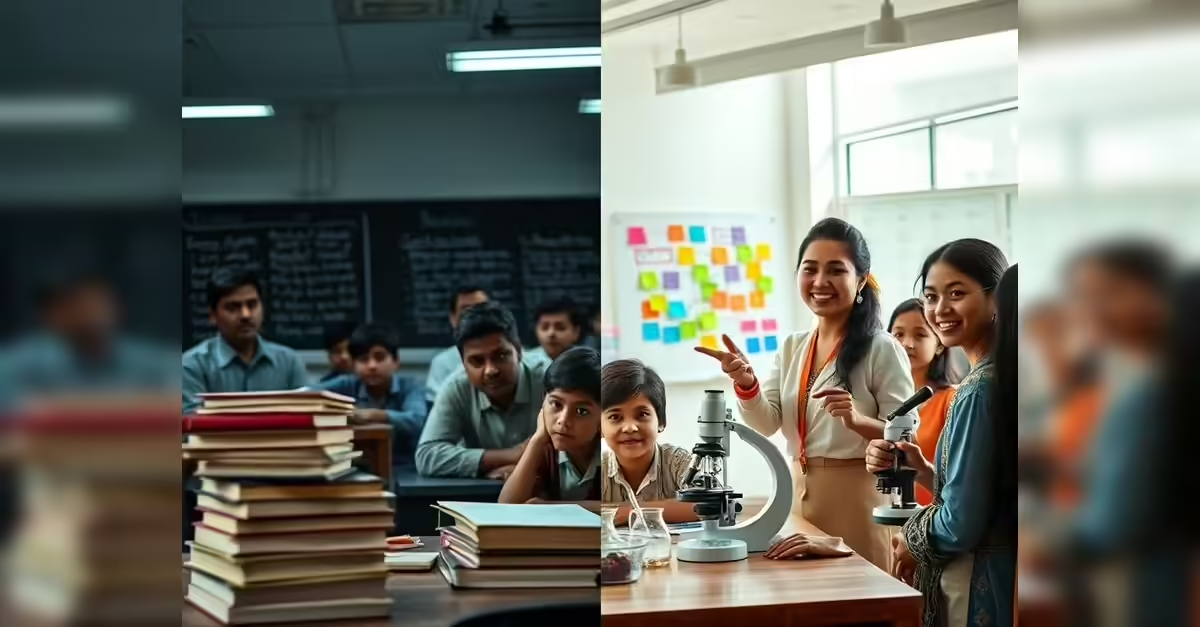
Most existing B.Ed. programmes are still rooted in rote learning. They do not adequately equip teachers to handle socio-emotional learning, skill-based assessment, or higher-order thinking. Practical exposure is also limited. When I pursued my B.Ed., I already had years of experience in teaching and thus had the understanding of how real classrooms function. Many young teachers today step into schools without that familiarity. Training remains largely theoretical and reinforces the very methods that education reform is trying to move away from. As a result, teacher education often works against the change it is meant to enable.This gap becomes more visible in a country as diverse as India. A one-size-fits-all approach to teacher training cannot work. Contextual learning is essential. When teaching Indian history, for instance, educators should be able to explore not just events, but motivations, emotions, consequences, and lived realities. Such teaching builds imagination and curiosity across subjects.
However, if teachers themselves have never experienced this form of learning, expecting them to deliver it is unrealistic. While some learning does happen on the job, teacher training is foundational and must address this gap early. Many educators are encountering these approaches for the first time, often without adequate resources or support. Without this grounding, policy intent will continue to fall short inside classrooms.
The National Education Policy has acknowledged this challenge. Initiatives such as the Integrated Teacher Education Programme aim to blend subject knowledge with pedagogy over four years. These reforms are promising, but they remain uneven and early in their journey. A real shift will require sustained investment in revamping curricula, expanding internships, strengthening faculty capacity, and building continuous professional development that reflects classroom realities.
Teacher preparedness, however, is only one part of the continuum. The second major gap lies in the disconnect between schools and colleges. Both shape young people’s intellectual and personal journeys, yet they function largely as separate worlds. There is little structured dialogue, shared planning, or academic continuity between them.
Schools are moving towards credit-based and skill-led learning. Colleges are doing the same, rethinking modular courses, flexible credits, and interdisciplinary pathways. But without alignment, students experience a sharp cultural and academic break when they transition. This disruption is neither necessary nor helpful.
Closer coordination could change this. If schools and universities shared insights on learning trajectories, competencies, assessment approaches, and expectations, students would experience education as a progression rather than a rupture. Colleges could even collaborate with schools to design real-world learning modules or co-curricular projects that reinforce continuity.
Education cannot operate in silos. Schools and colleges share responsibility for the same young people. The disconnect between them weakens reform efforts and undermines student confidence. With greater dialogue and shared curriculum thinking, education can become a coherent journey rather than a series of abrupt shifts.
2025 gave us the language of reform, the policy framework, and clear warnings. 2026 must bring courage. Teacher training and institutional alignment are not separate conversations. Each depends on the other. Ignore one, and the rest begin to falter. Education does not need more vision statements. It needs the resolve to act on ideas that have been discussed for far too long.
The author Vibha Kapoor is the Principal of Welham Girls’ School.
DISCLAIMER: The views expressed are solely of the author and ETEDUCATION does not necessarily subscribe to it. ETEDUCATION will not be responsible for any damage caused to any person or organisation directly or indirectly.

About the Author