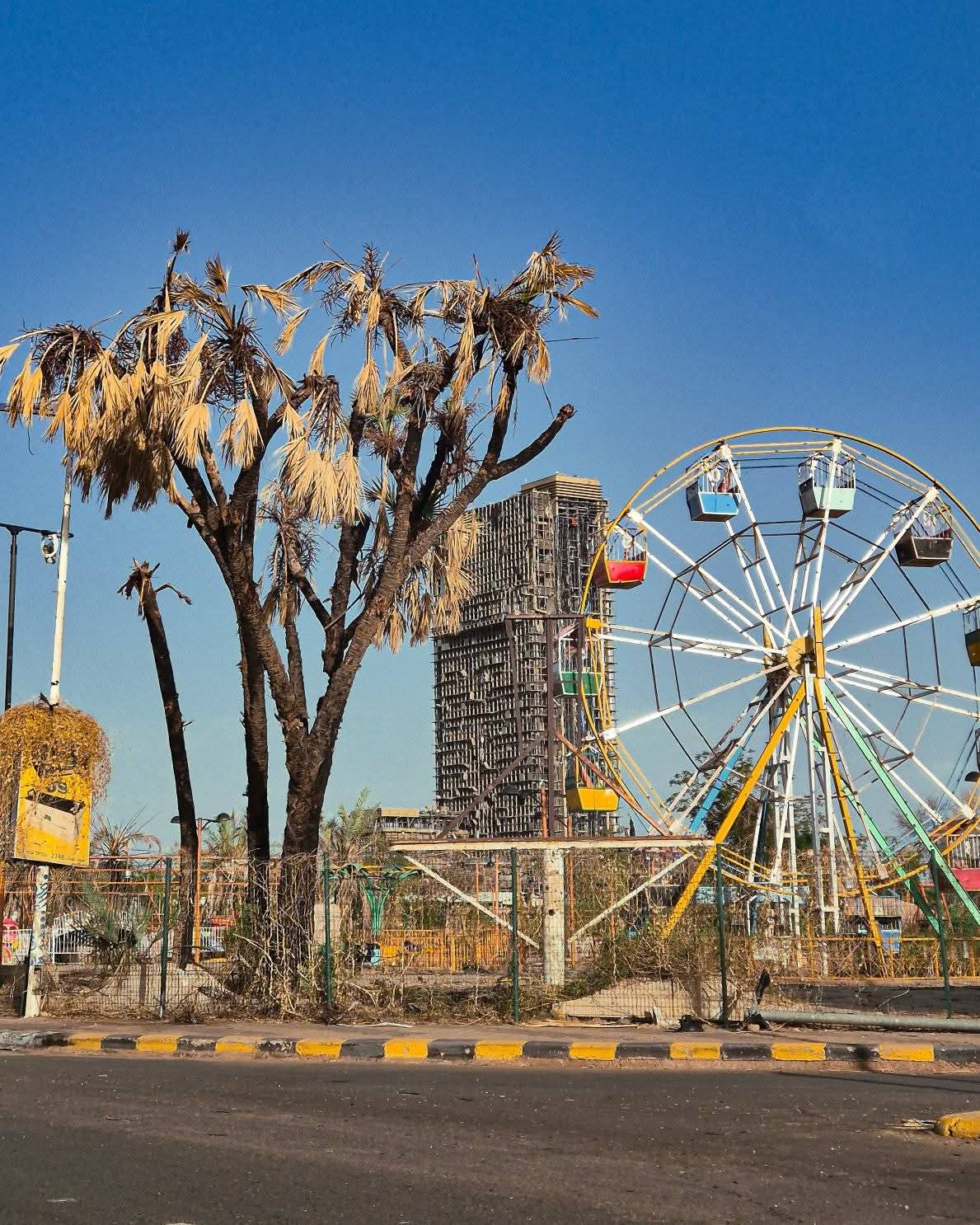
After more than a year and a half in Cairo, Um Mohamed is back to her home in Khartoum. But like many of the hundreds of thousands who have heeded the Sudanese government’s call to return since March, she found little more than rubble. Water is regularly cut off and electricity is no better, all in the middle of epidemics that claim dozens of lives each week.
All Um Mohamed has left is the wreckage of her home. She lost everything on the journey out. It began in the same neighborhood in the capital’s historically marginalized South Belt, surviving on charity handouts of boiled wheat to keep her children from starving. One of them caught malaria. She had no choice but to leave. She fled Khartoum to River Nile State. From there, they were brought into Egypt through informal routes. The hundreds of thousands of pounds needed for that journey came from selling off her belongings and collecting what her family could spare to help her escape war, hunger and disease.
In Cairo, work was sporadic. For migrants like her, the threat of detention and deportation under inhumane conditions was ever-present. There was never enough to keep her children fed. “I couldn’t bear the exile any longer,” she says. In May, when she heard her neighborhood, Azhari, had become relatively safe, and as life in Cairo grew increasingly harsh, she once again found herself with no real choice.
But returning only brought her back to the same cycle. “We’re surviving on what little aid we receive,” she says of her family’s life back in Azhari.
Um Mohamed is one of many taking part in what both the Sudanese and Egyptian governments have celebrated as the voluntary return to Khartoum — a campaign launched after the military took control of the city in March and is still ongoing. A string of official statements in Sudan first portrayed a city ready to welcome its people back, then adopted a more forceful tone that turned choice into a deadline. But so far, just over one million out of the 5 million people who left Khartoum have returned. Across the border, Egyptian authorities also reinforced the push, cracking down on Sudanese communities while coordinating with Khartoum on the returns.
And in the process, a pattern has coalesced around a bid for a Sudanese middle class whose capital Egypt has accommodated as it deported poorer migrants, and whose return Sudan has courted as a partner in rebuilding and rule, leaving those Egypt pushed out to, once again, join the margins of a newly mapped state order in Khartoum — one that sources say echoes pre-revolution dictatorship.
Since March, Mada Masr has spoken to sources involved in the great return — from those confronting the decision to Sudanese officials and civil society figures involved in the campaign — to understand what is at stake in the attempt to return a people to a country still at war.
***
At the onset of war in Sudan, Egypt quickly emerged as one of the most viable destinations for people looking for safety from the fighting. This was particularly true for Sudan’s urban middle class — disconnected from rural networks but possessing sufficient savings and assets to finance both the journey and their stay in Egyptian cities. It was also a natural option for those with preexisting ties, whether through trade, study or family.
In the first weeks of the war, Egyptian authorities adopted a lenient border policy, allowing Sudanese travelers to cross the border even with expired passports or temporary travel documents.
Rahma* crossed into Egypt on May 21, 2023, using a passport that expired that same day. Her six-year-old son was listed in her passport, while her younger child was added with a photo and a handwritten name.
But the open-door approach changed abruptly. As fighting reached Khartoum’s margins and spread across Sudan in late May and early June 2023, causing a surge in cross-border displacement — particularly among those seen by Egyptian authorities as unlikely to contribute economically — Egypt tightened its entry requirements.
Babiker* submitted his passport to the Egyptian consulate in Port Sudan in late May 2023 — a few days after Rahma had — but after waiting more than two weeks, he was still unable to obtain a visa.
In the few days between Rahma’s entry and Babiker’s application, Egyptian border authorities stopped accepting temporary travel documents and, days later, ended the issuance of a six-month extension for expired passports as well as the practice of adding children to their parents’ passports. Rahma was days away from being barred from entry.

Decision by Egypt’s border crossing authorities, a copy of which Mada Masr reviewed, removes visa exemptions for children, women and men over 49, which form part of Egypt’s commitment to freedom of movement under the 2004 Four Freedoms Agreement with Sudan
Yet despite the restrictions, arrivals continued to climb, with over 40,000 Sudanese people crossing into Egypt over those few days. The lengthy wait for visa processing, which by then was required for all travelers after previously applying only to men aged 16 to 49, pushed many to cross perilous desert routes, ending up in Egypt in a precarious situation without legal protection.
The breaking point for many in Sudan weighing whether to stay or leave came with the fall of Gezira State’s capital, Wad Madani, to the Rapid Support Forces in December 2023. The city had served as a fallback destination after Khartoum’s collapse, hosting medical services and relocated administrative offices. Its fall, combined with soaring rent prices, persistent security threats and collapsing public services left tens of thousands of displaced people with no choice but to leave the country altogether.
But with visas taking weeks on the one hand and bus fares to the border soaring into the hundreds of dollars amid the constant danger of bus routes crossing combat zones or RSF checkpoints, smuggling continued to offer a way out of the bind, albeit an equally costly one.

Bus carrying people fleeing Khartoum breaks down in the desert between Karima and Dongola. June 2023. Photographer: Mozafar Ramadan
Crossing into Egypt, however, brought another long wait for those without the resources to insulate themselves from the asylum seeking system. Applications for refugee status through the United Nations Refugee Agency (UNHCR) offices in Egypt can take months before any documentation is issued, leaving people exposed in the meantime, with every checkpoint carrying the risk of detention or deportation.
“The day I arrived in Egypt, I applied for a UNHCR card,” Um Hassan, who lives in Wadi Karkar City, Aswan Governorate, says. “But in order to receive it, I have to go to Cairo — there’s no UNHCR office here in Aswan. I’m afraid of getting arrested at the checkpoints on the road, not to mention the cost of traveling to Cairo.”
Even traveling to the city of Aswan carries a risk. Um Hassan is a diabetes patient. One of her daughters has a heart condition, and the other suffers from chronic respiratory issues. “I have to go to the Germaniyya Hospital in Aswan. But I have to pass through a checkpoint. Every time I go, I’m scared,” she says.
The majority of Sudanese in Egypt, however, are not registered with the UNHCR. Many without the means or networks to regularize their stay deliberately remain off the radar, beyond the reach of state authorities, but, in turn, also beyond the reach of civil society groups and refugee service agencies. They are thus left with little to no access to basic rights and services.
But even for those who tried to formalize their status, the space was rapidly closing. Amid increasingly hostile public sentiment and officials adopting alarmist rhetoric, the government introduced a deadline in mid-2024 for migrants to regularize their status, demanding US$1,000 in fees per person, effectively pricing people out of legal status.

Sudanese asylum seekers waiting in line outside the UNHCR headquarters in October 6th City. June 2024. Photographer: Ahmed Bakr
Then, by the end of 2024, Egypt passed a new law to establish a system of processing asylum claims that would replace the UNHCR’s without consulting the international agency or civil society organizations, and with no transitional framework to bridge the shift from the UNHCR-led process to the proposed national one.
The legislation criminalizes irregular entry, penalizes those who assist migrants and introduces vague-worded provisions on “national security” and “public order” that grant authorities discretion to exclude or revoke refugee status.
Yet, even as Egyptian authorities piled on measures to block ordinary Sudanese citizens from entering the country, Sudanese businesses found refuge in Egypt’s package of incentives to attract foreign investment: residency permits of up to five years for company owners and one-stop shops offering streamlined procedures to set up businesses in reduced timeframes, a source in the Chamber of Commerce in Port Sudan told Mada Masr.
These measures align with the outcomes of the Sudanese business forum held in January in cooperation with Egypt’s General Authority for Investment and Free Zones and the Egyptian Commercial Service under the Investment and Foreign Trade Ministry. The ministry approved the forum’s outcomes, including allocating land for a Sudanese industrial complex in Egypt and the authority coordinating with the Central Bank of Egypt to provide financial guarantees to encourage Sudanese investors to enter into strategic partnerships.
And while the Egyptian state made room for Sudanese capital through residency permits and facilitations, the majority of migrants faced an increasingly restrictive system of illegality and deportation. A joint report issued by the Global Detention Project and Committee for Justice in December estimated that around 18,750 people were deported in 2024 as of October last year, up from around 6,000 in 2023 and just 124 in 2022.
Apprehended Sudanese migrants are detained in degrading conditions at police stations or makeshift detention facilities, without access to legal counsel or UNHCR representatives, according to a report published June 2024 by Amnesty International.
In tandem, several security campaigns were launched in neighborhoods with large Sudanese populations. Seif Eddin, a Sudanese national who has lived in Giza’s Faisal neighborhood for six years, says the area — long home to Sudanese communities — has become a “nighttime Khartoum” since the war, with the surge in arrivals. This has also made the neighborhood a frequent target of repeated police raids and harassment, he said.
In many cases, the campaigns end with on-the-spot settlements, as the Sudanese residents end up paying police officers directly, Seif Eddin added.
Those unable to pay face a different fate. Ali ٍSaleh says that he was apprehended in the Tawabeq neighborhood following a half-hour-long police chase. Officers beat him and took him to a police station, from which he was transported to Aswan, and eventually deported.
Deportation procedures often involve holding detainees in overcrowded and poorly equipped facilities, including the Abu Simbel military base in Aswan. Aliaa al-Mordy describes how she and her family — including three children — were detained and interrogated in caravans and makeshift offices in Abu Simbel. She was told by an officer that they would be returned to Sudan the following day for violating Egypt’s entry regulations.
A Sudanese police officer told Mada Masr in July that over the course of the two years of war, they received over 100,000 Sudanese nationals whom Egyptian authorities had deported.
Yet, according to a senior official at the Sudanese consulate in Aswan, there are no binding agreements between Egypt and Sudan regarding the forced return of Sudanese nationals. Egyptian authorities act according to their own legal frameworks, while the Sudanese side rarely intervenes, largely due to the high financial costs of managing or preventing deportations, they say.
***
But things changed in the wake of the military’s takeover of Khartoum in March, one of three cities — along with Omdurman and Bahri — that make up the capital.
A call went out urging residents of Greater Khartoum to return to their homes — a call that would be repeated for months, as accounts from those who had gone back left many others wary of returning to a city far from ready to receive them.
Convoy of buses returning displaced people from Port Sudan to Khartoum, Gezira and Sennar States, June 2025. Courtesy of Mohanad Elbalal on X
“No matter how much power and resources the government has, it cannot secure all of Khartoum’s neighborhoods that stretch horizontally over great distances in the absence of its residents,” Khartoum State spokesperson Al-Tayeb Saad Eddin told Al-Jazeera in April.
The Sudanese must come back and check on their homes and secure neighborhoods, he said.
And while the military-led Sudanese government rushed to project an image of normalcy in the capital and assert a symbolic return to the seat of power amid an ongoing war with the RSF and its political ambitions, Egypt had long been repeating the refrain of the nine million “guests” in the country — a grossly inflated figure and a term that would be deployed again and again in a rhetoric linking refugees to economic pressures and social strain. On Egyptian social media, clips of Khartoum’s empty streets circulated alongside calls for Sudanese in Egypt to go back.
In April, Sudanese civil society organizations received an informal directive from the Sudanese government: Sudanese who fled the war should return by year’s end, a source at one such group at the Argeen border crossing told Mada Masr. But even the head of Sudan’s Humanitarian Aid Commission told the organizations that such a demand is “unlikely to be achieved easily,” given the collapse of services in Sudan, the source said.
In Cairo, several Sudanese community-led initiatives became active in these efforts. Some were linked to the Sudanese embassy, public and government figures or businesspeople, according to Mohamed Bakhit, a young volunteer at a civil society organization in Giza’s Haram district.
Bakhit told Mada Masr that those involved did not have the money to cover the steep cost of repatriation.
When contacted by Mada Masr at the start of the return campaign to ask about its involvement in repatriation, the Sudanese embassy declined to comment.
But in the months that followed, this covert involvement soon gave way to an official role. The Sudanese embassy in Cairo, in coordination with Egyptian authorities and civil initiatives, started to formally register migrants, as the two governments launched joint initiatives to send thousands back.

Egyptian Railways Authority, in cooperation with Sudan’s Defense Industries System, runs the eighth train returning Sudanese migrants under the voluntary return campaign. August 2025. Source: Dar al-Maref news porta
“We came back through what they call ‘voluntary return’,” Ahmed Moatassem, who returned in June, says of the Sudanese government’s campaign. “But let me be frank: it’s just a softer term for forced deportation.”
Hassan al-Basha spent nearly a year and a half in hiding in Cairo, having also entered the country informally after the fall of Wad Madani. To return, he had to first regularize his status by registering with the Sudanese embassy — a process that consular officials describe as “routine and uncomplicated,” according to Basha, but which he says is in fact riddled with delays, often leaving people stranded for long periods without food in extreme heat. Many of his unregistered neighbors in Cairo expressed that they would rather remain in Egypt “than endure suffering once again.”
But Egyptian security crackdowns never stopped. After the “voluntary return” campaign started, arrests and deportations were concentrated in Cairo and Aswan — the main destinations for the Sudanese citizens who had crossed into Egypt — four Sudanese who are members of the campaign’s registration committees in Egypt tell Mada Masr. They estimate that thousands continue to face arrest and harassment in the two governorates.
And while pro-state media in both Egypt and Sudan celebrated the returns, the people themselves were increasingly disillusioned.
Back in Khartoum, Moatassem found his repair workshop looted and his livelihood gone. “We had to start borrowing money. But with the pound collapsing, it’s become almost impossible to get back in the market,” he said. “We’re trying to survive amid the collapse. The government celebrates our return, but offers no real support.”
Sudanese authorities remain largely unable to deliver the most basic services across Khartoum’s sprawling localities. “The government currently lacks the capacity to carry out wide-scale repairs across the state,” the office of Khartoum’s governor tells Mada Masr, describing a heavy reliance on returnees to guide, and lead, the process. “Whenever citizens return to a neighborhood, reconstruction begins spontaneously,” the office says.

Man carrying firewood he cut from a civilian institution’s premises on Nile Street, Khartoum. The building in the background belongs to PETRONAS, an oil company. 2025. Photographer: Hassan Kamel
Some began clearing debris from their neighborhoods by hand and reopening shops. A few doctors set up volunteer clinics, and youth groups were working to repair power generators. Some of the returnees came back to volunteer, only to be overwhelmed by the scale of need. “I returned [in May] when I heard about the cholera outbreak. I’m now working with a mobile clinic,” Salma*, a physician, tells Mada Masr. “Everyday I see children suffering from malnutrition and preventable diseases.”
But what people find when they return varies starkly from one part of the capital to another.
The focus of the government’s rehabilitation efforts, even if they are limited, has largely landed on central Khartoum and parts of Bahri and Omdurman — urban areas with large numbers of government and private sector employees whose return the state was eager to secure.

Man walking along a bulldozed asphalt street in Khartoum, with buildings in the background severely damaged. 2025. Photographer: Hassan Kamel
Farther out, the state’s efforts hardly register. In the Jebel Awliya locality, 40 km south of central Khartoum, the health system has all but collapsed. Entire neighborhoods are without electricity or clean water, forcing families to purchase barrels drawn from wells or the White Nile, even as cholera continues to claim several lives each week, according to the locality’s health director. In Kalkala, 20 km from central Khartoum and the capital’s second largest locality, most charity kitchens that residents rely on have shut down, leaving people dependent on meager aid that barely covers 10 percent of their needs, the director says.
Even within Khartoum City itself, some areas have seen the shaky return of electricity, while others remain entirely without power. “We’ve had no electricity for more than two years,” Mugahed Azhari, a resident of Gabra in southern Khartoum tells Mada Masr.

Amid the spread of malaria and dengue fever, a person scrolls on their phone from inside a mosquito net during a power outage in Hajj Youssef, Khartoum. September 2025. Photographer: Mozafar Ramadan
Much of the humanitarian work in the capital is being shouldered by international organizations and civil society groups such as the emergency rooms, the grassroots relief groups that have been active across the country since the war. But with the influx of returnees — many of whom are settling in areas that had been spared the worst of the violence — already overstretched resources are buckling under the pressure.
Even the government’s own institutions have been unable to cope with the scale of destruction, with its headquarters relocated to areas less affected by the fighting.
***
Back in Egyptian cities, many middle-class Sudanese — with stable jobs, children in private schools and the means to secure housing in Egyptian cities — can afford to stay and often choose not to return, even as their neighborhoods and workplaces in Khartoum are getting the largest share of rehabilitation.
Safia*, a mother of two middle school students, says returning is not on the table for her family. Her children are enrolled in international schools in Cairo and have access to essential services. Her husband works in Dubai and sends in money. There is no reason to return, “especially given the spread of disease. And we are unsure that our family can reunite in Sudan anytime soon,” she says.
Business owners too are reluctant to shift their projects back from Egypt, fearing they could lose their assets in the process, the source in Port Sudan’s Chamber of Commerce says. With the exchange rate surging to 4,000 Sudanese pounds to the dollar on the black market and production costs rising, the chamber doesn’t expect a significant return of businesses to Khartoum, apart from those whose ventures in western Omdurman were not affected. In fact, the source expects their numbers in Egypt to grow under the streamlining and incentives offered.
So while Egypt is gladly holding on to this segment and the foreign currency and job opportunities they bring, Khartoum can’t offer much to lure them back.
But when the government resumed some operations from the capital in April, it summoned public sector employees back to work, officially announcing the end of wartime leave and giving employees until July to comply. While some men returned alone to assess the situation, leaving their families behind, women employed by the government were forced to return to a precarious environment, some with their children in tow, according to Mufti Abdallah, a young volunteer assisting in the registration of Sudanese returnees.
The state government set a mid-June deadline for all public servants to return, framing the decision as a response to the demands of reconstruction and the need for skilled personnel to manage state institutions.
Days after, another ultimatum was given to Sudanese migrants. The Sudanese Higher Education Ministry announced it will no longer recognize registration or degrees from Sudanese university branches abroad. All higher education institutions must return to Sudan without exception, the ministry said.
The decision placed immense pressure on many families, particularly those whose children were unable to secure university placements in Egypt. Families with women enrolled at universities had to regularize their status and return to Khartoum together, since sending them back alone is not an option. Parents of male students, on the other hand, had to inject cash into securing housing or have their sons live with relatives, according to a source from the parents committee at Khartoum University.
“I was months away from graduating with an engineering degree when the war broke out, and I couldn’t continue my studies in Egypt,” Omar Salah Eddin, a university student who returned to Khartoum, tells Mada Masr. “When I came back, I was living in a destroyed home with fellow students, and we attended lectures in damaged halls.”
Circumstances only started improving months later, Salah Eddin says, “but Khartoum might never be what it was.”
And that might very well be the case.
In July, a committee was formed by the Transitional Sovereignty Council (TSC) and headed by the military’s assistant commander-in-chief and TSC member Ibrahim Gaber to prepare Khartoum for citizens’ return and have it resume its role as the seat of government. But beneath the official framing — which raised eyebrows among government staff over why the military-led council is commandeering what is for the federal executive bodies by mandate — the committee’s early moves revealed an ambition to bring back and cater to the urban middle class.
“The committee monopolized all powers, sidelining not only the state’s government, but also federal authorities,” Emam al-Hilu, the head of the National Umma Party’s policy committee, tells Mada Masr.
And with sweeping authority over the capital’s planning and services, Gaber — acknowledging that the devastation in infrastructure is vast and requires sums the government does not have — said the focus has, for now, narrowed to providing only the most basic services.
But restoration of such services continued to be prioritized in middle-class neighborhoods, whose residents the state forced back. When citizens return to a neighborhood, an official in Khartoum’s governor office tells Mada Masr, “they start voicing their needs and priorities, which allows them to take precedence in the delivery of services and security maintenance. Increased school enrollment stabilizes the education system, and repopulation allows the government to reopen health centers. You can already see this, for instance, in Karari, Old Omdurman and parts of Bahri,” the official says, listing middle-class neighborhoods.
And while the Gaber-led committee’s selective restoration work continued to serve a particular social strata, its policies only pushed the vulnerable deeper into precarity.
Part of the committee’s mandate was eliminating “negative phenomena.” This ranges from demolishing informal housing on the peripheries and tearing down street vendor stalls, to imposing restrictions that hit day laborers in Khartoum’s commercial hubs the hardest.
Far from resolving the crisis, such measures only “add new complications,” Rashed, a member of the East Khartoum neighborhoods Resistance Committees Coordination tells Mada Masr. The government, he says, is encouraging citizens to return without creating mechanisms to involve them in managing their affairs. “Instead, it positions itself as the controller of people’s fate after they return.”
In the markets, seeking to provide established traders with the commodity of security, local administrations have been instructed to issue identification cards for market workers that grant them entry. In practice, this means government policy is now determining who is and who isn’t allowed in, with direct intervention in the organization of the market. But for many of the day laborers who depend on daily access to the markets, this just means more challenges, curtailing their freedom to work, three day laborers told Mada Masr.
Surrounding the markets and on the capital’s peripheries, meanwhile, the committee took over supervision of the campaign to demolish informal housing that started in March, re-planning the margins. The campaign had begun without warning.
In mid-March, bulldozers and heavy machinery demolished homes in Ezba and Bahri, and destroyed their contents without prior notice to occupants, residents in Ezba tell Mada Masr.
More areas across the capital followed, with state authorities describing the settlements developed over decades as a result of wars and natural disasters as “encroachments,” and the campaign — which is still ongoing, under the oversight of the TSC-led committee — as a response to the need to “remove visual distortions harming the city’s appearance,” with the necessity of continued oversight “to prevent the return of negative phenomena.”
The scope of demolitions also includes former displacement camps that date back to earlier conflicts in Sudan. Some continued to shelter refugees and migrants after the war in Khartoum forced international humanitarian organizations to withdraw. According to Mostafa Salah, who works with one such group, these camps had long been treated by the state as a source of revenue: authorities leased the land and in some cases required the organizations to hire local security personnel or officials and obliged them to purchase goods from Sudanese markets, Salah tells Mada Masr. Today, even as some international agencies return, their work is largely directed toward city residents, and the revenue that once sustained government interest stopped, so the state moved to reclaim the land.
Hilu of the National Umma Party describes these policies as “catastrophic.” The government, he says, is forcibly relocating communities in the cities’ displacement belts in the name of social control, while infringing on their rights and tightening its grip on livelihoods and mobility.
For migrant and refugee communities on the margins, the matter has gone beyond the loss of housing. New exorbitant residency fees and other charges have been imposed on them. More than a thousand who could not pay have been deported from Khartoum to camps outside the state. The campaign has already been underway since May, but is now overseen by the TSC-led committee.
Ahmed Ali, a researcher on social protection and informal economy, tells Mada Masr that these measures drew on security justifications few could dispute: the RSF had recruited Ethiopian snipers and made use of South Sudanese in its battles for the signal and armored corps. According to him, the government’s moves are opportunistic.
This is echoed by Jamal*, an Ethiopian migrant who has been living in Sudan for seven years and was forced to pay steep fees to renew his residency. He says the state’s policy toward refugees and migrants has turned their presence into a source of revenue.
This isn’t new, Ali says. After the revolution, authorities in Khartoum often turned to forms of “levies” that could be imposed without major political cost, categorized as “settlement fees.” One example, he says, is when Madani Abbas Madani, the post-Bashir commerce minister, issued a series of decisions targeting what he called “foreign presence,” using populist language that veered into incendiary propaganda to legitimize the policies. Following a similar approach, the current government has moved against foreign residents.
This return to pre-war, and even pre-revolution, practices is also evident in the demolition campaign. Ali notes that whenever the government has the capacity, it seeks to bring land under its control, regardless of whether war is underway or whether residents of these areas are accused of RSF “collaboration.” For decades, he says, governments have repeatedly cleared informal areas, restructured them and then sold the land as new residential developments.
But this is not just a relapse into pre-revolution habits, it is also bringing out a shelved blueprint to redraw Khartoum. According to an official in Khartoum State’s urban planning committee and the office of Khartoum’s governor, the capital’s urban reforms have been in the pipeline since 2016, when the government sought to introduce an alternative master plan for central Khartoum as part of broader structural reforms. But at the time, it was met with strong opposition, the urban planning official tells Mada Masr, and now the war has provided a chance for a “structural overhaul” of the capital that, they say, must encompass central and peripheral areas, necessitating demolition campaigns.
On September 25, the acting urban planning minister in Khartoum chaired a meeting with land and planning officials to review Khartoum’s urban surveys. According to a source in the ministry, the initiative is part of a broader campaign to overhaul urban planning policies, in line with the government’s vision for reshaping the capital. The plan, still under discussion, intends to clear informal settlements to repurpose the land for large-scale development projects, including industrial zones, agricultural schemes and new residential areas, according to the source.
“Khartoum cannot remain as it was before,” the source in the governor’s office says, likewise asserting that the war has created an opportunity to “change the capital’s urban culture and central plan — a process that has been underway for years, as is well known.”

Man skating on the damaged White Nile Bridge in Khartoum. 2025. Photographer: Hassan Kamel
The logic extends beyond demolition and reconstruction. Re-anchoring the centers of power, the TSC-led committee ordered federal ministries and institutions to be relocated toward the eastern neighborhoods and Soba in the southeast, despite objections by ministries who had already questioned the committee’s allocation of resources for restoration efforts.
Through such relocation, “the government is trying to create new value for land, providing added value to certain areas over others,” Rashed says. The state is “investing in the crisis,” granting privileges through such moves. “Government offices are not being moved to peripheral areas or complexes near them, for example,” he adds. “They are relocated to neighborhoods where land and housing already have high economic value.”
The race for return was thus quickly folded into a project of population redistribution and redrawing Khartoum’s geography of governance and power, with Sudan’s middle class — teachers, civil servants, professionals and mid-scale farmers — at its center.
Throughout Sudan’s modern history, this class has been a driving force in shaping the state and leading political change. Yet its relationship with the military has been marked by cycles of alliance and rupture.
During Omar al-Bashir’s three-decade rule, the middle class was steadily eroded by neoliberal economic policies, the dismantling of the civil service and the politicization of state institutions. Yet it endured as a political presence, emerging as a major force in the 2018 revolution that ousted Bashir.
The revolution restored the middle class as a political actor, but reviving their historic alliance with the military proved impossible in the presence of the RSF, whom the middle class saw as a rival and a threat, as the military attempted to force their inclusion in Sudan’s transitional political equation.
When the war broke out, the middle class, seeing the RSF destroy whatever gains they made in the revolution, was the first to answer Burhan’s call to mobilize alongside the military. But the war soon brought state institutions to a halt and pushed out much of this class.
“This war is breaking […] the very urban middle class that has held Sudan together for decades,” UNHCR’s High Commissioner for Refugees Filippo Grandi said in April 2024. “If the middle class and civil society are destroyed and displaced, what will be left of the country? Who will rebuild it?”
But now, with a foothold back in the heartland of Sudan’s economic elite, the state is looking to return the middle class to Khartoum.
The campaign for “voluntary return” has given the military the chance to rebuild not only the city but its alliance with the middle class, economist Mohamed al-Nayer tells Mada Masr. For Nayer, it is this renewed partnership that could shape the emerging political order — one that is rising after five years of economic and political turmoil, to define the country’s future.
Thus, at the heart of the campaign undertaken with Egypt’s backing is a political project that aims to return Sudan to a time before the revolution, to a blueprint conceived before but recast by the war, to imagine the city as liberated but without fundamentally changing the marginalization that once drove millions into revolution.
Hilu agrees that the military-led TSC is trying to travel back in time, to “bring Sudan back to square one: dictatorship.”
____________________
*Pseudonyms
About the Author