Remember Bridgerton mania? The first season of the candy-colored Shonda Rhimes–produced Regency romance-novel adaptation, which dropped on Christmas of the cursed year of 2020, still sits on Netflix’s list of the most-watched shows, globally, of all time, as does 2024’s Season 3. The commercial success of these adaptations of Julia Quinn’s series kick-started the Hollywood run on romance novel IP that’s still ongoing today. Fans continue to excitedly await the first drops of official photos presenting the season’s assigned Bridgerton sibling with their love interest, professionally lit faces full of desire.
But when was the last time I, personally, was afflicted with a nice case of Bridgerton psychosis? It was Season 2, which came out in early 2022, almost four (!) years ago. Back then, the show’s milieu—the pink-and-green palette, the bonbon buffets, the empire-waist dresses, the string-quartet covers of pop songs—still felt new, instead of like millennial cringe. It helped that Jonathan Bailey, who played the Viscount Anthony Bridgerton, has a potent way of yearning at an actress that would later render the Fiyero parts of the awful Wicked: For Good comparatively tolerable. Since the high of that season, however, the inevitable has happened: The law of diminishing returns has come for Bridgerton, as it comes for us all.
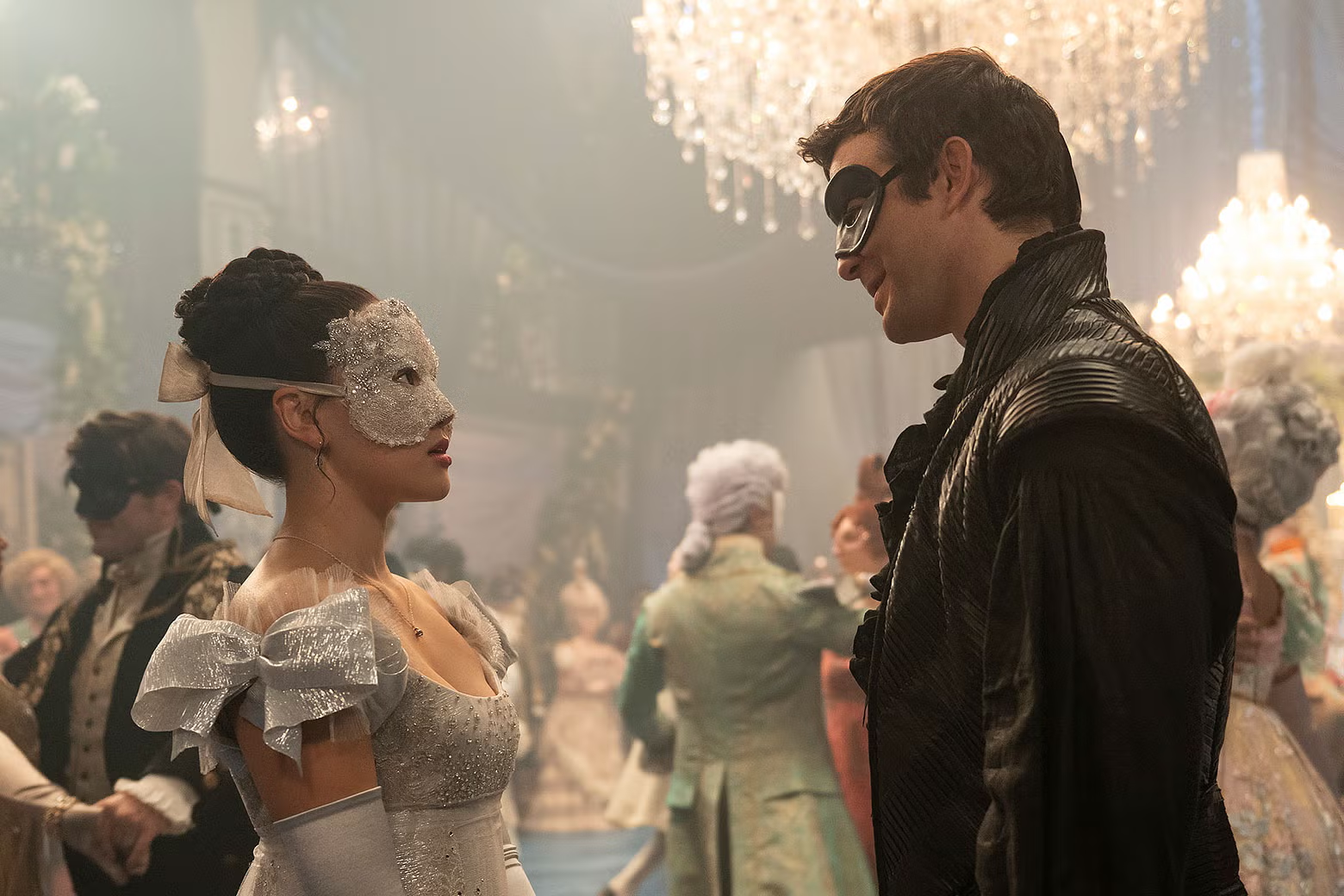
The show’s fourth season, half of which just dropped on Netflix (with the other half scheduled for next month), is focused on Benedict Bridgerton, the second son of this many-siblinged family, and adapted from Quinn’s 2001 book An Offer From a Gentleman. There are high points to this season, which is the fifth Bridgerton installment if you count Queen Charlotte. Yerin Ha plays a great, fun-to-watch Sophie Baek—a bastard child of an aristocratic father, abused and overworked by an evil stepmother who’s kept her as a maid since her father’s death. (The first episode is basically the tale of Cinderella, which Quinn uses as a springboard into Sophie and Benedict’s couple origin story.) Ha’s Sophie is an industrious, serious, capable person, whose face lights up with mischief when she’s interacting with our hero. Luke Thompson, who plays Benedict, has never really stood out in this large cast and has languished a bit in the past few seasons as the show followed him through a party-boy artist phase, but Ha and Thompson’s interactions have a spark to them that brings Benedict back into focus.
And if I complained last season that Bridgerton never showed us the “downstairs” parts of all these mansions and was starting to bore me to death with so many balls and functions and so much ton marriage mart gossip, this season has answered with Sophie, who takes us into the kitchens and servants’ quarters of the three houses where she works. We even have a few new nonaristocratic characters, like Alfie (David Moorst) and Irma (Fiona Marr), Sophie’s footman and cook allies, respectively, in the household of her monstrous stepmother, Lady Araminta (Katie Leung). Bridgerton House, of course, is the best of Sophie’s three jobs. Bridgerton will allow us some critique of the ruling class’s abuse of servants, but an actual Bridgerton will always be a “good” rich person. When their housekeeper tours Sophie through the behind-the-scenes of their house in Grosvenor Square, there’s camaraderie; the maids ironing clothes are even smiling and chatting. In fact, the question of whether Benedict is doing anything dubious by flirting with Sophie, given her position relative to his, is probably the closest the show has ever come to suggesting that a Bridgerton could do something morally wrong.
All these aspects of the main couple’s relationship are quite promising—chemistry! Cross-class love! A heroine who can take us places we haven’t gone! The problem is, everything related to Benedict and Sophie is padded out by A, B, C, and D plots ad infinitum. In Quinn’s books, like other romance novels that are written in series, you see glimpses of the characters from the previous stories, but briefly—a couple from a previous book might show up for dinner alongside their children, giving you a brief flashback to the narrative of that particular relationship. At most, the author might write in a sex scene for the past couple, but it always feels weird to read—like watching your parents get it on. It’s time, you think while skimming through these pages, for something new.
Bridgerton the show, though, seems afraid to give up on any of its characters. Netflix’s cast list for the season so far doesn’t include Season 1’s Simon and Daphne (Regé-Jean Page and Phoebe Dynevor), but nobody else, it feels like, will ever leave. In these four episodes alone, Francesca’s having issues reaching “the pinnacle” with her husband, matriarch Violet’s considering a romance of her own, Queen Charlotte is putting pressure on Penelope’s editorial independence as Lady Whistledown, Lady Danbury wants to travel in spite of the queen’s resistance to the idea, Eloise is deciding whether to give up on marriage and become a spinster, Varley is contemplating leaving the employment of the Featheringtons, and so on and so forth. There’s so much going on, and none of any of this has very much to do with Sophie and Benedict.
That gets at the heart of the problem with what Bridgerton has become. A recent romance adaptation made me realize how much juice the show had lost, and why. Self-diagnosed Heated Rivalry psychotics, fans who come to prefer the Canadian streaming sensation about two hockey players falling in love to their everyday lives, suffer so much in part because the show pours the heroes Shane and Ilya into your every orifice. Connor Storrie and Hudson Williams, who play Ilya Rozanov and Shane Hollander, respectively, are not the only two actors on the show, but every interaction between a hero and another character (Shane dates a movie star; Ilya’s father dies) matters only because it affects the emotional situation between the two of them. Like most romance novels, the show is structured to pull the heroes apart, then put them together, then pull them apart, building their interpersonal understanding in increments, until at the end, you get your happily ever after.
A good Fansplaining piece this week examines how Heated Rivalry adheres to this structure, producing a feeling of hothouse intensity via plenty of one-on-one scenes and resisting the impulse to pad things out, which would have made the result feel more like a television show with a romance in it and less like a romance novel. It helps that Shane and Ilya are famous people who are hiding an affair, and so must spend most of their time in well-appointed hotel rooms and the famous Cottage. The world around them recedes as the show brings us up close and personal, inducing a potent and helpless feeling of compulsion in the viewer.
Habitual romance readers know the feeling of being “stuck” in a narrative, almost compelled to continue—in fact, I’d venture to say that this is why many read romance. I’m able to get into a romance now without staying up later than I’d like, or getting snippy at my family when they pull me away, but it took me years of building up immunity to the structural tricks of the genre. I can see why Heated Rivalry is running rampant among the uninoculated. And this is what producers looking for “the next Heated Rivalry” in stacks of un-optioned romance novels are seeking: engagement, that most precious of currencies.
Bridgerton once felt totally singular, just like Heated Rivalry does now—something that could stick you to your television, unable to resist the siren call of “Next Episode.” But the risk of creating a universe as distinctive as Bridgerton’s is getting stuck in the matrix—unable to quit its commitment to casting decisions that at times feel both oddly rigid and narratively puzzling, unable to change the similar look and feel of every interior of every mansion, unwilling to stop moving every previous story forward. Eventually, the years go on, the stories pile up, and what once felt like a sweet escape collapses under their weight.
About the Author