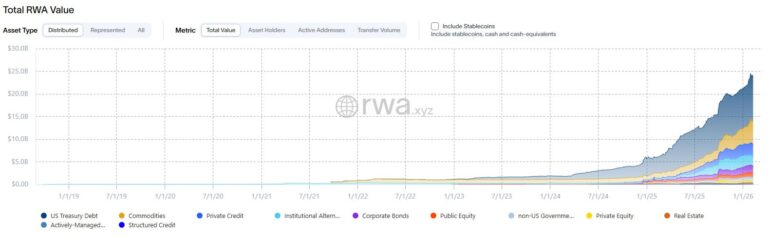
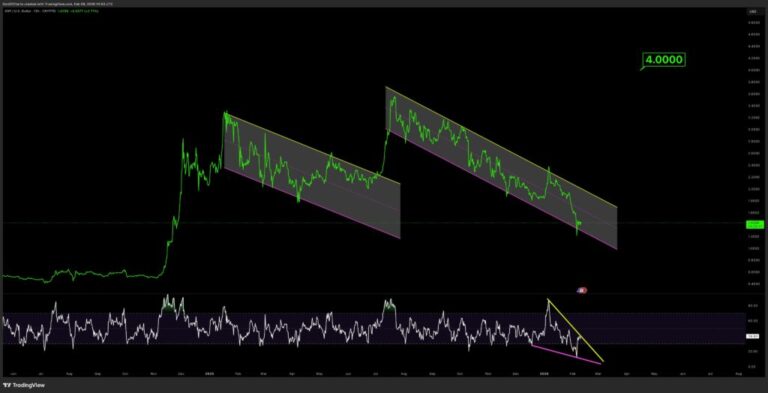
- Tokenized repos account for the largest share at $350.21 billion in the $688.75 billion RWA market.
- Canton Network and Ethereum lead in total RWA value.
- Provenance is a sleeping giant in the industry, while XRP Ledger’s latest updates reinforce its strong momentum in the sector.
Tokenized repurchase agreements (repos) have contributed immensely to the growing real-world asset (RWA) tokenization market. After all, they belong to one of the largest and most actively traded sectors in the short-term credit markets. Repos are a vital source of liquidity for money market funds (MMFs).
This article takes a deep dive into tokenized repos, looking at how they stealthily crept to dominance in the RWA tokenization market and why they’re poised to gain even more momentum in the coming years. Likewise, it examines the concentration of tokenized repos across different blockchains to help investors understand where opportunities lie in the sector.
What are Repurchase Agreements or Repos?
A repurchase agreement is a contractual agreement between two parties. One commits to sell securities to another at a specified price and pledges to buy the same instruments back at a later date at an agreed price, which can either be at a fixed or interest-based rate.
There’s also a tri-party repo adding an intermediary between the buyer and seller, which is usually a custodian bank or clearing organization.
Types of Repos
There are different types of repos in the market: overnight, term, and open repos. As its name implies, overnight repos only have one-day maturity. Meanwhile, term repos last more than a day. Then, there are open repos with no specific maturity date, which either contracting party can terminate at any time.
According to BlackRock, the world’s largest investment management company and a major participant in the US repo market, the two most important factors that impact repo rates are the following:
- Terms of the agreement, including the length or tenor and nature of the collateral
- Types of securities involved in the repo
Repos accept two types of securities:
- Traditional government securities, including Treasuries, agency debts, and agency mortgage-backed securities (MBS)
- Non-traditional securities from corporate debt and equity securities
The parties typically negotiate repo rates based on these factors:
- Market conditions
- Supply and demand of collateral
- Credit quality of the underlying securities
Wealth Does Not Always Equate to Having Money
Things move fast in the world of finance. However, wealth does not always translate to cash availability even for large institutions. Hence, they turn to repos for immediate liquidity.
The process allows institutions to acquire cash without selling assets, such as real estate, equities, or securities. It’s a short-term solution to prevent them from triggering a fire sale, which could result in a poor valuation if they rush to dump them on the open market.
Banks and financial institutions turn to repos to address temporary cash shortages for regulatory compliance or to maintain a revolving cash for daily transactions. Additionally, they could turn to them to quickly raise funds when capitalizing on a critical opportunity, such as an acquisition or investment.
What are Tokenized Repos
Like other tokenized RWAs, tokenized repos are short-term, fully collateralized loans integrated on the blockchain. The securities and cash are converted into digital tokens for automated and instant settlement 24/7 via smart contracts.
Holders of each token benefit from atomic settlements, where the transfer of the security and payment occur simultaneously in real time. It departs from the traditional procedure, in which clearing and settlement can take hours or days, and multiple intermediaries often complicate reconciliations.
For banks and institutions, tokenized repos offer transparency, making audits easier and enabling real-time liquidity management. Moreover, it provides a mechanism for more accurate margin and haircut assessments, as well as enhanced risk mitigation.
A Look at the Numbers
The US Office of Financial Research (OFR) reported that the US repo market alone averaged around $12.6 trillion in daily exposures in the third quarter of 2025. The Fixed Income Clearing Corporation (FICC), a subsidiary of the Depository Trust & Clearing Corporation (DTCC), accounted for clearing most, or $4.4 trillion, of repos during that period.
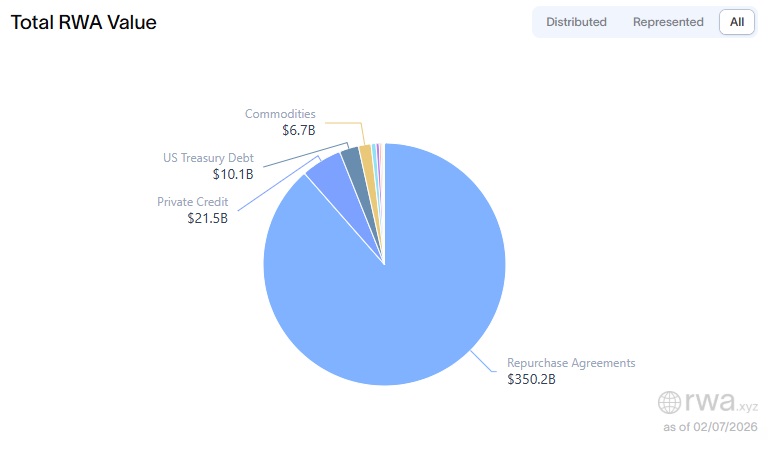
Meanwhile, tokenized repos have immediately overtaken stablecoins in overall RWA value since RWA.xyz started tracking them in mid-2025. From June 22, 2025, to February 6, 2026, tokenized repurchase agreements have grown from $284.46 billion to $350.21 billion.
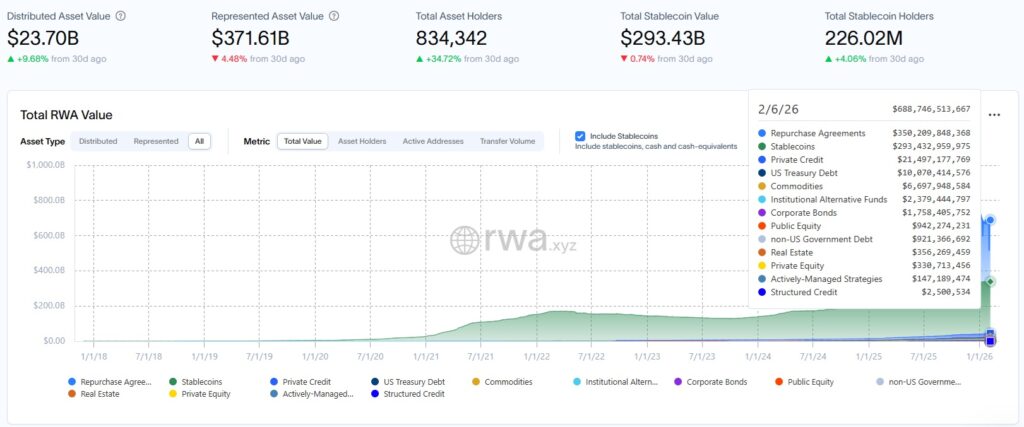
The latest data reflects a slightly over 50% share of the $688.75 billion RWA market. Tokenized repos have significantly surpassed the $293.43 billion RWA slice held by stablecoins.
The following chains have stood out in the repo tokenization category of the RWA market. Their tokens and other related projects are worth considering for investors seeking exposure in the sector.
Canton Network (CC)
Canton Network is the reigning king in tokenized asset valuation, with an 8,104 RWA count and a $350.2 billion market cap. It has the backing of a consortium of industry heavyweights, like Goldman Sachs, JPMorgan, Deutsche Bank, Cboe, BNP Paribas, and more.
The Broadridge DLR (Distributed Ledger Repo) platform powering it, as its name indicates, was purpose-built for repos. The Layer 1 (L1) network combines the transparency of public networks with advanced privacy controls.
R3 Corda Partnered with Solana (SOL)
R3 Corda is a permissioned Distributed Ledger Technology (DLT) solution specially designed for regulated financial institutions seeking to tokenize RWAs. Its technology also focuses on providing users with a high level of privacy in managing digital assets.
The network does not have its own token but has partnered with Solana to tap into public liquidity, activate interoperability, and enable seamless bridges across private Corda networks. The platform has boasted achieving more than 70x greater throughput than Ethereum’s RWA capacity in July 2025. Its current RWA metrics are unavailable, but it reported reaching over $17 billion in RWA value in September 2025.
Ethereum (ETH)
Ethereum possesses a battle-tested network in RWA tokenization. It has a 660 RWA count and a total asset value of $14.40 billion.
The network has the deepest decentralized finance (DeFi) ecosystem populated by popular Layer 2 chains. These include Base Protocol (BASE), Arbitrum One (ARB), Polygon POS (POL), and more.
BlackRock notably has $624.92 million tokenized RWAs on the network via Securitize, including the BlackRock USD Institutional Digital Liquidity (BUIDL) Fund. Other legacy finance giants have also built their RWAs on the chain, like WisdomTree and Fidelity Investments.
Potential Growth
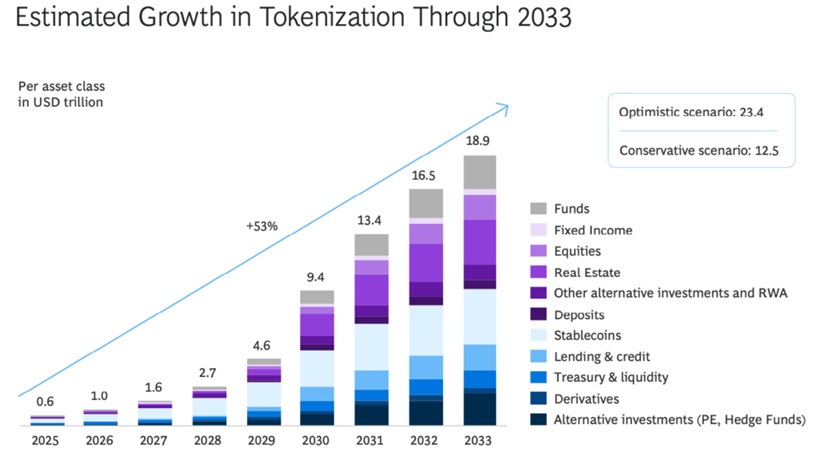
Based on the Boston Consulting Group (BCG) and Ripple report published in 2025, the tokenized asset market is expected to rise to $18.9 trillion by 2033. That’s up 30x from the eight-year timeframe, with a Compound Annual Growth Rate (CAGR) of 53%. The tokenized repo market is projected to continue making a key contribution to the industry.
With that, there are platforms showing pent-up momentum in the RWA stage, which could propel them in the repo tokenization sector over the coming years. Besides the currently leading chains, here are others worth looking into:
Provenance (HASH)
Provenance was built on the Cosmos SDK and CometBFT consensus engine. It offers optimized solutions for managing complex workflows in loans, payments, and asset exchange.
The platform currently has $18.93 billion in total tokenized loans, including $15 billion in active loans. Despite a lack of focus on repos, further advances could enable it to penetrate deeper into the tokenized repo market.
XRP Ledger (XRP)
The XRP Ledger (XRPL) is more than just an efficient platform for bridging cross-border payments and remittances. The recent introduction of Permissioned Domains could attract more compliance-focused institutions into its fold and position it as a top-tier platform in repo tokenization.
XRPL now has $2.18 billion in tokenized RWAs, centered on stablecoins, Treasury debt, private equity, corporate bonds, private credit, and commodities.
Disclaimer: The compiled data, analysis, and commentary featured in this article are only for informational purposes. They do not constitute financial advice or a product recommendation from the author or the Blockzeit team.
What’s your Reaction?
+1
2

+1
0

+1
0

+1
0

+1
0

+1
0

+1
0

About the Author