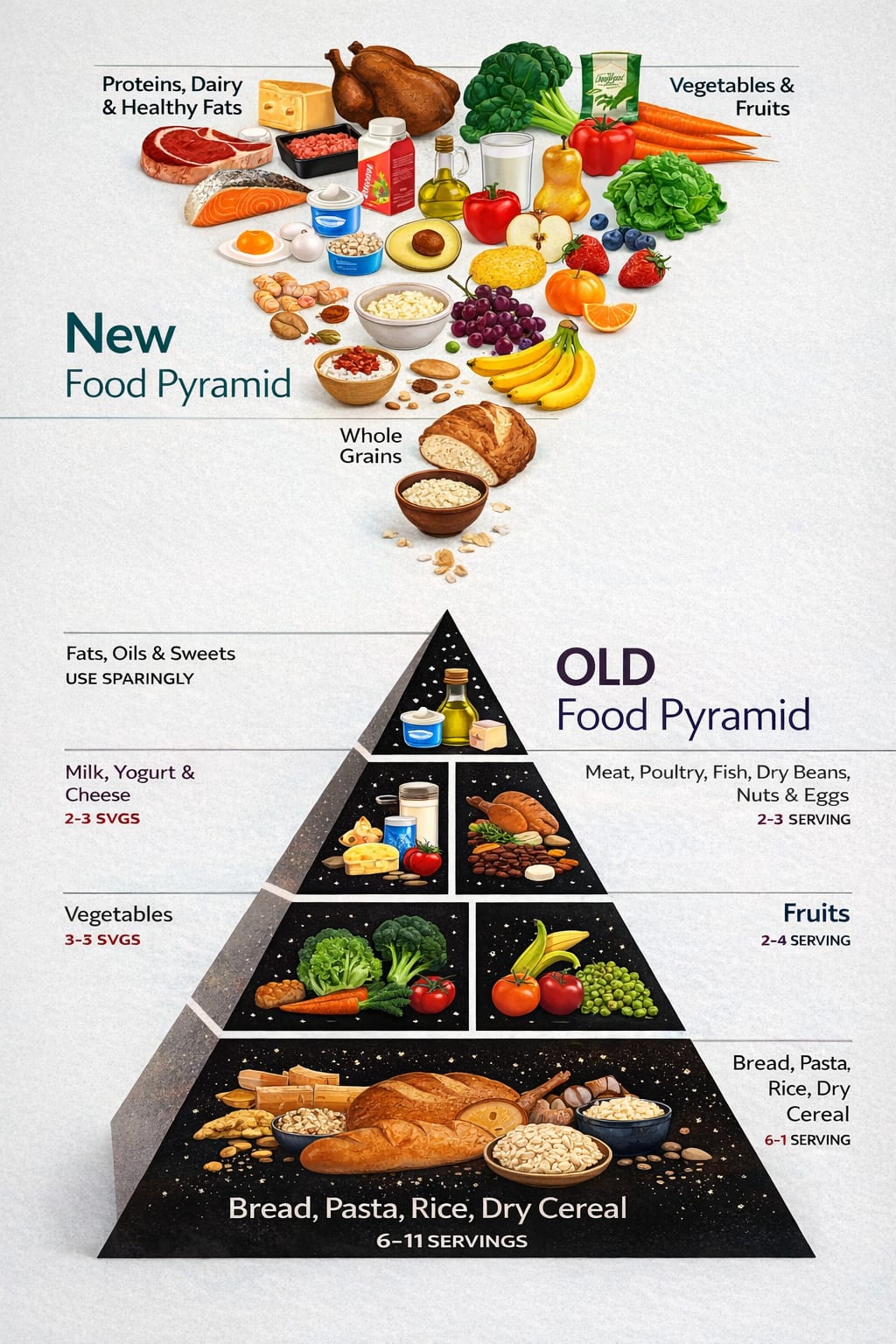
For decades, we were taught to eat from the bottom up.
Grains formed the foundation. Bread, rice, cereal. Protein and fats hovered higher, almost suspiciously. Sugar sat at the top like a guilty secret we all pretended not to touch.
That pyramid shaped school lunches, hospital meals, diet culture, and the quiet guilt people felt every time they chose butter over bran.
In early January 2026, that pyramid was quietly dismantled.
A new one was introduced, and it did not just rearrange food groups. It challenged the logic behind how we have been taught to eat.
This article is not about hype. It is about what changed, why it changed, and what the new food pyramid is actually trying to say.
Why the Old Food Pyramid Started to Collapse
The original food pyramid was built in a different era.
Its core assumptions were simple:
- Calories mattered more than food quality
- Fat was dangerous
- Carbohydrates were safe and necessary in large amounts
- Processing did not matter as much as macronutrient labels
Grains sat at the base because they were cheap, shelf-stable, and considered harmless. Fats were pushed upward because they were linked, sometimes unfairly, to heart disease. Protein was important, but not central.
What the pyramid failed to do was distinguish:
- Whole grains from refined ones
- Real food from industrial food
- Nutrients from numbers
Over time, chronic disease rates rose, ultra-processed foods multiplied, and the pyramid started to look less like guidance and more like a historical artifact.
What Triggered the New Food Pyramid
The 2026 update did not come out of nowhere.
It came after years of data showing that:
- Ultra-processed foods are strongly linked to obesity, diabetes, and metabolic disease
- Protein intake recommendations were likely too low for modern lifestyles
- Not all fats behave the same in the body
- Food quality matters more than calorie math
The new pyramid was created as part of updated national dietary guidelines. Its purpose was not to chase trends, but to correct blind spots that had become too large to ignore.
The New Food Pyramid Explained Simply
The most important change is not the shape. It is the priority.
1. Protein and Real Fats Move to the Center
The new pyramid emphasizes:
- Meat, poultry, fish, eggs
- Dairy, including full-fat options
- Plant proteins like legumes
- Natural fats such as olive oil, butter, nuts, seeds
Protein is no longer treated as a side character. It is now central to satiety, muscle maintenance, metabolic health, and aging.
Fats are no longer grouped with sugar as something to fear. The distinction is now between natural fats and industrial ones.
This does not mean excess. It means intention.
2. Vegetables and Fruits Remain Essential
Despite online arguments, vegetables were not removed or downgraded.
They remain a core layer of the pyramid:
- Fiber
- Micronutrients
- Antioxidants
- Gut health support
The difference is that vegetables are no longer expected to compensate for diets overloaded with refined carbs.
They are companions, not shields.
3. Grains Are Reframed, Not Removed
Grains still exist in the new pyramid, but with clarity.
Whole grains are encouraged. Refined grains are discouraged.
The old pyramid placed all grains in one box. The new one separates nourishment from convenience.
White bread and sugary cereals are no longer treated as nutritional equals to oats or brown rice.
4. Ultra-Processed Foods Are Explicitly Discouraged
This is one of the most significant shifts.
For the first time, ultra-processed foods are clearly identified as something to limit, not normalize.
This includes:
- Packaged snacks with long ingredient lists
- Sugary drinks
- Refined carbohydrates
- Artificial sweeteners and additives
The pyramid finally acknowledges what many people already sensed: food engineered for shelf life does not behave like food grown or raised for nourishment.
How the New Pyramid Was Created
The updated pyramid was built using:
- Long-term population studies
- Modern nutrition research
- Data on chronic disease trends
- Reviews by scientific advisory committees
It also reflects policy decisions, not just lab findings. That is important to acknowledge. Nutrition guidance always lives at the intersection of science, economics, and public health.
The goal was not perfection. The goal was course correction.
What This Means for Everyday Eating
The new food pyramid is not a command. It is a signal.
It suggests that:
- Eating real food matters more than hitting macro percentages
- Protein deserves more respect than it was given
- Fear of fat oversimplified nutrition
- Processing matters as much as ingredients
It invites people to stop outsourcing judgment to labels and start paying attention to food itself.
Time to Rethink:
The old food pyramid taught us how to eat cheaply.
The new one is trying to teach us how to eat deliberately.
Whether it succeeds will depend not on diagrams, but on whether people are finally allowed to trust that food is more than numbers on a package.
Sometimes, progress does not arrive as a revolution.
Sometimes, it arrives as a quiet inversion.
About the Author