A leaked development plan for the Zohriya garden — the latest in a series of public green spaces slated for private sector “development”— has raised concerns in recent months that the project would erase the garden’s botanical character.
The plan was first published online in September by the Zamalek Association for Development, which called on the Cabinet, several ministries, the National Organization for Urban Harmony (NOUH) and the presidency to confirm whether the circulating plan was accurate.
Spanning eight feddans and featuring expansive green spaces, historic glasshouses and rare plants brought to Cairo under the rule of Khedive Ismail, the proposed plan would transform the garden, long considered a hidden urban gem, into a commercial complex featuring numerous attractions, including restaurants and a boutique hotel.
In its statement on the leaked plan, the Zamalek association demanded that, if the plan was indeed accurate and final, it should be withdrawn and reconsidered, with strict adherence to NOUH’s requirements, which prohibit construction on more than two percent of the park’s total area.
Zamalek Gardens — a community initiative launched to raise awareness and advocate for the preservation of the upscale neighborhood’s historic gardens — also responded to the plan, issuing the “Gardens Pledge,” which calls for restoring, rather than redeveloping, the few remaining green spaces in Zamalek.
The plan, circulated as the developing company seeks to attract retailers and other entities interested in renting spaces in the garden as part of its “development” project, is the latest stab at turning a public park into a private, for-profit venture through obscure legal processes, despite preservation concerns.
***
Zohriya is located on the street leading to the Cairo Tower in Zamalek and is divided into two sections, each nearly four feddans, situated on both sides of a pathway.
In the middle of this pathway stands a majestic 157-year-old Bengal fig tree, bearing witness to the nearly 49 feddans the garden once occupied in 1868, when Khedive Ismail imported plant species from across the globe to cultivate them in Egypt.
The garden was among five other historical botanical gardens established by Khedive Ismail in the second half of the 19th century, as per a 2007 research paper, including the Giza Zoo, as well as the Orman Botanical Garden, the Horreya Garden, the Fish Garden and the Azbakeya Garden.
Historic gardens consultant Theresa Labib tells Mada Masr that, at the time of its inauguration by the khedive, Zohriya housed nearly 2 million species of plants and trees.
Other valuable assets in Zohriya were its 13 greenhouses used for plant acclimatization, 11 of which date back to its establishment, along with a tissue culture laboratory, operational since 1992.
According to Sohag University researchers, the garden was considered a “specialized private garden,” with the primary aim of supplying the khedive’s palaces with plants.
In 1917, it was brought under the Agriculture Ministry’s stewardship and continued to function as a center for plant acclimatization and propagation, as well as a site for horticultural exhibitions, according to the research.
Though the garden’s area shrunk to eight feddans over the decades, it retained some of its long-lived trees and plants and remained under the management of the Agriculture Ministry, specifically its affiliated Horticultural Research Institute. According to the 2007 research paper, titled “The floristic composition of some historical botanical gardens in the metropolitan of Cairo, Egypt,” Zohriya housed a total of 358 species from 2004 to 2006.
Due to its focus on scientific research and plant acclimatization, the garden was closed to the public since its inauguration and instead focused on serving experts and university students in the botanical field.
But this changed when former Agriculture Minister Al-Sayed al-Qusayr visited the garden in 2021.
Qusayr requested at the time that a quick plan be put in place to “develop and beautify the garden, enhance its efficiency and open it to visitors.”
Ehsan al-Deeb, who managed the garden from 2020 until earlier last year, previously told Mada Masr the minister had instructed that the garden must generate revenue or face closure.
Zohriya was then opened to the public in 2021, with an LE10 entry fee.
At the time, the garden began to attract people of different backgrounds, including a community of garden enthusiasts currently at the forefront of the campaign to preserve its plants and historical value.
After its re-opening, the garden relied on ticket sales and an ornamental plant nursery for revenue, a former employee tells Mada Masr. Permits for photo sessions, as well as the sale of botanical samples for pharmacy and agriculture faculty students provided some additional revenue, the source notes, adding that occasional film shooting at the garden contributed to its income as well.
“The Horticultural Research Institute fell short on funding for the garden,” Labib tells Mada Masr. As a result, she continues, trash would pile up in various spots of the garden and stay there until they could afford to remove it and, over time, the garden fell into disrepair. The garden’s modest revenue — far below self-sufficiency levels — has been going to the Horticultural Research Institute, she says, adding that when the garden’s management would request support, they barely received it.
News of the garden’s redevelopment resurfaced again in September last year in yet another attempt to generate profit — an aim explicitly stated by state authorities when the garden was first reopened to the public.

Leaked Zohriya development plan. Source: Zamalek Association for Development
The leaked development plan — which first emerged in September 2025 — divides the garden into four themed-areas, each with a main attraction, including as a shopping area, a boutique hotel, restaurants and a children’s playground.
Three of the four areas feature what the plan describes as “a nightlife destination.” An urban architect who spoke to Mada Masr on condition of anonymity explains that such destinations are usually intended to extend operating hours into the evening, encouraging longer visits and higher profits.
While it remains unclear if this is the final development plan, the Zamalek Association for Development demanded in its statement that developers take into consideration the garden’s status as part of NOUH’s guidance manual for “the preservation, enhancement and management” of state-owned gardens with “distinctive architectural character.”
Issued by NOUH in 2021, the guide presents methods for managing and upgrading certain public gardens while preserving and maximizing their historical, botanical and aesthetic value.
In the guide, the organization stipulates that no more than two percent of the island’s public gardens be built on, prohibiting the allocation of any part of Zamalek’s green spaces or public gardens for construction or any other purpose. However, according to the Zamalek association and Zamalek Gardens, the built area in the leaked plan exceeds the percentage stipulated by the urban harmony organization.
This counters promises made to representatives of the Zamalek association, who stated last year that “state entities responsible for upgrading the Zohriya garden” had pledged to “expand its agricultural land, increase tree and plant cover, and upgrade the site to fulfill its primary function as a garden, public park and agricultural research facility.”
These high level entities, unnamed by the Zamalek association despite Mada Masr’s probing, also vowed that the royal glasshouses would be renovated, their agricultural purpose preserved, and that services would be provided to visitors in accordance with the garden’s nature and historical mission.
In an interview with Al-Masry Al-Youm in October, NOUH Director Mohamed Abou Seada said a proposal for the garden’s development was submitted to the organization and that the plans were “being reassessed to ensure the preservation of the trees and the garden’s overall appearance.”
Meanwhile, a garden employee who spoke to Mada Masr on condition of anonymity says that although development works are to begin next year, changes have already started to take shape, including paint work in the historic glasshouses, which double as greenhouses. The source alleges that the paint work was criticized by a security official involved in the development plan and associated with the presidency, causing it to stop. These works took place in the area close to the public.
When the garden was opened to the public in 2021, only one side became accessible, while the other remained closed. The two sides — each spanning four feddans — are separated by a small street.
The employee says three of the greenhouses being renovated won’t be used for plants. “They’re being turned into cafés and restaurants,” he says.
He further explains that the developer’s logic is that, since the greenhouses are considered heritage structures, they can be restored on the outside while the interiors can be repurposed for commercial use. “That’s exactly what they’ve done,” the source says.
Zamalek association director Nadra Zaki expressed concerns over the developing company’s plan for the historic glasshouses. She says that all the plants were removed from the glasshouses in the garden’s closed-off area, raising concerns that the structures would be converted into restaurants. She adds that, in the leaked proposal, the glasshouses are replaced with similar constructions that house restaurants instead.
The little information provided about the companies undertaking development works in Zohriya makes Zaki and her association’s concerns more palpable.

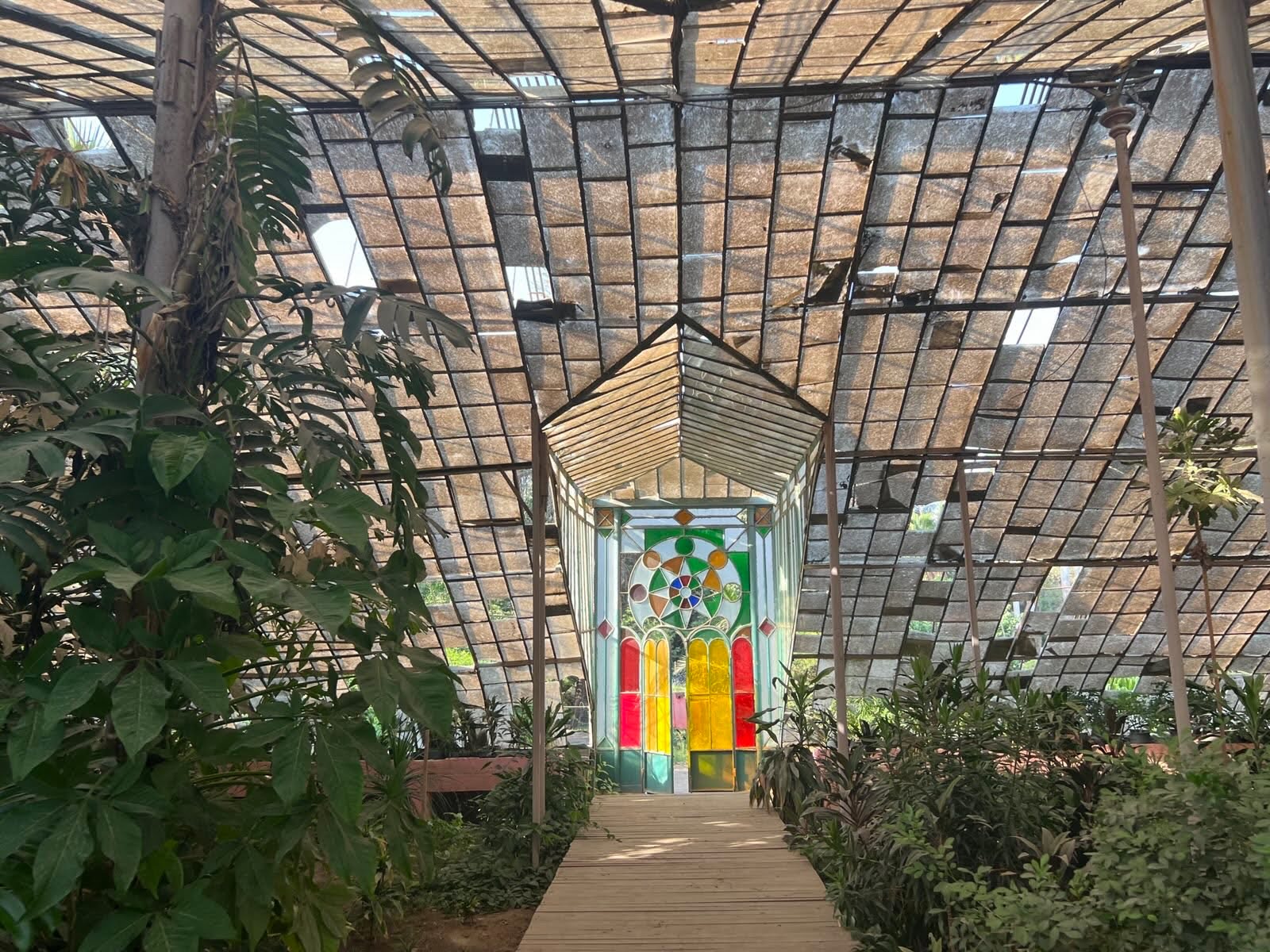
Inside Zohriya’s glasshouses, where rare plants were housed. Image courtesy of Zamalek Association for Development
When the garden’s development plan resurfaced last year, Deeb, the garden’s former manager, told Mada Masr that she had received a letter from the Agriculture Ministry saying the park would be handed over to another state entity — though she said she was unaware which one.
The former garden employee and Zaki confirmed to Mada Masr that the garden was first handed over to the Egyptian Presidency, which then granted usufruct rights to Ein al-Benaa.
They also said the same company was handed management of the walkway along the Nile Corniche in Zamalek. Launched in 2022, the project — dubbed by the government as “the Egyptian people’s promenade” — is to extend along the Nile Corniche in Greater Cairo, aiming to provide walking paths, bike lanes and green spaces, while also generating profit for the state through commercial services.
The former employee also noted that Ein al-Benaa received Zohriya under a 20-year usufruct contract from the presidency, but further details of this contract were not available.
In May, the Culture Ministry announced a competition to rebrand the garden’s logo and visual identity. In the announcement, the name of Ein Developments appears next to that of the Culture Ministry. Though a company with the name Ein was included in a number of the ministry’s official statements on the competition, its logo and full name changed several times, once appearing as “Ein al-Benaa” and then as “Ein Developments.”

When asked about the developer, a new employee told Mada Masr: “You will not be able to reach the company in charge of the development.”
The absence of a website, public headquarters or announced projects made the company more difficult to reach.
It was only during the Culture Ministry’s event announcing the competition winners that the company’s CEO, Abdullah Khalil — who attended the event — was publicly identified for the first time.
According to his Linkedin profile, Khalil has co-founded three real estate development companies in Egypt over the past five years. The first, Babylon Developments, is the only one with a declared headquarters in Egypt and publicly known projects.
The other two — Abyar for Real Estate and Ein Developments, the announced developer of Zohriya — were both founded in 2023, with Zohriya being Ein’s only publicized project.
Mada Masr attempted to contact Khalil for comment but received no response by the time of publication.
The little information available about the Zohriya developers stems from the fact that often, companies working on projects involving the development of state assets are subcontractors, urban researcher Ibrahim Ezz Eddin speculates.
“A large company wouldn’t risk officially being involved in a project that lacks transparency,” Ezz Eddin says, explaining that established firms often rely on smaller, low-profile entities or subcontractors to manage certain state projects — entities the government, he argues, allows to keep details private.
Meanwhile, according to both the former garden employee and Deeb, the garden’s nearly 40 employees — previously under the Agriculture Ministry — were dismissed a few months after the developing company took charge.
The turn toward private sector development has been adopted across several Agriculture Ministry-affiliated green spaces in Cairo, following presidential directives issued the same year instructing the ministry to “develop” its gardens and parks, particularly those in Greater Cairo.
This led to the ongoing development projects at Orman Botanical Gardens, Giza Zoo and the Fish Garden.
A development model — premised on the parks generating revenue for the public treasury rather than having it rely on state funding — has also been applied to several other parks in the Cairo Governorate, including Al-Hadiqa al-Dawliya in Nasr City, Giza Zoo and its neighbouring Orman Botanical Garden and, most recently, the Masalla garden in Zamalek.
Masalla reopened to the public in October following redevelopment works, with the Cairo governor, the local development minister, the acting environment minister and the urban harmony organization director attending the ceremony.
While the Cabinet celebrated the reopening, citing the preservation of rare trees and the addition of new plants, civil society groups viewed the project as running counter to their long-standing calls to preserve the garden’s heritage value.
In a statement issued shortly after the reopening, the Zamalek Association said that the garden’s green spaces had visibly shrunk following redevelopment and that it had been transformed into a commercial complex, erasing its cultural identity.
The transformation of Masalla, which garden enthusiasts have mobilized against since plans to install a ferris wheel emerged in 2021, has intensified community concerns over Zohriya’s fate.

Zohriya garden. Photo by Farah Fangary
Amid the opacity surrounding Zohriya’s development plan, civil society groups and garden visitors have pursued various forms of action.
“We had been calling for a sit-down with the development company to think of a way the project could remain profitable while still preserving the place — but that never happened,” Zaki tells Mada Masr.
Ahmed el-Seidy, an environmental lawyer advocating for Zohriya’s preservation, says that following the leak of the development plan, the Egyptian Foundation for Environmental Rights (EFER), which he heads, submitted an official complaint to the Cabinet requesting the project be halted until the developers disclose its details.
The foundation also called for environmental impact assessments, which it said are essential to ensuring community participation and safeguarding the site’s heritage.
Seidy says that EFER also submitted an alternative proposal to the Cabinet, advocating for restoration rather than redevelopment while preserving the garden’s environmental assets, but has yet to receive an official response.
Calls for restoration over redevelopment have echoed across other initiatives aimed at protecting Zohriya.
In the recently launched Gardens Pledge, visitors to Zamalek’s gardens were asked to support restoration efforts and refrain from backing “any shops, restaurants or developments” that reduce green spaces.
As repeated calls for public consultation went unanswered, several regular garden visitors — who started frequenting the park once it reopened, eventually prompting the state to see value in its “development” — paradoxically later mobilized to launch the campaign against the project.
Last year, a community-circulated petition garnered more than 4,000 signatures in under a week, and several garden goers launched an awareness campaign highlighting the garden’s historical and botanical significance.
Visitors who spoke to Mada Masr said their advocacy stems from a broader demand for access to Cairo’s shrinking green spaces.
In a report titled “The Green Crawl in Cairo: The Shift of Urban Green Spaces Towards Exclusivity,” sociologist Sana Sherif documented the steady decline of urban green space per capita on an annual basis, noting that promises of “green lifestyles” are largely confined to private-sector gated communities on the city’s outskirts.
The report found that the average share of green space per person declined from around 3 square meters in 2012 to 0.87 square meters in 2017, before falling further to 0.74 square meters in 2020. The World Health Organization sets a minimum of 9 square meters per person in urban areas, according to Sherif.
Ezz Eddin views the government’s dismantling of public spaces over the past years as inherently political — a policy that erodes social life by eliminating spaces where people can gather, interact or protest, he says.
The other dimension of the policy, he concludes, simply treats citizens as “an investment — a source of money.”
About the Author