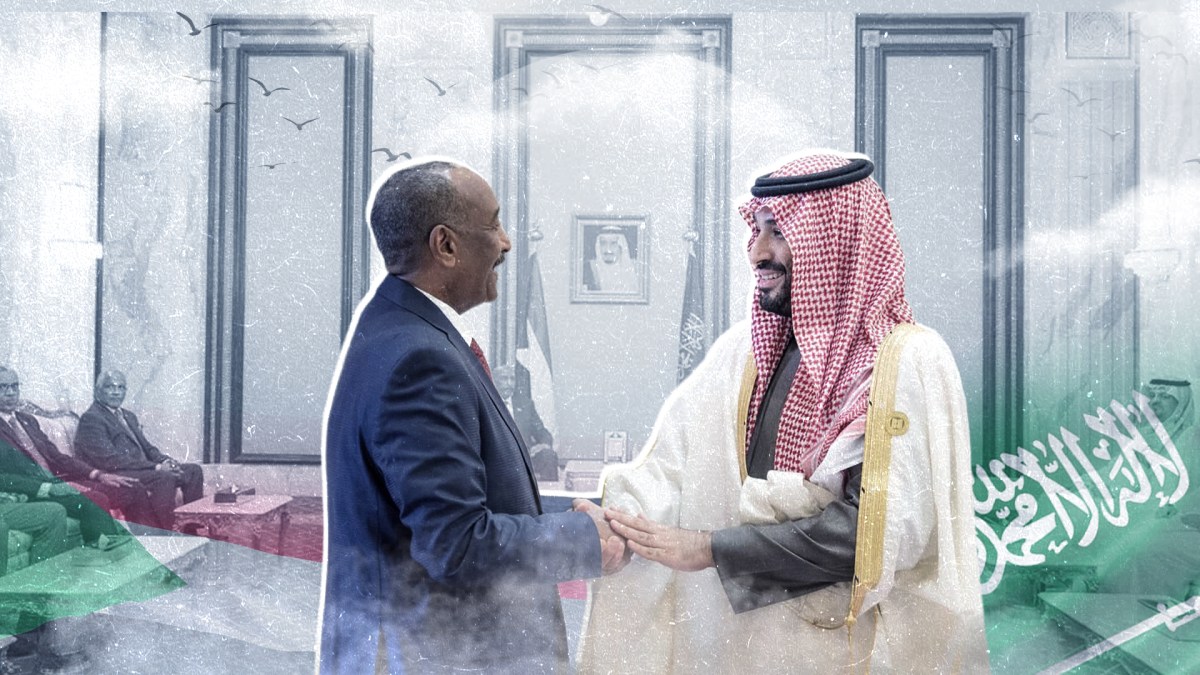
Sudan’s Sovereignty Council Chairman Abdel Fattah al-Burhan visited Riyadh on Monday, where he met with Saudi Crown Prince Mohammed bin Salman. While full details of the visit were not officially released, it comes amid growing regional and international efforts to revive initiatives aimed at ending the war in Sudan.
Analysts suggest the visit served as measure of high-level coordination in support of the Saudi initiative which served as a framework for negotiation since the outbreak of the conflict. The visit also comes at a time when battlefield developments are accelerating, and international pressure is mounting to secure a ceasefire.
Sudanese journalist Mohammed Shams al-Din said the visit reflects “full coordination and support” from Saudi Arabia for Sudan, extending beyond the political and diplomatic track to include humanitarian, security, and development dimensions.
Sudanese military expert Dr. Amin Ismail Majzoub pointed to the “importance of the visit,” noting that it followed the Saudi crown prince’s recent trip to the United States, which he said helped deepen U.S. President Donald Trump’s understanding of the Sudanese crisis. He added that the visit represents a step toward advancing the outcomes of the “Jeddah Platform” talks held in May 2023.
According to Majzoub, the discussions focused on bilateral cooperation to ensure the success of the Saudi initiative and end the war, economic relations between the two countries and ways to support them, as well as Saudi Arabia’s participation in Sudan’s reconstruction efforts.
Regarding the ceasefire file, Shams al-Din said Sudan’s government’s acceptance of such a step is a “sovereign matter”. It also depends on what he described as the “aggressor parties,” foremost among which the United Arab Emirates and its “tools,” including the Rapid Support Forces, Libya’s Haftar forces, the Chadian army, and the Central African government. He accused these parties of colluding in the transfer of weapons.
In the same context, former Human Rights Watch executive director Kenneth Roth said the primary task is “to put an end to the genocidal behavior carried out by the Rapid Support Forces.” He added that “a ceasefire alone is not enough” if those armed forces continue to commit massacres against civilians.
According to analysts, the visit signals that the U.S. approach to the conflict in Sudan is shifting in a direction aligned with Saudi pressure to name the parties responsible for the crisis.
Shams al-Din said the U.S. administration moved based on its own interests, stressing that its position “changed directly after the Saudi crown prince’s recent visit to Washington.”
He added that this shift was reflected in naming the aggressor parties, pointing fingers at them, and launching a package of sanctions targeting actors linked to what he described as the main driver of the aggression. He cited recent U.S. sanctions imposed on a Colombian network fighting in Sudan, saying it was “the main reason for the fall of El-Fasher and the crimes committed against civilians there.”
Majzoub said the United States “recognizes that Saudi Arabia is the closest to the Sudan file,” arguing that Washington, in coordination with Riyadh, “can pressure the UAE to adopt a more positive stance than its current positions,” especially in light of what he described as “evidence and complaints submitted by Sudan against Abu Dhabi.”
The UAE, which has been accused of supporting parties to the conflict in Sudan, has repeatedly denied any involvement in the war or in violations against civilians in the country.
For his part, Shams al-Din said the pressure is not limited to the diplomatic track, but also includes the U.S. home front, where the congressional foreign affairs committees are exerting “the strongest pressure on the administration to prevent arms sales to the United Arab Emirates,” as well as to push for designating the Rapid Support Forces as a terrorist organization. He added that the U.S. administration’s response to Saudi pressure has become “inevitable.”
Kenneth Roth, meanwhile, said he hopes the Saudi crown prince will go beyond “mere diplomatic support for peace” and condemn external parties involved in what he described as “complicity in genocide.”
Analysts who spoke to Alhurra believe the success of Saudi mediation will depend on its ability to manage complex regional balances, while achieving peace in Sudan remains contingent on Washington’s willingness—working in coordination with Riyadh, Abu Dhabi, and other regional powers—to translate political pressure into concrete commitments to a ceasefire and to halt all forms of external support for the conflict.
About the Author