The original promise of social media platforms was not only reach, but connection. For cultural institutions, they offered a way to speak in a more relatable voice, connect with audiences and invite participation (beyond the limits of geography).
Until around 2022, this felt genuinely transformative. At a time when many institutional websites were clunky and newsletters felt obligatory, platforms like Twitter and Instagram opened new doors. Campaigns like #AskACurator and #MuseumWeek showed what was possible: museums joined public conversations; curators shared scholarship in accessible ways; peers across the sector found one another.
Today, that landscape looks very different.
The beginning of Platform instability
Social media still delivers visibility but it no longer is a reliable as a tool for sustained community building (and engagement).
Take the case of Twitter – its transition to ‘X’, prompted several people to quit the platform. Years of audience building, professional networking and institutional presence fell apart before one could fully grasp the impact of it. Some of us migrated to Mastodon, some to BlueSky, some to both (while testing waters on LinkedIn) and yet some disengaged entirely. I fall into that last category but the experience left me with the larger question about dependence on platforms for community building – if platforms come and go*, will institutions keep investing resources in rebuilding audiences again and again?
*Whether technology companies should be political is a separate debate, but the reality is that platforms like X, Meta (who discontinued fact-checking), Substack (who took an anti-censorship stance on neoNazi voices), and others now carry explicit ideological and economic positions that institutions cannot easily separate themselves from.
So what comes after social media as we know it?
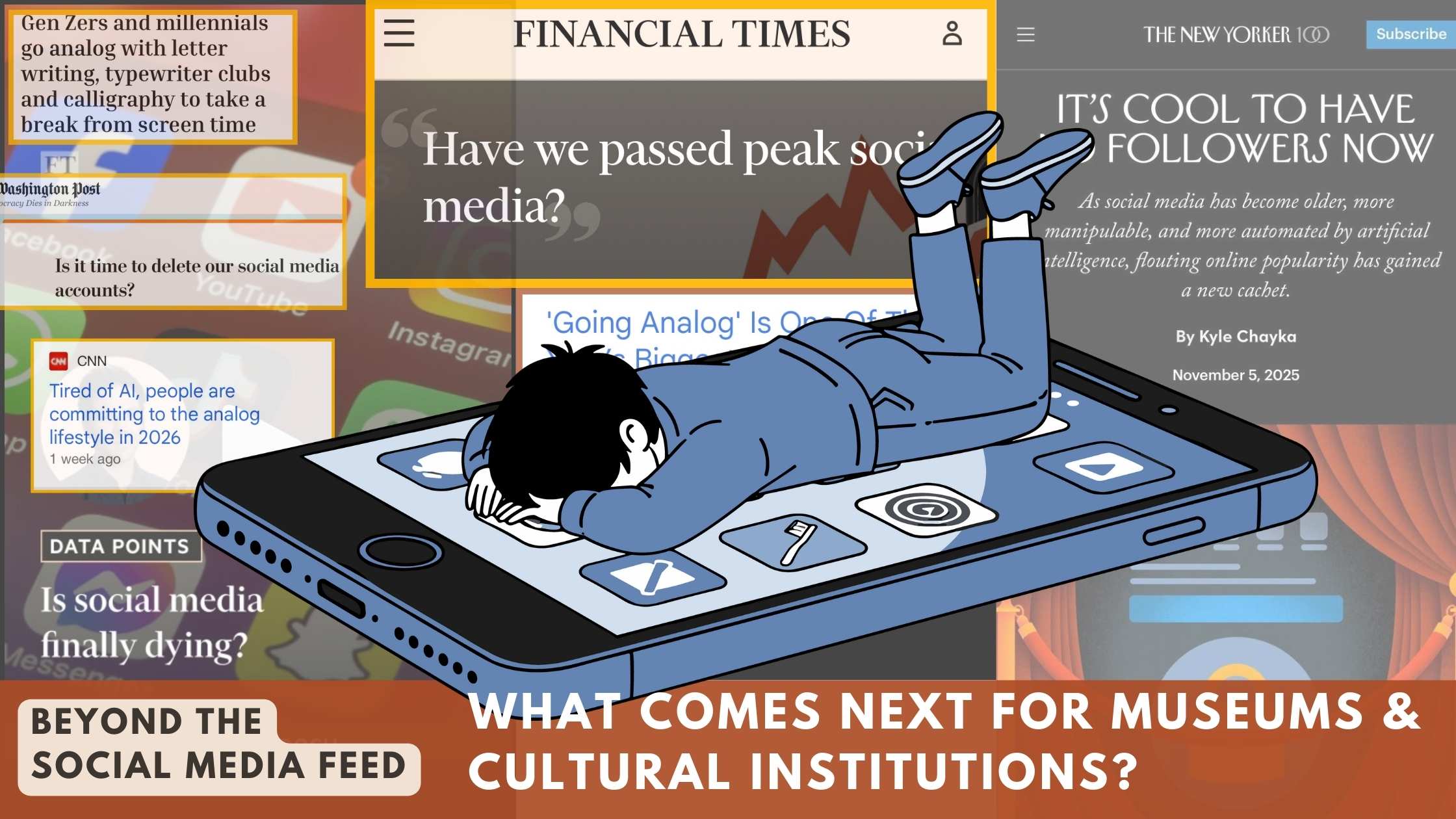
In early November 2025, the Financial Times released a report suggesting that we may have passed what it called “peak social media.”
Drawing on data from a global survey of more than 50 countries, the report pointed to slow user-growth, algorithmic fatigue, and a sharp decline in time spent on platforms (most visible among GenZ).
This is not entirely surprising. Who wants a social feed dominated by influencers, advertisements, AI-generated content?! What seems to be shifting is not a desire to disengage completely, but a growing consciousness around how and why we engage online.
In my own experience (and in conversations with colleagues) I’ve noticed a growing tendency to lurk rather than participate. We scroll, save, and read, but post less, comment less, and share less. To be completely honest, I’ve saved more cat-posts last year than culture ones! Platforms like Instagram have noticed this change too. If you notice, Views has become the dominant metric in the Insights tab, normalising ‘visibility without interaction’.
But for museums, libraries, and cultural institutions that have spent nearly a decade optimising for engagement metrics, the implication is deeper than a drop in likes/comments.
Let’s pause for a moment. The shift in social media isn’t an isolated occurrence. It sits alongside two other parallel shifts worth paying attention to – a renewed interest in analog and the steady growth of platforms built around shared interest.
The rise of Analog and why it matters…digitally.
Alongside this digital saturation and fatigue, analog culture is having its own moment. Around the same time that the Financial Times report was released, I came across an Instagram (IG) carousel with a confident prediction for 2026 : ‘analog is making a comeback..’. The post featured visuals of an iPod, a digital camera and other technologies of the past. I saved the post. Over the next few weeks, the algorithm (predictably) surfaced similar posts with an increased frequency. These included opinion pieces from established publications exploring different facets of the discussion: Vogue Business described going offline as a ‘status symbol’. The New Yorker agreed that it is ‘cool to have no followers now’. Eventbrite reported an uptick in board-game events, and Polaroid’s campaign ‘Real Vs Reel’, pushed back against the reign of screens and AI. For 2026, Pinterest has predicted a letter-writing renaissance, amidst the rise of printed zines and newsletters.
Is this nostalgia? Perhaps, but it also represents the values of a slow social era – intentional attention, reflection and engagement.
If we pay attention to where platforms themselves are investing, a different pattern emerges. Meta’s push towards Whatsapp Communities, an algorithmic preference for Facebook and Messenger groups, Instagram’s ‘broadcast channels’ and subscription features – all signal a move away from ‘feeds’ towards smaller, intentional groups. Outside Meta, Reddit (which I’ve grown to love), Discord and (even emails) continue to grow as spaces shaped by shared interest.
These may seem unrelated but together, these signal a shift towards intentional participation. Crucially, these are environments where participation is shaped, moderated, and sustained. The good news I guess, is that museums (libraries and theatres too) are already designed for this moment. Their physical spaces support pause, reflection, and collective experience.

We’re already seeing this surface in silent reading sessions at Berlin’s Bode Museum, film photography workshops at Museo Camera in Gurgaon, collage-making at Fotografiska, and so on. But there’s also an opportunity to support the making-culture online as well as promote digital collections, which can become central as reference points/inspiration.
The opportunity, then, is not to abandon digital platforms altogether, but to rethink digital communication as an extension of the values museums and cultural organizations already practice offline: community, continuity, and more human-centred forms of engagement.
Rethinking digital communication – beyond the feed
The challenge for cultural institutions is how to translate this shift, and these values digitally, (towards community, continuity, and more human-centred forms of engagement) without defaulting to endless content production.
1. What would it mean for museums & cultural institutions to act as community hosts, and not “content producers” ?
Social media rewards volume: more formats (posts, videos, stories..) and an increased frequency mean more chances to surface in someone’s feed. For lean teams, this is exhausting and unsustainable. Community hosting offers a different framing. It implies responsibility, supporting contributors, and valuing participation.
Let’s take the example of National Gallery’s bicentenary initiative – the Gallery invested in a sustained collaboration through its 200 Creators Network. It invited artists, writers, and cultural practitioners to engage with the collection over time. This has since evolved into a Creative Collaborators programme, working with local social media creators (supported by stipends).
Here, the emphasis is not on constant output. It is on relationship, interpretation, and shared authorship.
Berlin’s Museum of Islamic Art employed a similar approach towards foregrounding creators and collaborators. During the Pergamon Museum’s closure, its CulturalxCollabs initiative used Instagram as a public record of engagement already taking place.
2. Using Social Media as part of a ‘distribution’ ecosystem, not destination.
Many museums and cultural organizations produce content for socials exclusively – a post is published, gathers attention, and then vanishes into the feed. There aren’t many optimisable ways to keep certain posts linked together if they are part of a story. This often results in teams spending significant time creating content that cannot be reused, extended, or meaningfully archived.
With limited resources, perhaps the question becomes “Where does this story travel, and what does it build over time?”
This is where editorial and distribution partnerships matter. Cultural narratives can live across multiple contexts, institutional websites, partner publications, collaborative platforms, and shared-interest communities. For example, in the last year, The Heritage Lab’s editorial collaborations with the German Digital Library and even Wikimedia UK allowed both our audiences access to museum stories while remaining contextualised, discoverable, and archivable. Within social media itself, features like Instagram ‘Collaborations feature’ can support this ecosystem approach to amplify reach without duplicating labour.
3. Owned channels as spaces for continuity
Hosting a community requires at least one owned channel. Again, this isn’t a call to abandon social media platforms altogether, but instead, ensuring that platforms are not the only place where institutional memory lives. Websites, blogs, and newsletters* are not immune to digital fatigue but they offer something social feeds cannot: continuity, context, and ownership.
*Newsletters, in particular, are re-emerging as a form of editorial infrastructure rather than a marketing add-on (if the popularity of platforms like Ghost, Beehiiv is anything to go by). True, promotion and distribution is another question (and maybe a case for a follow up post) but when paired with analog programmes, newsletters can extend the life of an experience. And most importantly, perhaps we should consider that email has endured. We have seen apps come and go, but the email – it has stayed on.
Towards digital infrastructure
As AI-generated content spills across our screens and misinformation spreads even more easily, museums and libraries carry an even heavier responsibility as context-builders and memory-keepers. With social platforms continuing to shift, the more urgent question is not where museums should post next, but what kinds of digital relationships they want to sustain, and on whose terms.
These conversations, like communities, are built over time…
If your team is already experimenting with these approaches, or questioning the limits of social media as we know it, I’d genuinely love to hear what you’re learning.
If you’d like to collaborate, host a workshop or simply share feedback, you’re very welcome to get in touch.
You can subscribe to the RSS feed and get updates on posts such as these.
About the Author