6 poets from 5 Arab countries
The evening, presented by media personality Saeed Al Qamzi, featured a remarkable interaction with the diverse readings, which ranged from patriotic and emotional to sentimental and romantic. A multifaceted poetic tapestry of voices and styles was presented by a distinguished group of poets: Rashid Jumaa Bin Nayem (UAE), Al Meeth (UAE), Harith Al Buraiki (Oman), Abdul Razzaq Ayed (Syria), Tamani Al Jazi (Jordan), and Reem Al Janoub (Egypt).
The poems were not mere passing guests, but rather the centerpiece of the event, confidently striding through hearts and minds, capturing the listener’s attention before settling deep within their souls. A truly Nabataean evening, where dialects converged like rivers into a single sea, bearing the name of poetry and celebrating its living memory.
Emirati poet Rashid Juma bin Nayem began his participation with readings imbued with a sense of emotional reproach, where poetry seemed to offer a space for quiet candor. He presented excerpts from his poems: “Your Direction,” “The Homes,” “The Dry Grass,” and “A Gazelle’s Fawn.” Love appeared as a deferred question, and absence as a heavy shadow accompanying emotions, all in a transparent Nabati language that leans towards sincere expression.
As for Emirati poet Al Meeth, her poems were laden with the spirit of place and celebration. The texts seemed more like a collective call celebrating Sharjah and poetry.
From the Sultanate of Oman, the voice of poet Harith Al Buraiki resonated with the chill of winter and the warmth of expression. He presented a selection of his poems: “The wind, your absence, a winter of the heart, the night is sweet, after fasting,” where the poem appeared as a space for silent confession, a refuge for pain as it transforms into inner music, resting on a dense emotional image. The Syrian poet Abdul Razzaq Ayed gave Sharjah a special presence in his texts when he recited from his poems: “Sharjah, Your image has faded, The Religious Scholar, Lineage.” Here, the poem came as a message of love and gratitude, singing the praises of the city as a cradle of culture and poetry, and celebrating its intellectual and humanistic legacy.
From Jordan, the poet Tamani Al Jazi appeared with a voice carrying a tone of pride and belonging, presenting the poems: “I am Jordanian, The separation has been long, Ram has blossomed,
May peace be with you.” Her poem appeared as a mirror of the homeland, evoking its symbols, celebrating its land and values, in a clear and direct poetic discourse, not devoid of the warmth of emotion.
The evening concluded with the Egyptian poet Reem Al Janoub, who presented poems Among them was “Ahl Al-Badawa, Tarhiba,” where the poems conveyed a spirit of welcome and loyalty from the Nile Valley, presenting Sharjah as an open home for poetry and its people. The poem was rich with imagery of generosity, knowledge, and human connection, expressed in a warm and welcoming Nabati language.
Nabati poetry a living memory and a cultural bridge uniting Arab voices
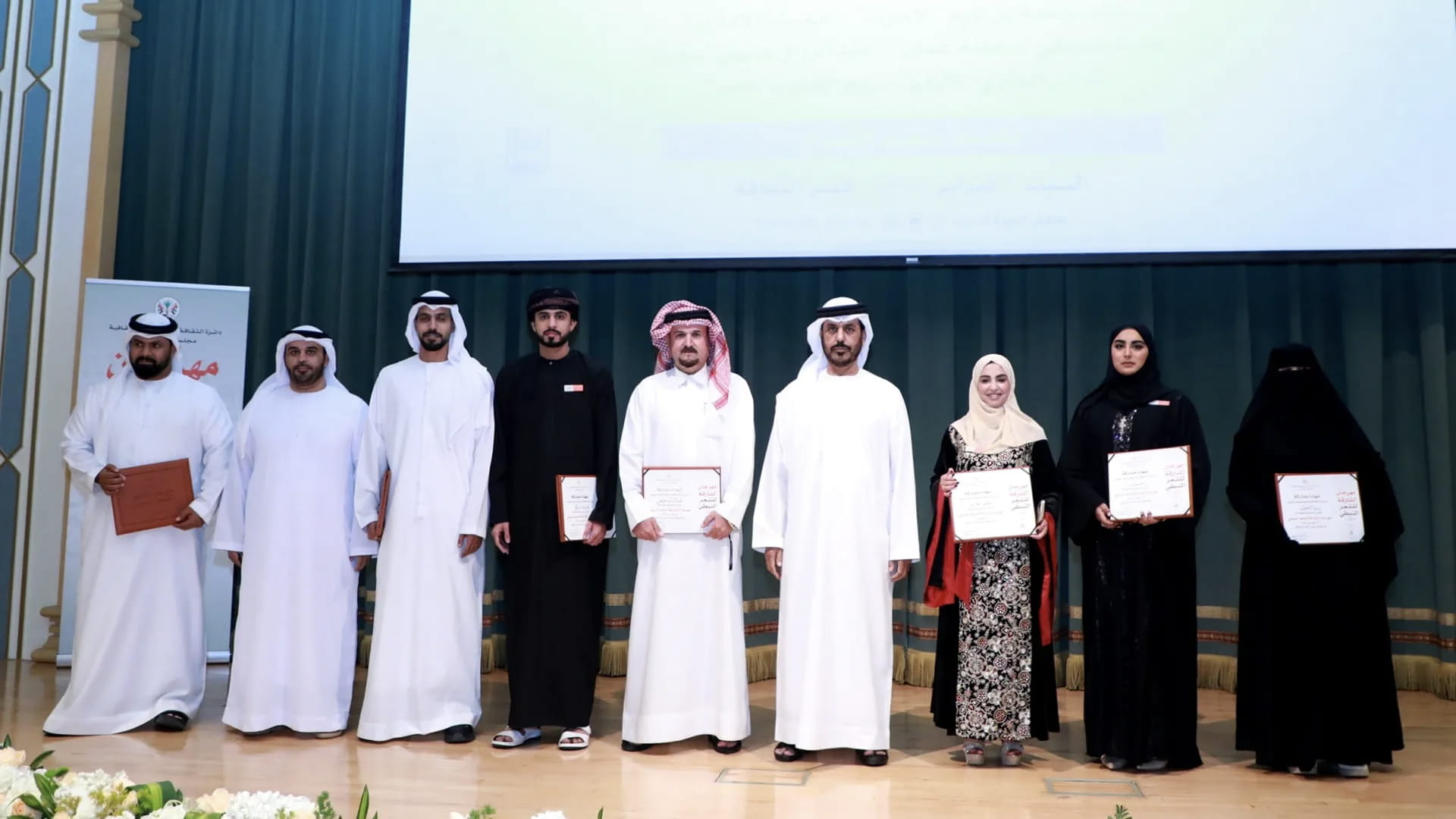
At the conclusion of the evening, Abdullah bin Mohammed Al Owais and Mohammed Al Qasir, in the presence of Butti Al Mazloum, honoured the participating poets in recognition of their contributions and participation in this edition of the Sharjah Nabati Poetry Festival. This affirmed the status of Nabati poetry as a living memory and a cultural bridge uniting Arab voices under the umbrella of the poem.
About the Author