SFAL as a vital platform for dialogue and cultural exchange
In a special in-conversation session, Tsitsi Dangarembga, an influential novelist from Zimbabwe, praised the Sharjah Book Authority (SBA) for organising SFAL as a much-needed space for dialogue and knowledge exchange.
Dangarembga, who received SFAL’s Sharjah Lifetime Achievement in Literature Award at SFAL 2026 on Wednesday, said:
“I think this bridge, this festival, is absolutely important because in order to bring about change so the world can travel in a better direction, we need to communicate and find commonalities.”
She added: “With the festival, we understand there are forms of knowledge that can be applied and lead to a better way of doing things as human beings. I think these connections are absolutely vital.”
Recognition beyond accolades: connecting across cultures
When asked by session moderator Abdul Karim Hanif to reflect on her accolades, with the latest being the Sharjah Lifetime Achievement in Literature Award, Dangarembga said the true value of the award lies in the acknowledgement that her work is resonating with readers from different cultures.
“I’ve ben to Sharjah now and had a wonderful conversation with Her Highness Sheikha Bodour bint Sultan Al Qasimi, Chairperson of SBA – that will be with me forever. The goal of sharing something that has touched other people has been achieved, and that is what is really important to me. Meeting different people at events, those kinds of connections is what I really love about the whole concept of this festival in Sharjah.”
The Tambudzai Trilogy and the universal search for belonging
Dangarembga also shared insights into her globally acclaimed Tambudzai Trilogy comprising Nervous Conditions (1988), The Book of Not (2006) and This Mournable Body (2018). The final novel in the series was shortlisted for the Booker Prize 2020.
The trilogy traces the journey of Tambudzai from a young girl growing up in a poor rural family to an adult grappling with internal struggles and external setbacks in post-colonial urban Zimbabwe.
“Tambudzai has the same conflicts as many of us; this issue of belonging is something that returns again and again in different ways. As the world becomes more mobile, this question of belonging is going to stay with us,” she said.
Land and literature: the influence of geography on storytelling
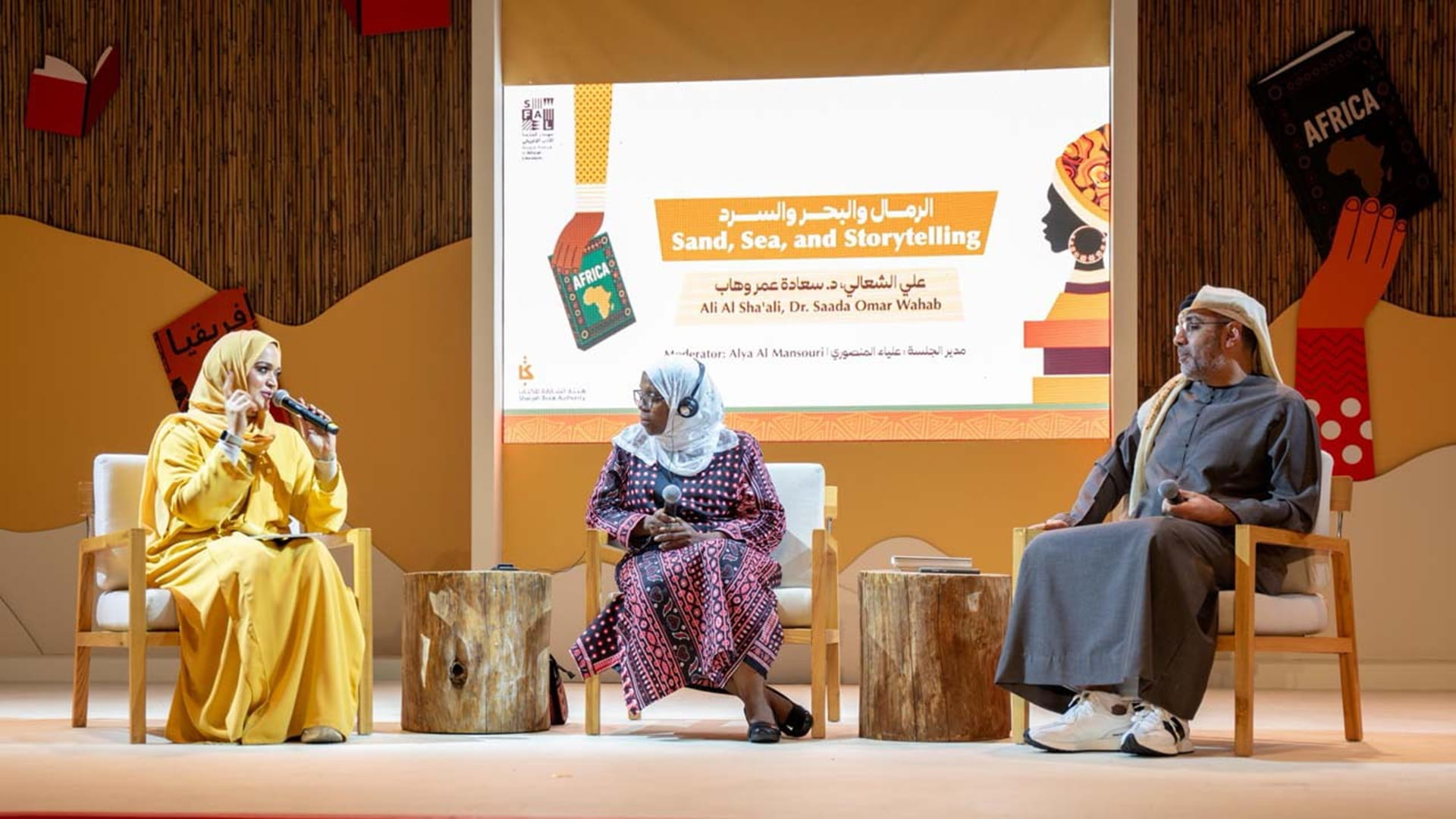
Also on the opening day of SFAL 2026, a panel discussion titled Sand, Sea, and Storytelling explored how natural environments have shaped African and Emirati storytelling traditions.
Moderator Alya Al Mansouri asked panellists — Emirati novelist Ali Al Shaali and Zanzibar-based historian Dr. Saada Omar Wahab — about the role local geography plays in shaping narratives rooted in place.
Urbanisation, nature, and the writer’s sense of place
Al Shaali said the rapid urbanisation of the UAE is reflected in several of his works, particularly through contrasts between village and city life.
“We talk about each element of this transformation with pride. I have a holiday home in the eastern region and my relationship with nature has changed; I’m deeply appreciative of it,” he said.
The UAE author added that no literature can truly escape the context of its creation.
“We are all prisoners of time and place. Nothing happens in a vacuum; the narrator or writer or voice from within has to pass through these elements of time and place.”
Zanzibar’s crossroads of cultures and oral traditions
Dr Wahab echoed similar themes, noting that Zanzibar’s location in the Indian Ocean, close to Africa, brought together early African migrations, Arab traders and European settlers, resulting in a rich, hybrid culture.
She explained that this convergence of heritages is why Swahili oral storytelling traditions often feature both “heroes of Africa” and “travellers from the Middle East”.
Celebrating “The African Way” at SFAL 2026
Held under the theme The African Way, SFAL 2026 runs from January 14 to 18 at University City Hall Square, Sharjah. Featuring thought-provoking discussions, immersive workshops, vibrant folk performances and cuisines from across Africa, the festival continues to strengthen cultural exchange between Africa and the Arab world.
About the Author