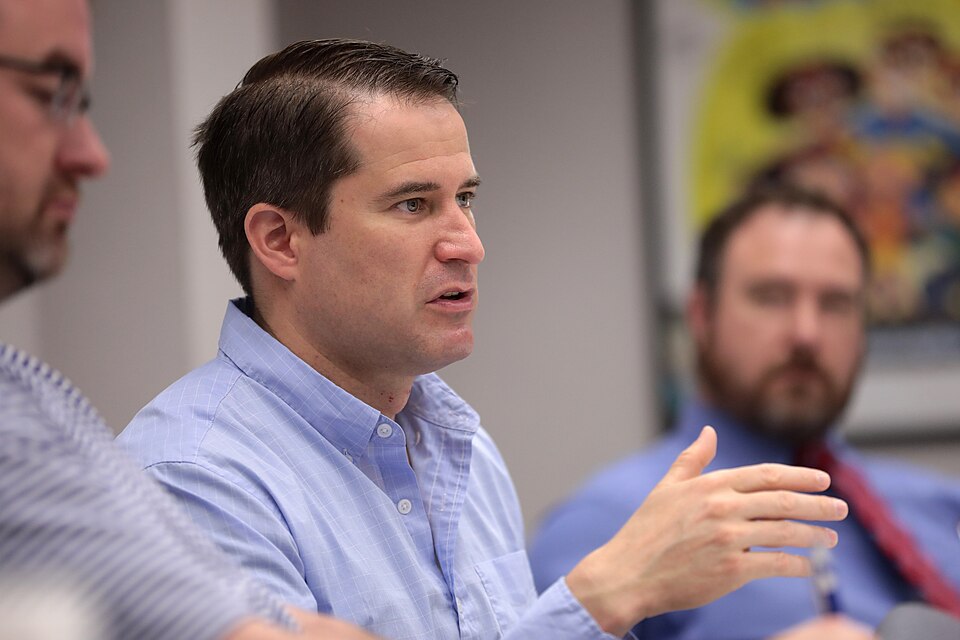

“It’s fundamentally un- American.” That’s how U.S. Rep. Seth Moulton, D-Mass., describes President Donald Trump’s administration’s crackdown on higher education.
Moulton, who represents Massachusetts’ 6th District, is currently challenging incumbent Sen. Ed Markey in the 2026 Democratic primary. During his campaign in western Massachusetts, he spoke with the Record on Jan. 6 in Pittsfield about the political landscape of higher education.
Raised in Marblehead, Mass., Moulton attended Harvard University before serving in the military during the Iraq War. After returning home, he briefly worked in business and was elected in 2014 to represent the 6th Congressional District.
After a short, unsuccessful bid for the presidency in 2020, Moulton decided to run for a Senate seat because he believed that Democratic leadership needs a “new generation.” Moulton is 47, while his opponent, Markey, is 79 and has served in Congress since 1977.
Moulton’s position in Congress has given him a front row seat to the ongoing hostilities between the federal government and academic institutions. Last year, the College faced uncertain pauses on research grants, the threat of an increased endowment tax, struggles with protecting international students from federal policies, and pressure to change the faculty handbook to conform to new federal standards on diversity, equity, and inclusion (DEI).
President Maud S. Mandel has spoken out several times against the federal government’s actions.
In a campus-wide email on Oct. 6, Mandel opposed the Trump administration’s “Compact for Academic Excellence in Higher Education,” which called for nine of the nation’s leading universities — though not Williams itself — to conform to certain ideological standards under the threat of losing federal funding. The Trump administration later extended the compact offer to all higher education institutions in the United States. “The Compact threatens to undermine academic independence,” Mandel wrote.
Because the highest-profile legal fight thus far has played out at Moulton’s alma mater, Harvard, he has a personal stake in the battle between the federal government and higher education. Last spring, the federal government threatened to revoke all future federal funding in response to what it described as Harvard’s failure to modify DEI policies and adequately fight antisemitism. The university responded with a counter-lawsuit against the Trump administration.
“I have been both privately and publicly encouraging Harvard to fight. Fight, fight, fight,” Moulton said. “I think institutions like Williams and Harvard at the end of the day will actually come out better and stronger, because by being willing to show that you’re willing to stand up not just to Trump, but for American values, you’re doing the right thing.”
Moulton cited freedom of speech as one such value, referencing the detention of Rümeysa Öztürk, an international student whose op-ed calling for Tufts’ divestment from Israel prompted the Department of Homeland Security to revoke her student visa.
“When someone who has views that Marco Rubio doesn’t like … gets rolled up by immigration, we’ve got to stand up really strong and fight that,” he said.
Moulton touched on another growing concern among undergraduate students: artificial intelligence’s impact on post-graduate job opportunities.
“[AI is] a huge issue,” he said, directly addressing undergraduates. “You’re going to graduate and have a lot fewer job opportunities than I had not that long ago when I graduated college, because so many of those entry-level analysts, paralegals, and whatever else, are going to be automated out of existence.”
Moulton stressed the necessity of bipartisan cooperation to pass legislation that can defend academic independence. Moulton pointed to Sen. Bill Cassidy, R-La., as an example of this collaboration. While supporting the Trump administration’s “Compact” proposal, Cassidy also sponsored the College Transparency Act along with Sen. Elizabeth Warren, D-Mass. The act would aid families in their decisions about higher education by providing public information about net costs and post-graduate earnings at institutions in the United States.
Molton hopes that more bipartisan legislation in the future will help defend higher education. “Let’s just make a pact that we’re not going to let this administration take any money away from the University of Alabama, or from Williams and Harvard,” Moulton said. “That’s the kind of compromise you have to forge.”
About the Author