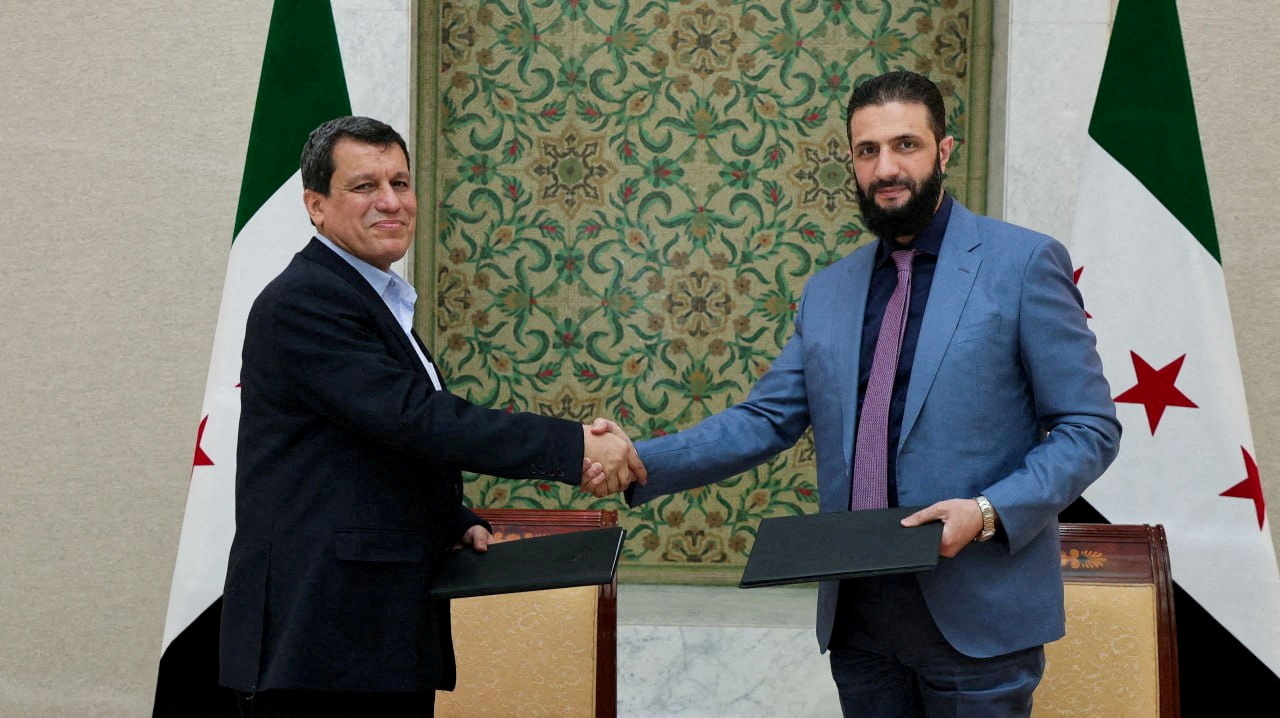

Syria’s interim President Ahmed al-Sharaa and Commander of the Kurdish-led Syrian Democratic Forces Mazloum Abdi shake hands after Syria reached a deal to integrate the SDF with state institutions, March 2025. Source: the Syrian Arab News Agency/Handout via REUTERS.
The Syrian government and the Syrian Democratic Forces have agreed to halt hostilities, alongside “an understanding between both sides on a phased process for integrating [the SDF] and administrative structures into the state.”
The deal, which marks a shift in the Syrian government’s longstanding refusal to integrate the SDF into the Syrian army, brings to a close a fractious chapter that began in December with clashes between the two sides in Aleppo. The conflict escalated when the Syrian military made rapid gains in northeastern Syria, seizing areas that the SDF had controlled for nearly a decade amid the Assad regime’s fragmentation during the country’s civil war.
Under the deal, the SDF will withdraw from contact lines and Syrian security forces will deploy to the cities of Hasakah and Qamishli, “with the aim of enhancing stability and initiating the integration of security forces in the region,” according to a text of the agreement published by the Syrian Information Ministry.
The deal also makes way for the formation of a division comprising three brigades drawn from the SDF, in addition to the establishment of a Kobani brigade within a division affiliated with Aleppo Governorate.
The agreement also guarantees “the integration of the autonomous administration’s institutions into those of the Syrian state, while ensuring the retention of civilian employees,” with an emphasis on “the settlement of civil and educational rights for the Kurdish community” and “guarantees the return of displaced persons to their areas.”
According to a political source in the interim Syrian government, the deal will also see a regional governor appointed from within the SDF, while the administrative departments will retain their staff, who will be integrated into the state.
The political source also underlined that there will be a dividing line within this integration, namely those that will be integrated must be “Syrian” while members of the Kurdistan Workers’ Party (PKK) are expected to withdraw to northern Iraq.
Speaking shortly after the agreement was made public, Elham Ahmed, the co-chair of the Foreign Affairs Department of the Democratic Autonomous Administration of North and East Syria, added that “security forces will be composed of local people” and that SDF officials have “been assured that our security forces will remain in their positions and no force will replace our local forces.”
Ahmed also specified that the governor appointment will be for the Hasakah governorate and added that Turkish forces will also withdraw from Afrin as part of the deal.
The deal differs from those agreed to last week in the series of shuttle negotiations between Syrian President Ahmed al-Sharaa’s interim government, leading SDF officials as well as United States officials, whose country was once a strong backer of the Kurdish-led forces in the fight against the Islamic State. The key difference concerns how the integration of fighters into the state military would happen. Last week’s deal made provision for “individual integration” — without preserving a unified Kurdish-led command — whereas the deal reached Friday stipulates the creation of a division comprising three brigades drawn from the SDF.
The integration of the SDF into the Syrian state has been one of the most contentious issues between the two sides over the last year of negotiations, as sources close to the SDF previously told Mada Masr that the group has consistently insisted on the integration of their forces into the state military as full units rather than as individuals.
But after last week’s talks broke down into outright hostility, it was clear to all sides that the only avenue forward would be all-out war if a deal could not be reached.
And that was a deciding factor for both sides.
“We must know, the worst agreement is better than any war,” an SDF official told Mada Masr.
Ahmed echoed this sentiment in her public comments, stating that the agreement was “signed with the aim of stopping the bloodshed, and one of its main points is to ensure a permanent ceasefire.”
The SDF official did, however, acknowledge that for many SDF hardliners, the agreement struck on Friday will be unsatisfactory.
“It is true that the agreement falls short of Kurdish aspirations and rights. But it does include a form of distinction specific to our Kurdish culture and society,” the official added.
But that dissatisfaction extends beyond the SDF, the official said. “Hardliners on both sides will not be satisfied with this deal. The Kurdish side has been waiting for an announcement of a semi-autonomous region or administration similar to the Kurdistan region in Iraq. The interim government, its supporters and its backer, Ankara, had hoped to see the end of the SDF and any political role or rights for the Kurds.”
The political source in the interim government echoed the same sentiment regarding concessions, saying that rather than a definitive settlement of the SDF issue, the agreement responds to the necessities of the present moment.
The deal, the source said, “includes concessions from both the Syrian government and the SDF.”
“At this stage it is considered a good agreement to cool off fronts between the two sides,” the political source said. “It represents a temporary necessity that serves the interests of the Syrian state at the present stage and aligns with the regional reality, one that could shift in the aftermath of an Iran war should it happen, and with the resulting repercussions for Iran-aligned militias in neighboring Iraq and Lebanon.”
And while the Syrian government is looking to regional dynamics to decide what to do next, the SDF side is looking to the next fight over political and cultural rights.
“We call on Kurdish forces to form a joint delegation that includes academic figures specializing in history and international law, to safeguard civil, cultural and political rights through a constitution that guarantees national participation for all of Syria’s social components,” the SDF official said.
This effort, which can be a step toward building a national partnership in “the Syria to come,” can mark the end of eras and decades of Kurdish erasure and exclusion, she said.
“Previous policies never recognized the social specificity of ethnic and cultural diversity, and so they never granted even limited civil or cultural rights to our people in Rojava,” the official said. “Certainly, some dreamed of independence for Rojava, while others on the other side hoped to have things return to square one and deny the Kurds any form of specificity, perhaps even exterminate them entirely.”
About the Author