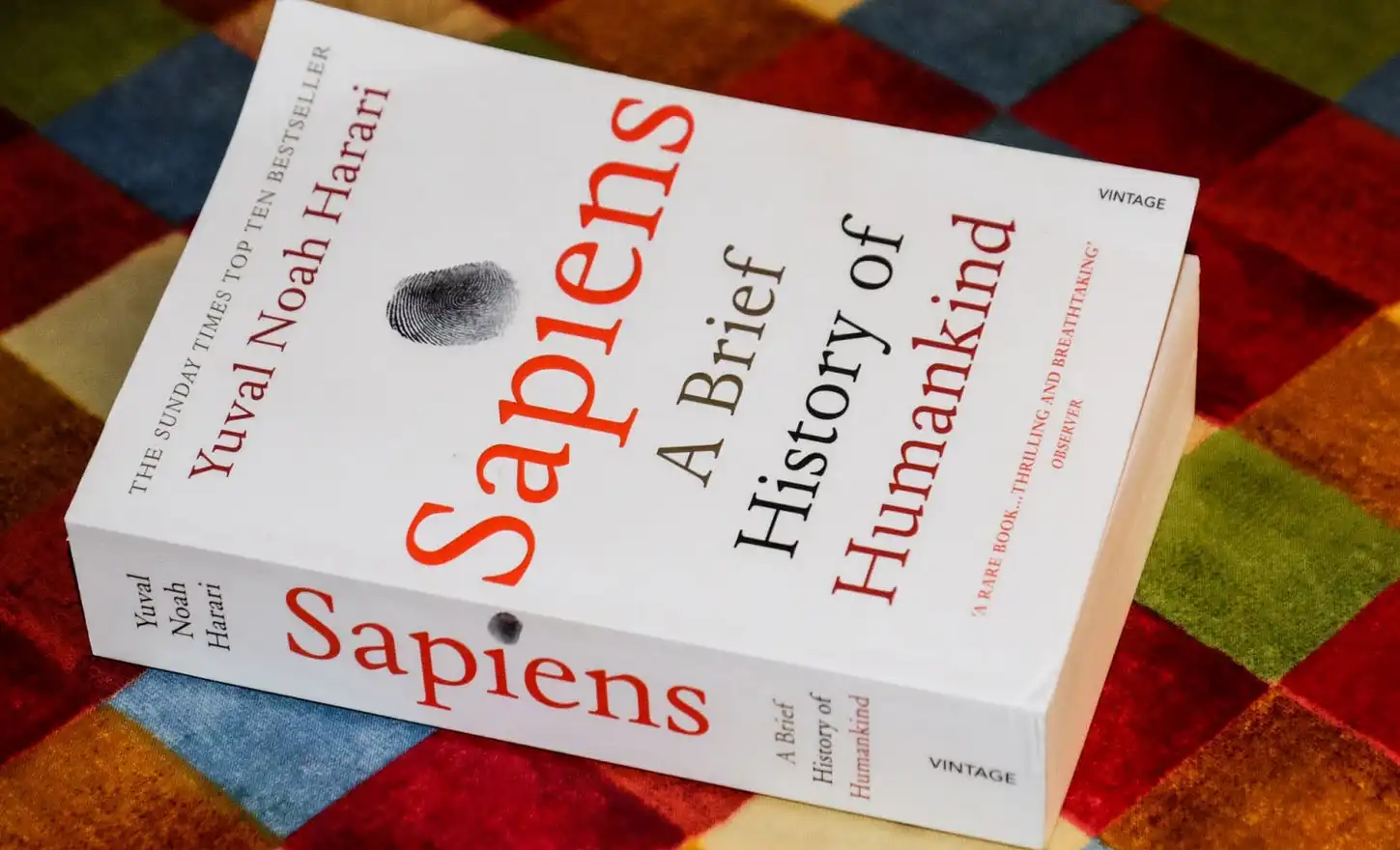
Imagine standing in a mundane bakery line or waiting at a red light when a simple yet haunting question strikes: How did we end up here? Not just on this street, but as a species. How did a creature, biologically unremarkable compared to other mammals, come to shape, consume, and dominate an entire planet? Sapiens: A Brief History of Humankind begins at this exact intersection. Yuval Noah Harari does not seek to decorate history or impose a moral meaning upon it; he simply maps the trajectory—a path that began tens of thousands of years ago and whose end remains unwritten.
In this narrative, man is neither a hero nor an absolute villain. He is an animal with the unique ability to construct shared myths. These stories are the glue that builds tribes, sustains empires, and keeps the global economy afloat. By weaving together biology, anthropology, and history, Harari creates a mirror that is both familiar and profoundly unsettling. This book offers neither empty hope nor an apocalyptic warning; it is an invitation to see the world from an unfamiliar angle—one that ensures you will never look at humanity the same way again.
Who is Yuval Noah Harari? The Mind Behind the Masterpiece
“
Did you know?
Yuval Noah Harari has been a vegetarian for over 20 years, and he believes that the way humans treat animals in industrial farming is the greatest moral crime in human history.
Yuval Noah Harari is a historian and researcher who, rather than remaining confined within academic ivory towers, entered into a global dialogue with the world. Born in 1976, he completed his doctorate in history at the University of Oxford. Harari’s primary focus is on macro-history and the fundamental questions regarding the trajectory of human civilization—questions rarely found in traditional textbooks.
What distinguishes Harari from many other historians is his storytelling method. Instead of focusing on specialized details, he identifies patterns. From the Agricultural Revolution to the rise of modern science, he demonstrates how small changes in the way humans live have had massive, sometimes irreversible consequences. Harari believes in writing for a general audience; his language is simple but never simplistic. In his work, you find fewer absolute verdicts and more questions—questions about happiness, progress, and the very meaning of being human. Following the success of Sapiens, books like Homo Deus and 21 Lessons for the 21st Century solidified his position as one of the most influential contemporary thinkers.
Who is Homo Sapiens and Where Did We Come From?
Homo sapiens is a species within the genus Homo that emerged in Africa about three hundred thousand years ago. At that time, humans were not significantly different from other mammals and held no prominent position in the food chain. They were neither the fastest nor the strongest. They possessed primitive tools, and most large predators were far more dangerous than they were. If a lone human were left in the wild, their chances of survival were not particularly high.
Harari explains that alongside Homo sapiens, other human species existed. Neanderthals lived in Europe, while other species were scattered across Asia. Sapiens did not have a clear physical or intellectual superiority. The primary difference lay in the ability for large-scale cooperation. This ability allowed humans to create groups larger than mere blood ties and to form more complex collective behaviors.
The migration of Sapiens out of Africa marked a turning point in human history. Upon entering other continents, humans rapidly transformed the environment. Many large animal species went extinct. Harari views this process not as accidental, but as a direct result of the human presence. From the very beginning, man had an impact far greater than his biological size suggested. At this stage of history, there was no sign of civilization, agriculture, or states. Humans lived in small groups of hunter-gatherers They knew their environment, consumed resources carefully, and had more free time than modern humans. This simple image is vital, as it provides the baseline for all subsequent changes.
The Cognitive Revolution and the Power of Stories
About seventy thousand years ago, a fundamental shift occurred in the human mind, which Harari calls the Cognitive Revolution. During this period, humans acquired the capacity for complex language. This was not just a language for warning or describing danger, but one that could describe things that did not physically exist. Myths, beliefs, and shared stories began here.
This ability allowed humans to form much larger groups. It was no longer necessary for all group members to know each other personally. It was enough that they believed in a common story—stories like the spirit of the tribe, unwritten laws, or shared values. Harari believes these stories became the foundation for all human institutions. In this view, concepts such as nations, money, or human rights are not objective realities; they are inter-subjective realities. That is, they only exist as long as humans believe in them. This trait is both a human strength and the source of many crises, as stories can unite humans or drive them to slaughter one another. The Cognitive Revolution also enabled humans to imagine the future. Planning, fear of tomorrow, and the hope for progress all stem from this ability, transforming man from an ordinary animal into the decisive player in the history of the Earth.
The Agricultural Revolution: History’s Biggest Fraud
“
You might not have heard this:
Before the Agricultural Revolution, wheat was just a wild grass growing in a small corner of the Middle East; but by luring humans into cultivating it, wheat now covers an area roughly the size of Great Britain across the Earth.
About twelve thousand years ago, humans gradually shifted from a hunter-gatherer lifestyle to farming. In the traditional view, this change is introduced as a great advancement. However, Harari challenges this narrative. He calls the Agricultural Revolution history’s biggest fraud. Agriculture produced more food, but it decreased the quality of individual life. Humans were forced to work longer hours, have a more limited diet, and live alongside animals. Diseases increased, and social inequality took shape. From Harari’s perspective, this change benefited wheat more than it benefited humans.
Agriculture led to population growth. A larger population meant a need for more land and more control. This process resulted in the formation of ownership, boundaries, and ultimately, organized violence. Man could no longer simply change his lifestyle; he had become dependent on the land and the crop. Nevertheless, a return was impossible. Agriculture initiated a chain of changes that made civilization possible. Cities, governments, and complex social structures would not have formed without agriculture. Harari emphasizes that progress does not necessarily mean more happiness.
The Formation of Inequality and Imagined Orders
With the establishment of agriculture, social inequality grew rapidly. Some held more land and resources, while others were forced to work for them. These inequalities were justified through stories—stories about racial, divine, or class superiority. Harari calls these structures Imagined Orders . These are orders that seem real but have no biological basis. Class systems, gender discrimination, and slavery are all founded on stories passed down from generation by generation.
These orders are often stabilized through education and law. From childhood, humans learn what is “natural” and what is unchangeable, while from Harari’s view, many of these structures are constructs of the human mind. In this section, the book shows how power and meaning are intertwined. Whoever controls the dominant story shapes collective behavior. This is a key point for understanding the political and social history of humanity.
Empires and the Unification of the World
As population and power expanded, empires were formed. Empires brought different cultures and languages under a single order. Harari sees this process as dualistic. On one hand, empires brought violence and oppression. On the other hand, they led to the unification of laws, languages, and technology. Empires played a major role in shaping today’s world. Many current values and structures are the result of this unification. Even resistance against empires often takes place within the framework of those very same orders. In this narrative, history is neither black nor white. Harari attempts to show the complexities and avoids simplistic judgments.
Modern Science and the Deal with Ignorance
About five centuries ago, humans accepted that they did not know everything. This admission of ignorance was the starting point of Modern Science . Instead of relying on tradition, man began to observe, experiment, and measure. Science became linked with political power and capital, and the speed of change increased at an unprecedented rate. Science gave man the power to control nature but created new ethical questions. Harari emphasizes that science is not inherently good or bad; it is the human who decides how to use it.
Money, Trust, and Invisible Networks
One of the important turning points in Harari’s narrative is the explanation of the role of Money in expanding human cooperation. In his view, money is not a physical object but a form of collective trust. Humans can believe in something entirely abstract and, based on that, perform real and sometimes vital behaviors. A banknote or a digital number has no value in itself, but the story formed behind it creates its power. Money allowed humans to cooperate with strangers. In the past, trust only made sense within the framework of the tribe or family. But money broke this limitation. A human can exchange goods or services without knowing the other person. This evolution became the foundation for complex economies and global networks. Harari emphasizes that money has functioned more successfully than any religion or ideology because almost all humans, regardless of belief or background, are willing to accept it. Money is a clear example of the power of shared stories—a story that coordinates the behavior of billions of humans without direct force.
Religions, Meaning, and Social Order
“
A rare insight:
Harari argues that modern capitalism is not just an economic system, but the most successful religion in history, because its followers seek paradise in this world through the promise of endless growth, rather than in the afterlife.
The book further explores the role of religions in organizing human societies. Harari does not define Religion merely as a belief in supernatural beings; rather, he sees it as a set of shared laws and values that stabilize social order. From this perspective, modern ideologies are also forms of religion. Religions provide humans with answers regarding meaning, suffering, and the order of the world. They legitimize inequalities and make collective behaviors predictable. Harari shows how universal religions, by promising a global moral order, were able to unite vast societies. The key point is that Harari does not enter into value judgments. He does not say religion is good or bad; instead, he explains why religions have had such a profound impact on human history. Without these systems of meaning, many social structures would not have remained stable.
Capitalism and the Faith in Growth
Regarding the modern era, Harari refers to Capitalism as a system based on faith—a faith that the future will be better than the past and that economic growth will continue. Banks, loans, and financial markets operate based on this belief. This system caused an unprecedented leap in production and innovation. However, it simultaneously increased human dependence on perpetual growth. If growth stops, the entire system faces a crisis. Harari demonstrates how science, politics, and economics became intertwined and changed the course of civilization.
Animal Suffering and the Price of Progress
One of the most shocking parts of the book addresses the status of animals in industrial systems. Harari reminds us that despite alleged moral progress, humans have imposed immense suffering on billions of animals. Industrial Farming, in his view, is one of the darkest chapters in human history. This section of the book challenges the common human-centered perspective and shows how power without empathy can lead to systemic violence. This topic is directly tied to the question of happiness and ethics in the modern world.
Happiness, Meaning, and the Future of Humanity
In the end, the book arrives at a fundamental question: Is modern man happier than his ancestors? Harari provides no definitive answer. He shows that material progress does not necessarily lead to internal satisfaction. Modern man possesses unprecedented power but has lost meaning. With advancements in Biotechnology and Artificial Intelligence, a future is taking shape where the definition of being human might change. The book ends with an invitation to reflection, not a final answer. In the closing pages, Harari looks toward the future. Genetic engineering and algorithms are altering the definition of humanity. Homo sapiens may not be the last human species. This idea is presented not as science fiction, but as a real trend. Harari does not warn, but he asks: If we can manipulate emotions, memory, and decision-making, what is the meaning of freedom? If algorithms know us better than we know ourselves, what place will free will have? The book concludes at this point—not with an answer, but with a call to responsibility. Because man, more than ever before, possesses power and still does not know what to do with it.
Historical Context and Position in Contemporary Historiography
Sapiens: A Brief History of Humankind was published at a time when academic historiography had become overly specialized, and the general audience was practically excluded from macro-historical narratives. In the decades preceding this book, history was often divided into limited branches like economic, social, or cultural history, and a general picture of the human path was rarely presented. Yuval Noah Harari, in such an environment, consciously turned toward Macro-history. He drew inspiration from the classical historiographic tradition but integrated tools of modern science such as evolutionary biology and cognitive science into the narrative. This combination made Sapiens not just a history book, but an attempt to answer fundamental questions about humanity. The historical context of the book’s writing is tied to 21st-century concerns. Globalization, environmental crises, and technological advancements increased the need for a perspective beyond national or civilizational history. By focusing on the human species rather than a specific nation or culture, Harari addressed this need. In this framework, Sapiens can be seen as a reaction to the fragmentation of knowledge. It tries to show that human history cannot be understood without considering the body, mind, and imaginary structures of man. It is this macro perspective that has turned the work into a reference text for contemporary intellectual dialogues.
Hidden and Abstract Concepts in Sapiens
One of the deep layers of Sapiens is its focus on abstract concepts that shape human life but are often invisible. Harari repeatedly emphasizes that the true power of man lies not in muscles or even tools, but in the capacity for Collective Belief. The concept of the Imagined Order is one of the key ideas of the book. Harari explains that many things humans consider natural or self-evident are constructs of the collective mind. Money, nations, corporations, and even certain moral values would collapse without shared belief. This perspective shifts history from a narrative of heroes and events to an examination of mental mechanisms. Another idea is the separation between individual happiness and collective progress. The book quietly but persistently raises the question of whether the increase in human power has led to an increase in internal satisfaction. Harari’s answer is not certain, but his historical evidence suggests that the two are not necessarily aligned. At a more abstract level, Sapiens questions the concept of Meaning. If meaning is a construct of the human mind, can it be changed or rewritten? This question is directly linked to the future of man and his moral responsibility.
Adaptations, Inspirations, and Influence on Subsequent Works
Sapiens is not an adaptation of a specific work, but it has heavily inspired subsequent works in history, philosophy, and technology. Following its publication, a wave of books and articles emerged with a macro-historical and interdisciplinary approach targeting a general audience. In the media sphere, many documentaries and public lectures drew inspiration from the narrative structure of Sapiens. Linear yet conceptual storytelling, the use of everyday examples, and linking the distant past to today’s concerns became a common pattern. In the intellectual space, the book allowed concepts such as “shared stories” and “imagined orders” to enter public discourse. Even in discussions regarding the digital economy, AI, and politics, the traces of these concepts are visible. The importance of this influence lies in the fact that Sapiens was not just read; it provided a new language for thinking about history—a language that blurred the boundaries between the university and society.
The Today’s Importance of Sapiens and its Intellectual Legacy
Today, more than a decade after its publication, Sapiens is still considered a living book. The reason for this longevity is not future prediction, but the raising of the right questions. Instead of providing a prescription, the book makes the reader’s mind sensitive to the self-evident. In a world where technology advances at an unprecedented speed, the book’s ideas about the flexibility of the human concept have gained more importance. When Harari speaks of the potential end of Homo sapiens, he is actually drawing attention to our current responsibility. The intellectual legacy of the book can be summarized in one sentence: Sapiens reminds us that human history was neither destiny nor an inevitable path. Our choices, stories, and beliefs built it, and they can still change it.
Analysis: The Paradox of Power and the Void of Purpose
In this creative analysis, we must consider Harari’s central paradox: the “Power-Meaning Gap.” As Sapiens gained the ability to manipulate the world through the Agricultural and Industrial Revolutions, we simultaneously traded away our intimate connection with nature and immediate sensory reality for abstract systems. We became “God-like” in our capacity to destroy or create, yet we remain biologically wired as hunter-gatherers. This misalignment creates a unique modern neurosis—we have everything to live with, but often nothing to live for. Harari’s work suggests that our greatest invention, the “Imagined Order,” is both our greatest tool for cooperation and our most dangerous trap, as we often forget these orders are fictions and begin to suffer for them as if they were physical laws.
Furthermore, Harari’s perspective on the “Technological Singularity” suggests that Sapiens is currently in its final act. If history is the record of what humans do with their minds and bodies, the moment we begin to biologically engineer those minds and bodies, “history” as we know it ends. We are no longer playing the game of evolution; we are rewriting the code. This shifts the role of the historian into that of a philosopher-prophet. The legacy of Sapiens isn’t just about understanding the past; it’s about recognizing that our current “stories”—Capitalism, Humanism, and Liberalism—are just as fragile as the myths of ancient Mesopotamia. We are at a threshold where our myths must catch up to our mechanics, or we risk becoming powerful, unhappy “gods” who do not know what they want.
Smart FAQ
1. Why does Harari call the Agricultural Revolution a “fraud”?
He argues that while it allowed the population to grow, it forced individuals into harder labor and a worse diet compared to hunter-gatherers. The revolution benefited the species’ “evolutionary success” (more copies of DNA) but significantly decreased the average person’s quality of life and health. Essentially, humans became slaves to wheat rather than its masters.
2. What is an “Imagined Order” and why is it important?
An imagined order is a social structure, like a nation or a legal system, that exists only in our shared imagination. It is crucial because it allows millions of strangers to cooperate effectively by believing in the same myths. Without these shared fictions, large-scale human civilization would be biologically impossible.
3. Does the book suggest that Sapiens will go extinct?
Harari suggests that Sapiens as we know it might “end” not through a typical extinction, but through biological and technological transformation. We are moving toward becoming “Homo Deus” by using genetic engineering and AI to upgrade ourselves. This would mean our descendants might be so different from us that they constitute a new species entirely.
4. How has the book influenced modern Silicon Valley leaders?
Tech leaders utilize Harari’s concepts of “algorithms” and “dataism” to understand how social networks can shape human behavior. The idea that humans are “hackable animals” has become a foundational warning for those building AI and persuasive technologies. It has prompted a massive debate on the ethics of data ownership and the future of human agency.
5. What is “Dataism” in the context of Harari’s later philosophies?
Dataism is the emerging “religion” that views the entire universe as a flow of data and organisms as mere biochemical algorithms. It suggests that the ultimate value lies in processing information and that AI might eventually make better decisions for us than we can. This concept challenges the traditional Humanist belief that human feelings are the ultimate source of authority.
6. Is Harari’s work considered strictly “historical” by academics?
While highly praised, some academic historians criticize him for oversimplifying complex events to fit his overarching “macro” narrative. They argue that his biological reductionism sometimes ignores the nuances of specific cultural and local histories. However, most agree that his work has successfully bridged the gap between science and the humanities for the public.
Conclusion
The journey through Sapiens is more than a history lesson; it is a psychological audit of our species. We have traced our path from insignificant African primates to the masters of the biosphere, fueled by the unique superpower of storytelling. By understanding that our world is built on “imagined orders”—from the money in our pockets to the borders on our maps—we gain the perspective needed to navigate a future dominated by AI and bioengineering. Harari leaves us with a profound realization: we are more powerful than ever, but we must decide what kind of stories we want to believe in before our tools decide for us. This summary serves as a gateway to that urgent reflection.
What do you think about the future of Homo sapiens?
Do you believe our new powers, such as artificial intelligence, will ultimately make us happier, or are we, as Harari warns, repeating the same mistakes we made during the Agricultural Revolution? Share your thoughts and analysis in the comments section; we are genuinely looking forward to reading your perspectives.
دکتر علیرضا مجیدی پزشک، نویسنده و بنیانگذار وبلاگ «یک پزشک» دکتر علیرضا مجیدی، نویسنده و بنیانگذار وبلاگ «یک پزشک».
با بیش از ۲۰ سال نویسندگی «ترکیبی» مستمر در زمینهٔ پزشکی، فناوری، سینما، کتاب و فرهنگ.
باشد که با هم متفاوت بیاندیشیم!
About the Author