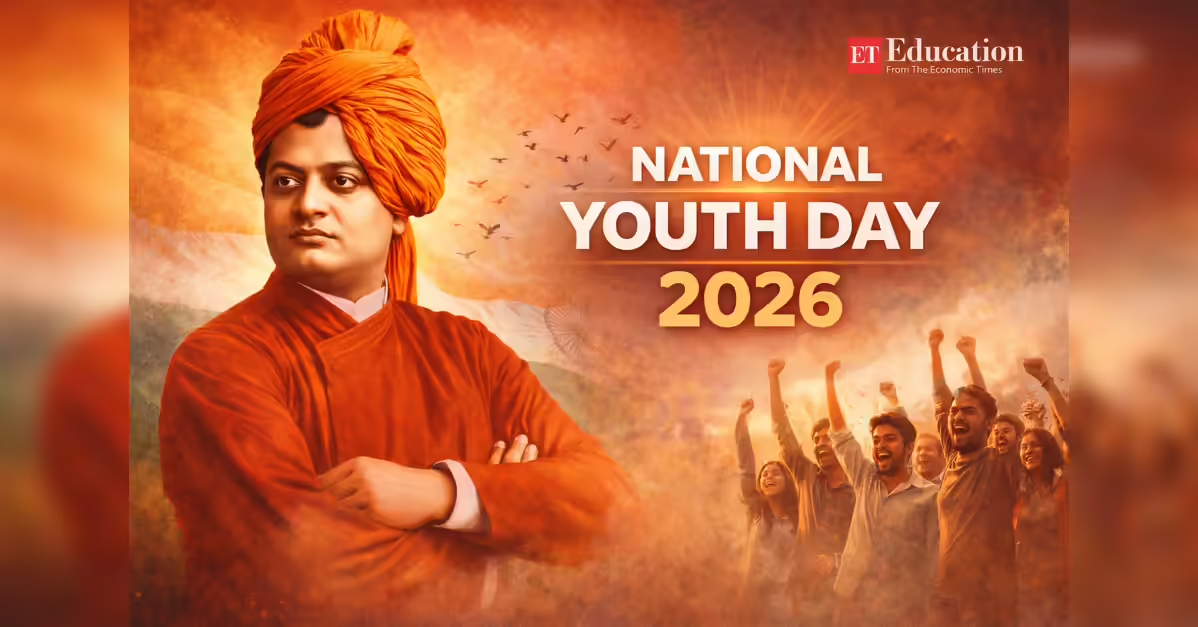

A nation defined by its youth moment
Every National Youth Day invites India to pause – not merely to commemorate the birth anniversary of Swami Vivekananda, but to reflect on the enduring relevance of his ideas in a rapidly changing world. In 2026, that reflection carries new urgency.
India stands at a rare demographic inflection point. With more than half its population under the age of 30, the country is not just young – it is being actively shaped by youth ambition, anxiety, creativity and conviction. From classrooms and campuses to startups, sports arenas and social movements, young Indians are no longer waiting to be “future leaders.” They are already shaping outcomes.
Ashok Kumar, IPS, Vice Chancellor, Sports University Haryana and Former DGP, Uttarakhand underscores this shift, noting that as India marks National Youth Day 2026, education must move away from mediocrity and an exam-centric approach to identifying talent at an early stage and strengthening practical training. Inspired by Swami Vivekananda’s vision of fearless youth, education should nurture confidence, character, ethical values, and self-belief. Learning must be experiential – connecting classrooms to real-world challenges through projects, innovation, and community engagement while prioritising life skills, emotional intelligence, and digital fluency. By giving young people a voice and linking education to purpose and social responsibility, India can shape future-ready leaders committed to nation-building. This urgency is already visible in how young Indians are redefining leadership across sectors.
The rise of entrepreneurs like Ritesh Agarwal, who built OYO into a global hospitality brand in his early twenties, or Nikhil Kamath, who reimagined retail investing for millions of first-time investors, reflects a generation willing to challenge legacy systems and design new ones. Similarly, leaders such as Bhavish Aggarwal, who disrupted urban mobility and manufacturing at a young age, represent an India where youth-led ambition is no longer the exception – it is becoming the norm.
Yet, as opportunities expand, contradictions deepen. Access to information is instant, but clarity remains elusive. Achievement is highly visible, while pressure often stays invisible. It is within this complexity that Swami Vivekananda’s vision for youth demands fresh interpretation – not as historical reverence, but as a living framework.
Vivekananda’s youth: strength, character, purpose
Swami Vivekananda saw youth not as passive recipients of education, but as active builders of civilisation. His call was unapologetically bold:
“Arise, awake, and stop not till the goal is reached.”
But this was never a call for blind ambition. It was a demand for inner strength, moral courage, and self-belief. Vivekananda consistently argued that education must build character before credentials, confidence before conformity, and service before success.
Prof Dr Amit Patra, Director, IIT (Banaras Hindu University) Varanasi, echoes this philosophy, stating that all persons have natural talents. Through education, it can be refined and channelized for different purposes. One should get the opportunity to hone his/her skill through education, in their areas of interest and passion. In Swamy Vivekananda’s words, education should manifest the perfection already in a person.
“Education is the manifestation of the perfection already in man,”
he asserted – a reminder that learning is not about accumulation, but awakening.
This philosophy finds a powerful parallel in figures like Neeraj Chopra, who combined discipline, patience, and quiet resilience to become India’s first Olympic gold medallist in athletics. His journey reflects Vivekananda’s conviction that true strength is not loud or hurried – it is cultivated through perseverance, self-mastery, and unwavering focus.
From ambition to ownership
This shift in thinking is already reshaping how young Indians view ambition itself. One of the defining shifts among Indian youth today is the move from ambition to ownership. Young people are no longer content with aspiration alone; they are asking sharper questions about relevance, impact, and responsibility.
Prof Himanshu Rai, Director, IIM Indore, shares that as Swami Vivekananda envisioned, education must move beyond credentialism and focus on cultivating inner strength. Future-ready education should integrate philosophical inquiry with technological fluency, ethics with innovation, and self-awareness with social responsibility. It is time to teach students to continuously upskill, question, empathise, and lead with conscience, thereby emerging as values-driven leaders for the Viksit Bharat we collectively aspire to build.
Across startups, social enterprises, and creative industries, youth leadership is increasingly defined by action rather than entitlement. This reflects Vivekananda’s belief in self-reliance – that nations rise when individuals take responsibility for their intellectual, ethical, and social growth.
In today’s context, this means equipping young people not just with employable skills, but with judgment, adaptability, and courage – the ability to navigate uncertainty without losing direction.
The role of education: beyond preparation, towards purpose
If youth are ready to lead, institutions must be ready to evolve.
Schools, universities and training systems in 2026 are being challenged to move beyond exam performance and placement statistics. The real question is whether education is helping young people understand who they are, what they value, and how they can contribute meaningfully.
Dr Arun Mohan Sherry, Founding Director, IIIT Lucknow, highlights that as India celebrates National Youth Day 2026, education must transform in the true spirit of NEP 2020 and the national vision of Viksit Bharat @2047. Moving beyond rote learning, institutions must build strong foundations in critical thinking, creativity, and problem-solving through experiential and multidisciplinary learning. Equally vital is the integration of ethics, empathy, and values alongside technological excellence. To realise India’s long-term aspirations, education must inspire purpose, encourage lifelong learning, and prepare youth to see themselves not just as professionals, but as ethical leaders and nation builders.
Vivekananda warned against education that produces imitation rather than originality. His vision demands learning environments that nurture inquiry, courage and compassion – spaces where students are not trained to fit into the world as it is, but prepared to shape the world as it should be.
“You cannot believe in God until you believe in yourself”
he reminded the youth of India – a message that feels strikingly contemporary in an age of comparison, validation metrics, and constant performance.
Prof KK Pant, Director, IIT Roorkee, reinforces this view, stating that education must move beyond information delivery to character formation and purpose-driven learning. To shape confident and ethical young leaders, institutions must integrate critical thinking, scientific temper, empathy, and societal responsibility, alongside a sustainability-focused, holistic approach. Future-ready education should nurture innovation grounded in values, addressing interlinked challenges of food, water, and energy, and enabling youth to lead with integrity, resilience, and a deep commitment to national and global progress.
As younger education entrepreneurs and institution-builders reimagine learning through technology, creativity, and access, the focus is gradually shifting from rote success to reflective growth.
“Take risks in your life,” Vivekananda urged. “If you win, you can lead. If you lose, you can guide.” Education, at its best, must create room for both.
A shared responsibility
National Youth Day is not only a celebration of young people; it is also a moment of accountability for institutions and society.
Vivekananda placed immense faith in youth, but he also believed society must create conditions where that energy is channelled constructively – through trust, guidance, and opportunity.
Praneet Mungali, dedicated educationist and Trustee, Sanskriti Group of Schools, observes that as India marks National Youth Day 2026, the focus must be on nurturing a new generation of confident and perseverant leaders. Swami Vivekananda’s ideas strongly emphasise character rooted in integrity, honesty, and self-belief – values that remain deeply relevant today. Experiential learning is essential to help young people shape strong personalities, while emotional intelligence is increasingly critical to navigate modern challenges. In an era where AI is transforming every sphere, digital readiness is no longer optional. Education must empower youth to rise as intelligent, creative, and responsible leaders shaping India’s innovative future.
Supporting youth today means offering clarity instead of confusion, pathways instead of pressure, and participation instead of symbolism.
From potential to purpose
As India marks National Youth Day 2026, Swami Vivekananda’s message feels less like a quote from the past and more like a challenge to the present. The nation’s future will not be determined by how young its population is, but by how meaningfully that youth is prepared to think, choose and lead.
The task ahead is not to motivate young Indians – they are already moving. The task is to match their momentum with direction, their confidence with conscience, and their aspiration with purpose.
That is the most meaningful and true tribute to Vivekananda. And that is the real work of National Youth Day.

About the Author