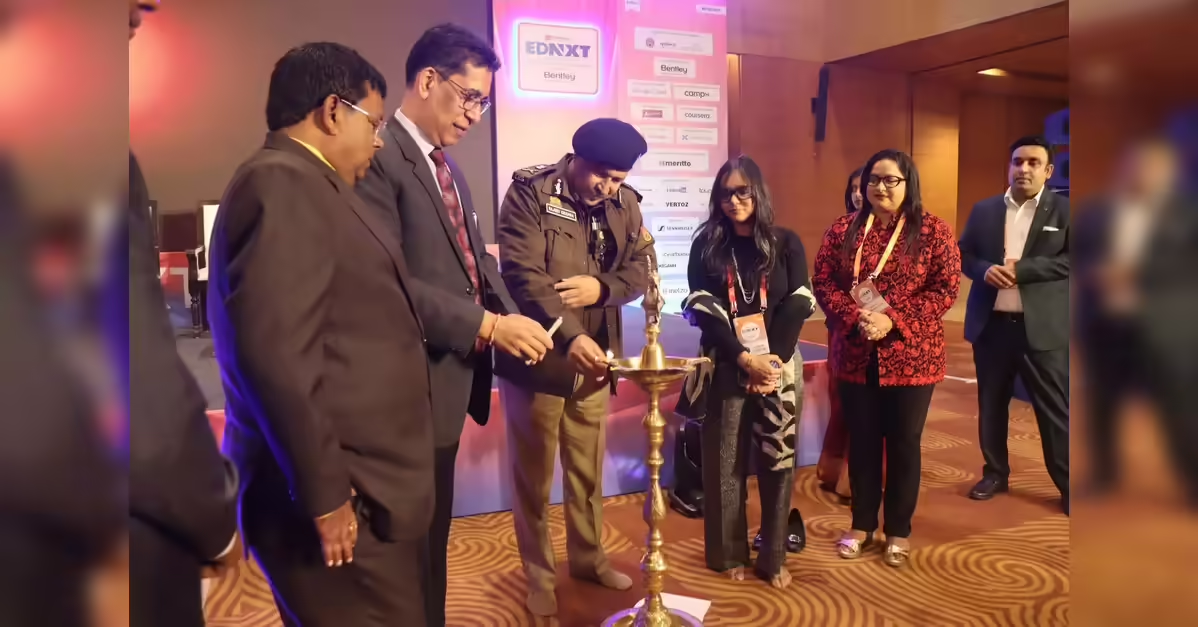
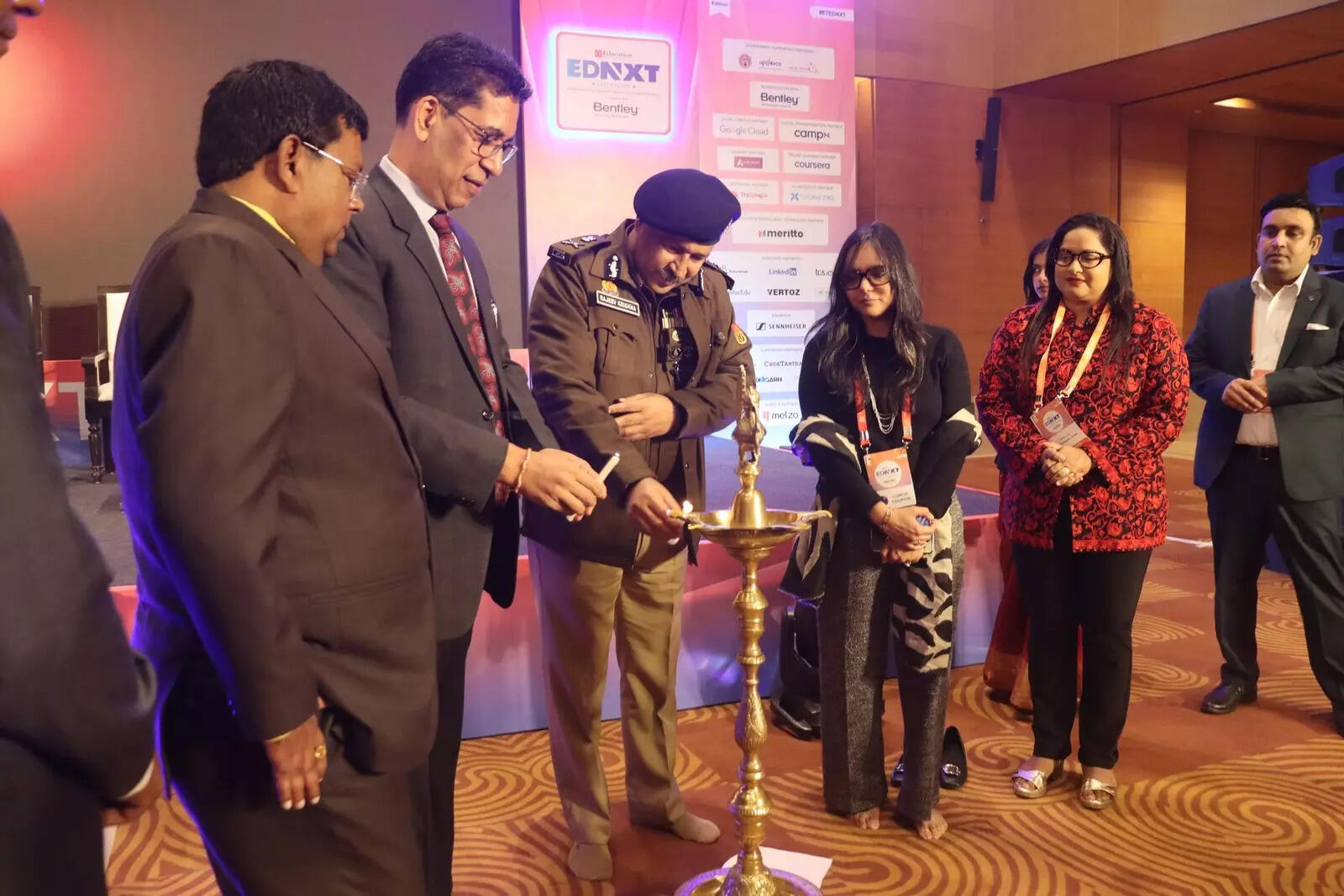
As India advances towards becoming a global knowledge economy, higher education sits at the core of the nation’s growth, employability, and global competitiveness. With over 43 million students across 45,000+ colleges, the sector carries unmatched scale and equally urgent challenges, from employability gaps and Industry 5.0 readiness to equity, access, and quality outcomes. In this transformation journey, Uttar Pradesh assumes strategic importance: home to one of the country’s largest student populations, a rapidly expanding university ecosystem, and a state-led push to operationalise NEP 2020 at scale. Anchored in this context, The Economic Times presents the 6th Edition of EDNXT Lucknow 2025, was held on December 11, 2025 at The Centrum, Lucknow, bringing together policymakers, higher education leaders, industry experts, and innovators to drive outcome-led reforms, strengthen employability, and position Uttar Pradesh as a national engine of education-led growth.The summit commenced with high-impact inaugural keynotes on Policy Reforms and Strategic Initiatives in Higher Education, setting a decisive tone for a future-ready academic ecosystem focused on quality, employability, and institutional excellence in Uttar Pradesh and beyond.
Narendra Bhooshan, Additional Chief Secretary, Energy and Addl. Sources of Energy & Technical Education Department, Government of Uttar Pradesh, underlined that “a knowledge economy cannot be built on constraints – it must be built on choice, flexibility, mobility, and quality-led systems,” outlining UP’s shift from compliance-driven affiliation to measurable, industry-linked academic excellence.
Rajeev Krishna, Director General of Police, Uttar Pradesh, highlighted education as the strongest enabler of social harmony, stating that “every classroom strengthened is a step towards a safer and more confident Uttar Pradesh,” while emphasising cyber safety, youth engagement, and trust-based community policing.
Neha Jain, Special Secretary, IT & Electronics & Managing Director, UPDESCO, Government of Uttar Pradesh, called for breaking silos between academia, industry, and government, noting that “technology has democratised access – what institutions must now build is depth, ethics, creativity, and adaptability in students.”
Girijesh Kumar Tyagi, Special Secretary, Department of Higher Education, Government of Uttar Pradesh, noted that Uttar Pradesh was the first state to implement NEP’s core values at scale and, with its vast learner base and expanding university ecosystem, is on track to meet national GER targets of 50% by 2035 and 65% by 2047, positioning the state as a model for others to emulate.
Responding to the need for future-ready employability, Dr Hari Om, Principal Secretary, Vocational Education & Skill Development & Entrepreneurship Department, Government of Uttar Pradesh, stressed that “degrees alone are no longer enough – skills, flexibility, and real-world learning must sit at the core of education under NEP 2020.”
The Mega Panel on ‘Future-ready Workforce: Supercharging Skills for the Jobs of Tomorrow’ reinforced that adaptability, communication, unlearning, faculty upskilling, and holistic development are as critical as technical skills. Dr Arun Sherry, Director, IIIT Lucknow, showcased 4 P’s “project-to-product, passion-to-profession” model turning student ideas into scalable ventures.
Adding to the panel discussion, Prof Manuka Khanna, Vice Chancellor, University of Lucknow, Uttar Pradesh, emphasised the need to balance adaptability with strong communication skills, stating that “we need adaptability but we also need communication skills – personality should be ready to adapt everything, but we will only be able to do it when we are able to communicate and feel more positive about it.” She added that the university is working closely with students on meditation and their happiness quotient, noting that learners “shouldn’t get depressed or threatened by what is happening.”
Highlighting institutional priorities, Dr Syed Nadeem Akhtar, Pro-Chancellor, Integral University, Lucknow, Uttar Pradesh, identified agility and faculty training as the two most critical focus areas for higher education institutions. He shared that “the most amount of happiness we see is when our efforts bear fruit, when we see light at the end of the tunnel,” underscoring the need for outcome-oriented academic practices.
From an institutional reform perspective, Ajay Prakash Shrivastava, Chancellor, Maharishi University of Information Technology (MUIT), Lucknow, Uttar Pradesh, stressed the importance of curriculum flexibility and industry integration, stating that “our aim is that when students step out of the university, they are always ready – whether for a small business or a big business.” He added that MUIT continuously upgrades its curriculum with industry expert inputs and emphasises stress-free, holistic learning through industry exposure and meditation-led practices to enable clear, adaptable thinking.
In the Industry–Academia Collaboration panel, Prof (Dr) Rama Shanker Verma, Director, Motilal Nehru National Institute of Technology (MNNIT) Allahabad, and Prof Arvind Sahay, Director, Management Development Institute (MDI) Gurgaon, underscored trust and mutual understanding as the most critical enablers for sustainable research partnerships and innovation ecosystems.
A special Fireside Chat by Suhas L Yathiraj, Secretary (Sports), Government of Uttar Pradesh, highlighted the role of discipline, mindset, and inspiration in shaping resilient generations beyond academics.
The summit also saw participation from eminent academic leaders who enriched discussions on governance, digital pedagogy, skills, and institutional excellence:
- Dr Surabhi Bhadauria, Pro Chancellor, Pratap University, Jaipur, Rajasthan & Trustee, Maharana Pratap Group
- Dr VV Gopal, Director, IILM University Lucknow, Uttar Pradesh
- Prof (Dr) Satish Chander Sharma, Pro Vice Chancellor, Babu Banarasi Das University, Lucknow, Uttar Pradesh
- Prof (Dr) Sanjay Srivastava, Vice Chancellor, Manav Rachna International Institute of Research & Studies, Faridabad, Haryana
- Dr D K Chauhan, Executive Director – Group, Raj Kumar Goel Institute of Technology (RKGIT), Ghaziabad, Uttar Pradesh
- Prof Raj Kumar Mittal, Vice Chancellor, Babasaheb Bhimrao Ambedkar University, Lucknow, Uttar Pradesh
- Dr Siddharth Chaurasia, Director Technology, Chandigarh University, Lucknow, Uttar Pradesh
and many more…
Next Stop: The Economic Times Education EDNXT Bengaluru 2026 – scheduled for 5th February 2026 at Conrad, Bengaluru, the 7th edition will explore “The Education Transformation: AI, Access & Acceleration,” convening over 400+ education leaders, policymakers, and innovators to chart the future of AI-driven learning, equitable access, digital infrastructure, and accelerated skilling in India’s education landscape.

About the Author