Zimbabwean photographer Jono Terry turns to the myth of NyamiNyami and the history of Lake Kariba to examine belonging, displacement, and the complicated inheritance of a colonial past
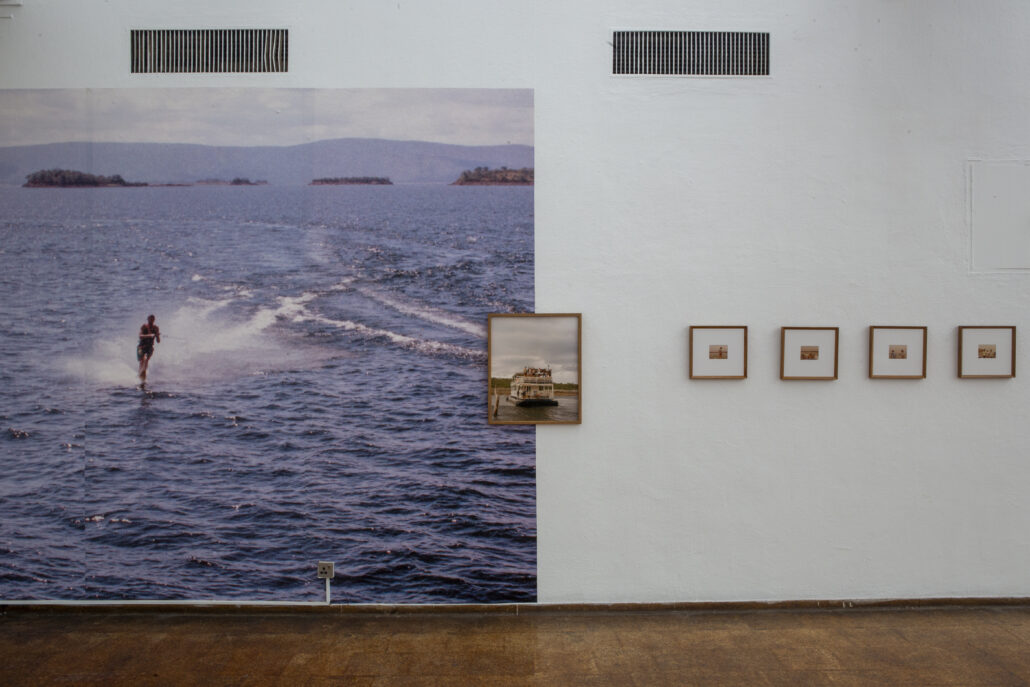
Installation view of ‘They Still Owe Him a Boat’ at The National Gallery of Zimbabwe. © Jono Terry
The story of Lake Kariba is a story of rupture. It is a story of a river dammed, a landscape submerged, and a people displaced. It is also a story layered with myth, in which the river god NyamiNyami is said to have watched as the rising water swallowed ancestral lands, sacred sites, and entire ways of life. For Zimbabwean photographer Jono Terry, born in Harare and now based between London and his home in Kariba, it is both a place of childhood memories and a site of historical reckoning.
His long-term project, ‘They Still Owe Him a Boat’, turns toward the Zambezi Valley to grapple with the legacies of the Kariba Dam, one of the world’s largest artificial reservoirs. Rooted in photography, research, and community engagement, the work examines what was lost during the dam’s construction, from the displacement of the Tonga people to the cultural and ecological transformations that continue to shape the region.
At the heart of the project is a personal tension. As a white Zimbabwean and grandson of British immigrants to Rhodesia, Terry uses the work to interrogate his own relationship to land, history, and belonging. Kariba becomes the entry point for a deeper conversation about identity, memory, and the stories we inherit.

Below The Dam Wall: The Zambezi River photographed as it winds through the valley beneath the Kariba dam wall. The Tonga people, who believed in NyamiNyami, the river deity widely depicted with the head of a tiger fish and the body of a snake thought the construction of the Kariba dam wall forever separated him from his wife downstream. The Zambezi was regarded as a sacred, life-sustaining river and its name comes from the Tonga phrase ‘Kasambabezi’ which means ‘only those who know the river can bathe in it’ and ‘Basilwizi’ the name given to the people of the Great River who interwove their existence along it. © Jono Terry
ART AFRICA: Your project engages deeply with the myth of NyamiNyami and the history of the Kariba Dam. What first drew you to explore this story, and how did myth, memory, and history come together to shape the direction of your work?
Jono Terry: I am motivated by creating work that represents a more honest relationship with my home, Zimbabwe. My interest in Kariba began when I learned that my father wanted his ashes scattered there. The idea of returning to the land, even a land to which we did not necessarily belong as white people, felt powerful and complicated. Kariba is one of my favourite places in the world. Many of my formative memories are connected to it. It is where I feel most at home and where I imagine returning one day. Since my work focuses on belonging, it was natural for me to turn to this place.
As I began to look more closely at Kariba’s history, I realised how much had been lost long before my own love for it. Its construction destroyed cultural histories, sacred sites, and ecological systems. That made it necessary to acknowledge and celebrate the original narratives and the original peoples of the Zambezi Valley. Myth, memory, and history became guiding tools, helping me decentre myself to understand a story much larger than my own.
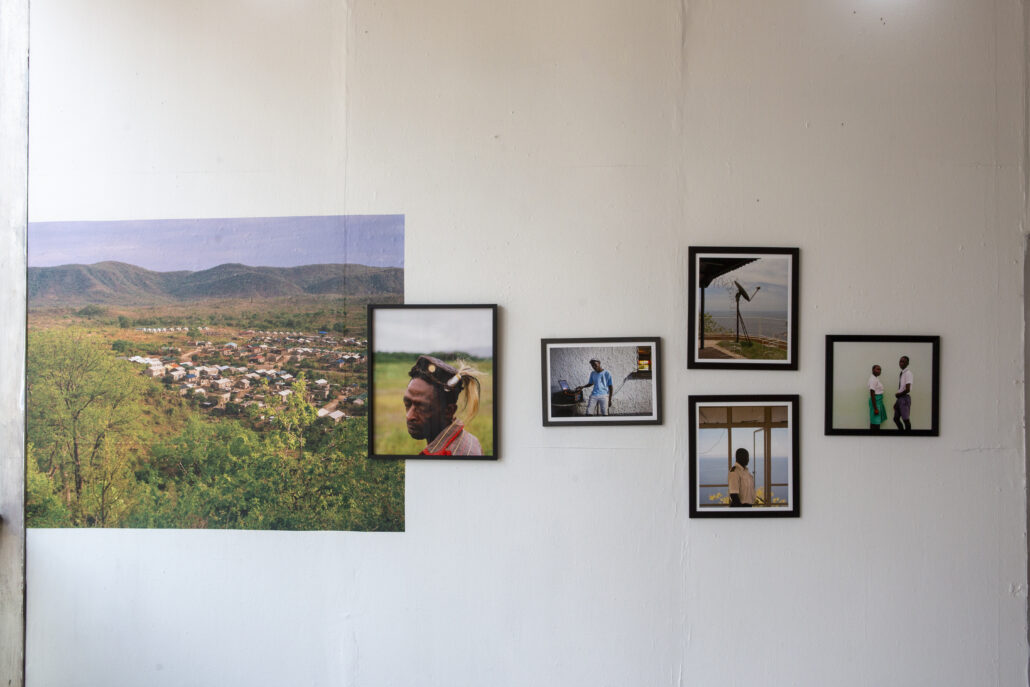
Installation view of ‘They Still Owe Him a Boat’ at The National Gallery of Zimbabwe. © Jono Terry
As someone born in Zimbabwe but based in London, and as the grandson of British immigrants to Rhodesia, you have spoken about questioning your own belonging as a colonial remnant. How does this personal tension influence your practice and the way you approached They Still Owe Him a Boat?
This tension is the core of my practice. As a white man in postcolonial Africa, my work has always been tied to questions of belonging. It is how I try to understand Zimbabwe’s colonial history while locating my own position within it. Once you become aware of the weight of your own presence, it is impossible to unsee it. That awareness shapes my photographic approach.
I critique cultural and societal issues while also critiquing myself as part of the system. My identity as a white Zimbabwean exists because of British colonialism, and acknowledging that gives my work nuance and sensitivity. While working on They Still Owe Him a Boat, this tension pushed me to understand the history of Lake Kariba from multiple perspectives and to examine my own privileged relationship to it.
The story is partly about me and partly about Zimbabwe. I want my work to spark overdue conversations about our shared history. As idealistic as it sounds, I want to contribute to the story of Zimbabwe in the hope of contributing to a better Zimbabwe.

Rope: A tow rope attached to a smaller tender boat whilst in motion across Lake Kariba. The lake is very much a tale of twos. There are two sides to the lake: Zimbabwe and Zambia, an imaginary line demarcates the lake in two, roughly following the course of the Zambezi River. The NyamiNyami river god, depicted with the body of a snake and the head of a tiger fish, is separated from his wife downstream, his other half, by the Kariba dam wall. There are two histories and two very different experiences of the lake -those of the white population and those of the black population. In its creation, there were things that ‘we’ stood to gain, and ultimately there was so much that was lost. It was a place of expectation and it is a reality that we are still reckoning with today. © Jono Terry
The project seeks to platform and acknowledge the narratives of the Tonga people, who were displaced when Lake Kariba was created. How did you engage with oral histories and lived experiences, and what responsibility did you feel in representing these voices?
Given the history of photography in colonial Africa, I felt a huge responsibility. These are not my stories to tell. I see myself as a custodian of sorts, someone given the privilege of hearing these histories and the chance to amplify them. Being honest about my intentions played a significant role in my acceptance within these communities. I learned things that had never been shared outside the tribe. It was incredibly humbling.
Much of my work involved documenting traditions and mythology as a form of preservation, especially where oral histories are vulnerable to the pressures of urbanisation, modernisation, and ongoing colonisation. Part of my long-term goal is to give displaced communities more control over their own representation. I am working toward building a museum within one of these communities to house artefacts, teach, and share stories.
The relationships formed during this process are one of the greatest joys of my work. That is also why I self-published the accompanying book, to maintain control over the narrative and ensure that voices often sidelined in Kariba’s history are appropriately acknowledged.

Installation view of ‘They Still Owe Him a Boat’ at The National Gallery of Zimbabwe. © Jono Terry
Your photographs balance beauty with a haunting sense of absence. How do you see photography functioning as a tool for preserving memory and addressing loss in the context of displacement and ecological transformation?
Photography plays a significant role, yet at times I became aware that images alone are not enough. They offer only one element in a complex landscape. When dealing with myth, the unseen, or things that no longer exist, photographs leave room for interpretation. These images balance beauty and absence, reflecting both creation and destruction.
I spent seven years making this body of work, not only because the process is slow, but because I refused to remain on the surface. I embedded myself in the communities, forming relationships and learning about the place not as an outsider but as a Zimbabwean. To tell a complete story, the work needed text, interviews, research, and my own writing alongside the images. That combination gives They Still Owe Him a Boat more strength and depth.
The physical objects that make up the project, such as the book and exhibition prints, become tools for conversation. They allow the work to contribute to necessary discussions about loss, memory, and the future of Kariba.

Abandoned Boat: An abandoned houseboat sits on the lakeshores of Kariba near Mica Point slowly being reclaimed by the wilderness. Following the construction of the Kariba dam wall in 1960, the lake became a popular tourist destination for the white minority population of Rhodesia and during international isolation, domestic tourism to places like Lake Kariba was promoted through slogans like ‘Forgot Rome, Holiday at Home.’ Houseboats were a key attraction in the Kariba tourism industry. © Jono Terry
You have described your practice as rooted in challenging Western colonial narratives. In this project, what specific narratives about Lake Kariba and its legacy are you hoping to challenge or complicate?
The imagery surrounding Kariba has often focused on what it provided: electricity, tourism, and industry. Its construction was compared to the Pyramids of Giza. Operation Noah, which rescued animals as the waters rose, became a celebrated story. Kariba is indeed all these things, and those narratives form part of why I love it. But they represent a privileged perspective, one that ignores the experiences of most Zimbabweans.
The history of Kariba has been told through a narrow lens, often in language that framed the Zambezi Valley as something to be tamed. The work aims to challenge this single story. Zimbabwe has benefited from Lake Kariba, but its creation came at a significant cost. Tens of thousands of indigenous people were forcibly relocated, losing sacred sites, burial grounds, and entire ways of life.
Understanding these dualities guided the images I made and the stories I felt responsible for including. I intend to build a fuller, more honest narrative about Kariba, acknowledging both its beauty and its trauma.

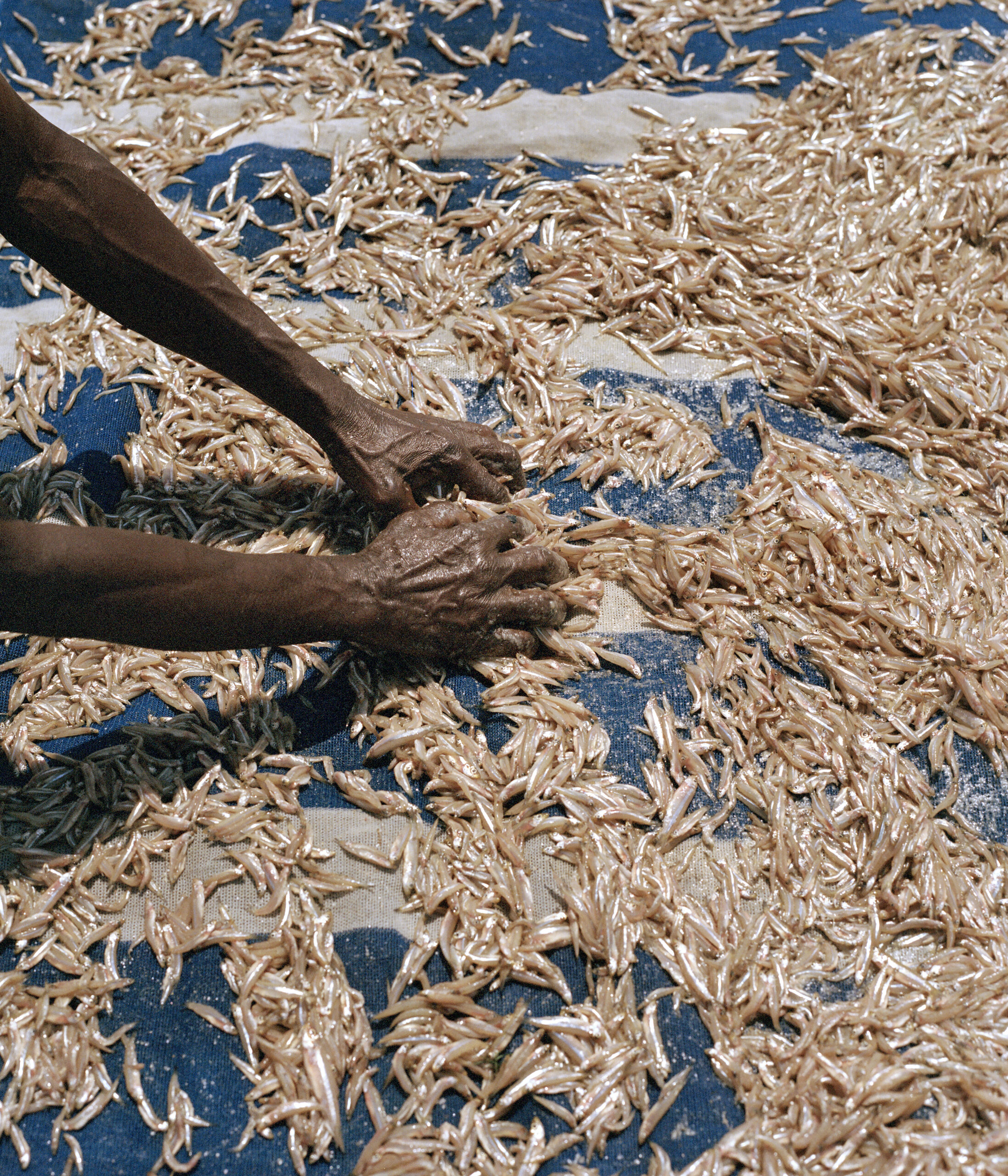
Kapenta: Kapenta or matemba, is a small bait-like fish that was introduced into Lake Kariba in 1967 from Lake Tanganyika where it is called the Tanganyika sardine. They are caught at night on rigs that use LED or kerosene lamps to attract them to the surface where they are then scooped up using a large dip net. The introduced species were able to colonise the whole lake in a very short space of time and subsequently became one of the largest industries on the lake as well as a staple diet for many local Zimbabweans. It is usually dried in the sun on racks or, on a much smaller scale, like here, on reused sacks on the lakeshore. A Kapenta fisherman is one of the hardest jobs on the lake – dangerous weather conditions, minimal facilities, poor safety measures, and long nights on rigs in the middle of the lake. With Kapenta populations now overfished, widely attributed to Zambian regulations relaxing permit restrictions, it is now sadly also an industry in decline, almost an anachronism of the lake itself. © Jono Terry
Mega dams like Kariba are increasingly scrutinised for their ecological and social consequences. What conversations do you hope this exhibition sparks about the future of Kariba and the sustainability of large-scale infrastructural projects?
Before I began this work, I did not understand the long-term effects of mega dams. Through research and community engagement, the issues became clear. I hope the work sparks conversations about reverence, respect, and better community relationships. I also wish for recognition of the promises that remain unfulfilled more than 65 years after Kariba’s construction.
Although the Kariba Dam Wall Rehabilitation Project was completed in 2024, the lake’s future remains precarious. Low water levels, overfishing, and increasing pressure on the lake for survival are significant concerns. I hope the exhibition encourages dialogue with the original custodians of the land and urges more sustainable, forward-looking approaches.

Installation view of ‘They Still Owe Him a Boat’ at The National Gallery of Zimbabwe. © Jono Terry
You call the exhibition a reckoning with your own relationship to Lake Kariba. What has been the most personally transformative or challenging part of creating this body of work?
The seven-year journey has profoundly transformed me. It has shaped my understanding of belonging and my relationship to Zimbabwe. The support from Zimbabweans across different backgrounds has reminded me how important it is that we tell our own stories and have honest conversations about our shared history.
The most challenging part was knowing when to stop. Kariba has been my constant for seven years. Letting go of a project that shaped so many of my relationships is something I am still coming to terms with. My solo show at the National Gallery of Zimbabwe will be a homecoming. It will be the first time the larger body of work is shown in Zimbabwe on a national scale. It feels like an ending of sorts, but also the beginning of something new.
‘They Still Owe Him a Boat’ is on view at the National Gallery of Zimbabwe in Harare until 15 January 2026. For more information, visit the National Gallery of Zimbabwe.
About the Author