Rearming Europe should be top priority to reduce reliance on US, Denmark’s Frederiksen says
We are now getting more quotes from Danish prime minister Mette Frederiksen after her appearance at the Sciences Po university in Paris earlier today.

Asked about Nato secretary general Mark Rutte’s comments about Europe’s ability to defend itself, Frederiksen conceded it would be “extremely difficult” with how things are at the moment, AFP reported.
She said that’s because “when you look at intelligence, nuclear weapons, and so on, we depend on the US.”
But she insisted that “I think we’re able to do more than what is being said publicly right now.”
The Danish PM stressed, however, that rearming Europe should be “the most important thing” for European leaders, adding that 2035 would be “too late” as a target.
Key events
-
Dutch parties strike minority coalition deal three months after D66 election upset
-
‘Work it harder, make it better, do it faster’ to position Europe for new ‘rapidly changing’ world, Denmark’s Frederiksen says
-
Rearming Europe should be top priority to reduce reliance on US, Denmark’s Frederiksen says
-
French former senator found guilty of drugging MP with intent to sexually assault her
-
Hungarian prosecutors charge liberal Budapest mayor over Pride march
-
Kremlin rejects US report suggesting Ukraine invasion has led to 1.2 million Russian casualties
-
Five dead after Russian drone strike on passenger train in Ukraine
-
‘Russia does not want peace with Europe,’ Frederiksen warns, as she urges EU, US unity
-
‘World order as we know it is over’ and not coming back, Denmark’s Frederiksen says
-
EU needs to ‘rapidly’ build its defence ‘independence’ and strengthen European Nato arm, says defence chief
-
‘It cannot be that one country’s veto defines policy for others,’ EU’s Kallas says
-
Nato ‘needs to become more European to maintain strength,’ EU’s Kallas says
-
Morning opening: EU needs to step up or risk its future in this new dangerous world that is emerging, EU’s Kallas warns
Jakub Krupa
I think the outgoing Dutch prime minister, Dick Schoof, will be particularly pleased about the conclusion of the coalition talks, as that means he will still have a few months to prepare for that Sydney Marathon in August that he had signed up for before the election.
He won’t even have to use an alias this time (in 2024, he entered the Amsterdam half marathon as “Peter Jansen”).
Dutch parties strike minority coalition deal three months after D66 election upset

Jon Henley
Europe correspondent
The leaders of three Dutch political parties have agreed a new coalition deal, paving the way for a rare minority government in the Netherlands almost three months after elections that produced an upset victory for the centrist D66 party.
The liberal-progressive, pro-European party, led by the probable new prime minister, Rob Jetten, will join up with the conservative Christian Democrats and the right-wing VVD in a government that holds only 66 seats in the 150-seat lower house.
“We’re incredibly eager to get started,” said Jetten, 38, who will become the country’s youngest ever premier, announcing the accord on Tuesday night. “We’re going to do it as a three-party coalition, but we’d also like to work with other parties.”
The new cabinet should now be formally sworn in by mid-February, but will have to work with opposition parties in the fragmented Dutch parliament to pass legislation. It also lacks a majority in the senate, which can block laws passed by the lower house.
The three parties made the highly unusual choice to govern without a majority after the VVD leader, Dilan Yeşilgöz, refused from the outset to consider including the left-leaning GroenLinks/PvdA alliance, which won 20 seats, describing it as too radical.
‘Work it harder, make it better, do it faster’ to position Europe for new ‘rapidly changing’ world, Denmark’s Frederiksen says
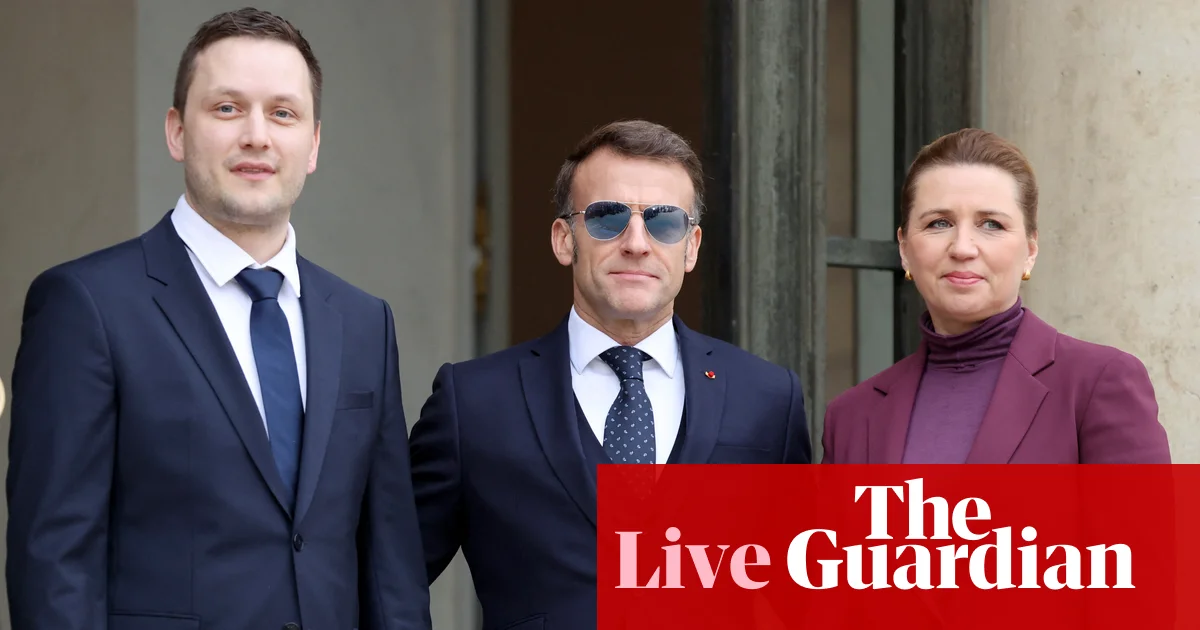
France’s Emmanuel Macron (yes, still wearing his now-iconic sunglasses) has appeared alongside the Danish and Greenlandic prime ministers at the Élysée Palace in Paris to highlight France’s solidarity amid continuing US president Donald Trump’s interest in Greenland.
The three leaders met in Paris as part of the broader push to rally support for Greenland, after meeting with German chancellor Friedrich Merz in Berlin on Tuesday.
Danish prime minister Mette Frederiksen thanked Macron for continuing support, including his last year’s visit to Greenland’s capital Nuuk, and for France’s willingness to get involved in strengthening the Arctic security.
She stressed that “in a situation where the world order, as we have known, it is under pressure, changing rapidly [or] maybe it’s gone, we need a stronger Europe than ever.”
“For me, the way forward is quite clear. It’s up to us, and only up to us Europeans to create a confident and prosperous Europe of tomorrow,” she said.
In pointed remarks, she said that the last few weeks of standoff with Trump showed that “if somebody is threatening us from outside, we will stand up together and we will respond.”
Greenland’s Jens-Frederik Nielsen struck similar tones, saying:
“Our close cooperation in this situation is not only about Greenland. It goes beyond Greenland. For us, this is about the values in the world: our democracy, respect for international law and order, integrity.”
But Frederiksen ended on a slightly lighter note, with a reference to the French electronic music duo Daft Punk’s hit Harder, Better, Faster, Stronger, using it to describe how Europe needs to get stronger and more independent from the US:
“It is a decisive moment for Europe … and it works. … To use the words of one of your most famous music groups: we must work it harder, make it better, do it faster, and make us stronger.”
(Yes, you do want to listen to this song now – even better, the military Bastille Day version from a few years ago, performed in front of no one else but Donald Trump himself.)
Rearming Europe should be top priority to reduce reliance on US, Denmark’s Frederiksen says
We are now getting more quotes from Danish prime minister Mette Frederiksen after her appearance at the Sciences Po university in Paris earlier today.
Asked about Nato secretary general Mark Rutte’s comments about Europe’s ability to defend itself, Frederiksen conceded it would be “extremely difficult” with how things are at the moment, AFP reported.
She said that’s because “when you look at intelligence, nuclear weapons, and so on, we depend on the US.”
But she insisted that “I think we’re able to do more than what is being said publicly right now.”
The Danish PM stressed, however, that rearming Europe should be “the most important thing” for European leaders, adding that 2035 would be “too late” as a target.
French former senator found guilty of drugging MP with intent to sexually assault her

Angelique Chrisafis
in Paris
In other news, a former French senator has been found guilty of drugging a fellow politician in order to sexually assault her, in a case that has shaken French politics.
Joël Guerriau, 68, was sentenced on Tuesday evening to four years in prison of which 18 months must be behind bars. He has appealed against the verdict, which means he will not immediately serve his sentence and instead will face a fresh trial at a later date.
At the time of the drugging, in November 2023, Guerriau was a centrist senator for Loire-Atlantique in the west of France. The politician was found guilty of spiking a glass of champagne with MDMA and serving it to Sandrine Josso, 50, a member of parliament for the centrist MoDem party.
Josso told he court she had had heart palpitations, nausea and struggled to stand upright, but managed to flee his apartment. She said the guilty verdict was a “huge relief”.
The high-profile trial of the former senator comes after Gisèle Pelicot became an international hero in 2024 after waiving her right to anonymity in a trial of dozens of men convicted of raping her after she was drugged by her then husband.
Hungarian prosecutors charge liberal Budapest mayor over Pride march
Elsewhere, Hungarian prosecutors have brought charges against Budapest’s liberal mayor, Gergely Karácsony, over his role in arranging an LGBTQ+ rights rally, and are seeking to impose a fine without holding a trial, Reuters reported.
Tens of thousands of protesters marched through Budapest last June despite a police ban, turning the Pride march into one of the biggest anti-government demonstrations in years against nationalist prime minister Viktor Orbán.
Reuters explained that Karácsony had attempted to circumvent the ban by registering the Pride march as a municipal event, which he argued did not require a permit. Police nevertheless prohibited it, saying it fell under the child-protection law. The march ultimately went ahead peacefully.
Prosecutors allege Karácsony violated the law by organising and leading a banned assembly.
In his response, the mayor said: “I went from being a proud suspect to a proud defendant.”
“Apparently this is the price in this country for standing up for our own and others’ freedom. But if anyone thinks they can stop me from doing this, discourage me, prevent me and my city from doing this, then they are very, very wrong,” he said.
The move comes just months before the closely contested parliamentary election in the country, which could see the end of Orbán’s 16 years in power, as the liberal opposition party Tisza is leading in the polls.
Kremlin rejects US report suggesting Ukraine invasion has led to 1.2 million Russian casualties
Meanwhile, the Kremlin has dismissed a report by a Washington-based thinktank that Russia had suffered nearly 1.2 million casualties since it began its war in Ukraine in February 2022, saying that such reports should not be seen as reliable, Reuters reported.
The report, by the Center for Strategic and International Studies, estimated that at current rates, combined Russian and Ukrainian casualties could reach 2 million by the spring of 2026.
Five dead after Russian drone strike on passenger train in Ukraine
If anyone somehow still had any doubts about Russia’s intentions, its last night’s drone strike against a moving passenger train in Ukraine may have offered some further answers.
At least five people were killed in the attack, local authorities said.
Prosecutors said fragments of five bodies had been found at the scene of the strike on the train, which took place near a village in Ukraine’s Kharkiv region.
The train had been operating from Chop, near Ukraine’s western borders with Hungary and Slovakia, to the town of Barvinkove. Photographs posted online showed at least two carriages ablaze next to a snow-covered rail bed.
“In any country, a drone strike on a civilian train would be considered in exactly the same way – purely as terrorism. There is not and cannot be any military purpose in this,” Ukraine’s Volodymyr Zelenskyy wrote on the Telegram messaging app.
‘Russia does not want peace with Europe,’ Frederiksen warns, as she urges EU, US unity
Speaking with students at SciencesPo, Frederiksen has also warned that “Russia does not want peace with Europe,” as she urged Europe and the US to “stick together.”
Commenting on recent tensions with the US over Greenland, she said that both sides shared concerns on Arctic security, and they “will try to find a way forward with US.”
Greenland’s Nielsen also spoke about the impact the confrontation with the US had on the local population.
“What we are dealing with as a government is trying to push back from outside and handle our people who are afraid and scared,” he said.
I will keep an eye on more lines coming out from that meeting, and the pair is also later expected to meet Emmanuel Macron at the Élysée Palace in Paris.
‘World order as we know it is over’ and not coming back, Denmark’s Frederiksen says
We are also getting first lines from a public event with Denmark’s prime minister Mette Frederiksen and Greenlandic’s prime minister Jens-Frederik Nielsen at Sciences Po university in Paris.
Picking up the theme of the morning so far, Frederiksen has warned that “the world order as we know it is over and I don’t think it will return”.
Ugh. It’s not even 10am.
I will bring you more on this as soon as we have it.
EU needs to ‘rapidly’ build its defence ‘independence’ and strengthen European Nato arm, says defence chief
EU defence commissioner Andrius Kubilius follows Kallas and he strikes very much the same tone of urgency as he outlines the bloc’s defence policies.
He says the EU needs to prepare for diminished US presence in Europe, and rapidly build up its “independence” in defence “without delays” or excuses.
He stresses that “independence” doesn’t mean going alone, but building on what is already there, strengthening the European arm of Nato.
Again, that’s clearly a response to Rutte’s comments earlier this week.
He also says that Europe needs to “develop pan-European capabilities, not only national ones,” as “some gaps are so big they can only be filled together”.
Kubilius also calls for a new European Security Council – an idea first floated by Emmanuel Macron and Angela Merkel in the late-2010s – to enhance political coordination on defence.
‘It cannot be that one country’s veto defines policy for others,’ EU’s Kallas says
Kallas also sent a warning shot to EU countries trying to occasionally obstruct the bloc’s policies, particularly on Russia, saying this must not be tolerated.
“Let’s face it, Europe can be slow. Unanimity means we can not always act at the speed of relevance. Of course, there are policy differences among member states. This is all natural, but unanimity is also used by some as a bargaining tool. And it cannot be that one country’s veto defines the policy for others.”
Yes, she probably means Hungary’s Viktor Orbán in particular.
Expect to see more comments along these lines as we get closer to the high-stakes parliamentary election in the country in April, which could see the end of Orbán’s time in power after 16 years.
Nato ‘needs to become more European to maintain strength,’ EU’s Kallas says
In comments that will likely be seen as a challenge to Nato’s secretary general Mark Rutte and his recent insistence that Europe cannot defend itself without the US (Europe Live, Monday), EU’s Kallas specifically called for more work to be done on te European side of Nato.
“Nato needs to become more European to maintain its strength, and for that Europe must act. For example, we need to ensure that our security and defence initiatives remain complementary to Nato.”
In comments that will likely raise eyebrows at Nato HQ across Brussels, she said:
“For this, the ball is also in Nato’s court. If you want to use EU instruments such as our budgetary and regulatory power to support and enable Nato, we have to know what these needs and targets are. The more information Nato provides, the better we can align here.”
She concluded:
“In short, we need to sync our efforts together with Nato so as to complement each other and to demonstrate how distinct European pillar adds to value through more burden sharing and military strength on our continent.”
Morning opening: EU needs to step up or risk its future in this new dangerous world that is emerging, EU’s Kallas warns
Jakub Krupa
EU foreign policy chief Kaja Kallas has just been speaking at the European Defence Agency’s annual conference this morning, and the picture she painted is pretty bleak.
In summary:
“We need to prepare ourselves for the future. Indeed, the crisis we face has deepened dramatically, during the past year.”
Who could she possibly mean here?
She spoke the continuing impact of Russia’s aggressive behaviour on Ukraine, the growing global uncertainty, but also, yes, the dramatically shifting nature of the EU-US relations that underpinned the transatlantic system over the last eight decades.
Kallas has warned that “Europe needs to adapt to new realities” as it is “no longer Washington’s primary centre of gravity.”
In a stark warning, she said:
“The shift has been ongoing for a while. It is structural, not temporary.
It means that Europe must step up. No great power in history has ever outsourced its survival and survived.”
She raised alarm that “the risk of full-blown return to coercive power, politics, spheres of influence and world where might makes right is very real.”
Kallas says that Europe – and the EU more specifically – needs to respond by raising its defence spending, and getting clarity on what role it wants to play in tomorrow’s world.
Drawing on her personal story, she said:
“When I was a schoolgirl in Estonia, before anyone had mobile phones in their pocket, many schools used the bell system to tell you the time.
The first bell was the signal to go to the class. The second bell was a warning, and the third bell meant that you were late and there would be consequences.
We are now dangerously close to the third bell.”
Gulp. Who needs coffee, eh?
I will bring you more lines from the EU as Kallas and the bloc’s defence commissioner Andrius Kubilius speak at this conference, but also get you all the latest updates from Ukraine, the battle for Greenland’s future, and other key topics of the day.
It’s Wednesday, 28 January 2026, it’s Jakub Krupa here, and this is Europe Live.
Good morning.
About the Author