Scottish star Peter Mullan is not going to the U.S. anytime soon.
“There’s a lot about it that I love, but a lot that has become so ugly and so toxic. I’d never have thought, in a billion years, that we would actively not want to go to America,” he says.
“My son is autistic. He wanted to go to Las Vegas, although that’s my idea of hell, and we had to cancel. I didn’t trust border control not to look into my politics. My terror was they wouldn’t take care of my son, who has cognitive issues. It broke my heart, but he knew we weren’t going because of Trump. I’m not alone in that.”
Mullan, an institution in Scotland, is known for “Braveheart,” “Trainspotting,” “My Name Is Joe” and powerful turns in “Top of the Lake” or “Ozark.” He also directed “The Magdalene Sisters” and scored a BAFTA nom for “I Swear” just a few days ago.
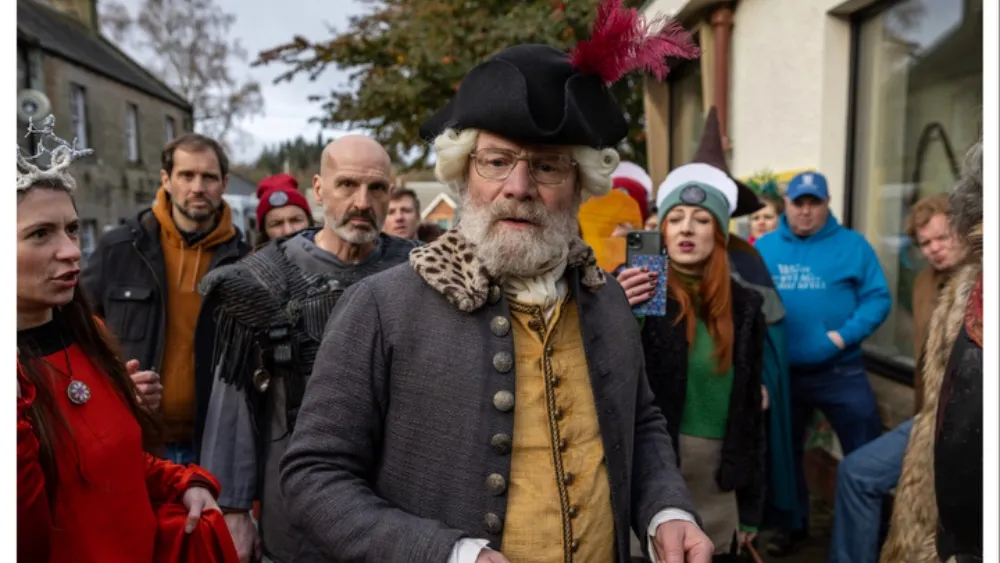
Now, he’s leading Rotterdam festival premiere “The Fall of Sir Douglas Weatherford,” directed by Sean Dunn and being sold by Charades, about an unassuming tour guide Kenneth who becomes obsessed with a historical figure he frequently dresses as. As a popular fantasy series takes over his town, the line between fact and fiction blurs.
The clip debuts exclusively here:
History and truth are very much on Mullan’s mind, too.
“More and more people are less and less interested in what has gone before. There’s a lovely quote from historian E. H. Carr: ‘History is what one generation finds of interest in another.’ Thankfully, we now have a generation that wants to know more about Palestine, slavery and the history of genocide, and how they pertain to Australia, New Zealand and the Americas,” he tells Variety.
“Scottish history is of less interest than it was 20 years ago after ‘Braveheart.’ It has become ‘boring’ again, and that’s what makes a guy like Kenneth tick. Sadly, he then realizes this revered figure was actually a corrupt and compromised colonialist.”
These days, entire countries are being reduced to keywords.
“Ask anyone what they know about Scotland: William Wallace, golf and whiskey. The U.S.? Movies. Trump. Racism. We’re living in a world that reinterprets history with alternate facts. To paraphrase Jack Nicholson, ‘They can’t handle the truth.’ When people look at the horrors of Farage, Meloni, Trump, Orbán and fucking Bolsonaro, and Putin, they’re all rewriting history as we speak. Even history that happened yesterday, because now Alex Pretti is a ‘domestic terrorist.’”
Pretti was fatally shot by federal immigration agents in Minneapolis on Jan. 24.
“The Trump bandwagon will tell you: ‘Don’t believe your own eyes, don’t believe what you see.’ Then what hope do we have of them believing history?” he wonders.
“You’re informed by the people around you. That’s what’s so disgusting about what Trump is doing: he’s trying to turn Americans against Americans. When he says there’s a ‘good immigrant’ and a ‘bad immigrant,’ what he’s really saying is: There’s a white immigrant and a black or brown immigrant. With Renée Good [shot and killed by an Immigration and Customs Enforcement agent] and Pretti, they were hoping to paint him as a radical leftist and that hasn’t quite worked out. But what if he were black? Forget about it.”
So where does Mullan find solace these days? In his own town and his “community of creatives.”
“We are fucked up, but we are, on the whole, a decent bunch. I don’t despair for human kind at the moment, because that would be giving in to these fuckers.”
Dunn, making his feature debut, admires Mullan’s honesty.
“That’s what made him so right for Kenneth. There are no airs with Kenneth. He believes what he says. He’s stubborn. Despite his flaws, he’s completely authentic. There’s something very endearing about that,” he admits.
“Peter is best known for his raw, humane, and naturalistic approach to acting. I first saw him in ‘My Name Is Joe’ and, like everybody else, I was blown away by that performance.”
As Kenneth, Mullan shows a man who’s lost everything: his wife, daughter. His “loneliness is his vulnerability,” says Dunn.
“What he has left is this role. He’s the sole custodian of Weatherford’s legacy and, by extension, his town’s entire identity. That’s not just a job for him. It’s who he is.” But when that role is challenged, things so awry.
“When people stop caring, he becomes untethered. That’s when the loneliness becomes pathological. He has no one to pull him back, so the obsession takes over completely.”
It would be difficult to find actual heroes in “The Fall of Sir Douglas Weatherford.”
“Kenneth isn’t a hero. Weatherford certainly wasn’t one either, even though Kenneth desperately needs him to be. The film is more interested in what happens when you build your entire sense of self around something that turns out to be fiction. Or worse, a lie you’re telling yourself.”
“Should we know our heroes better? Maybe. But I think the real question is: What do we do when we find out they weren’t who we thought they were?”
About the Author