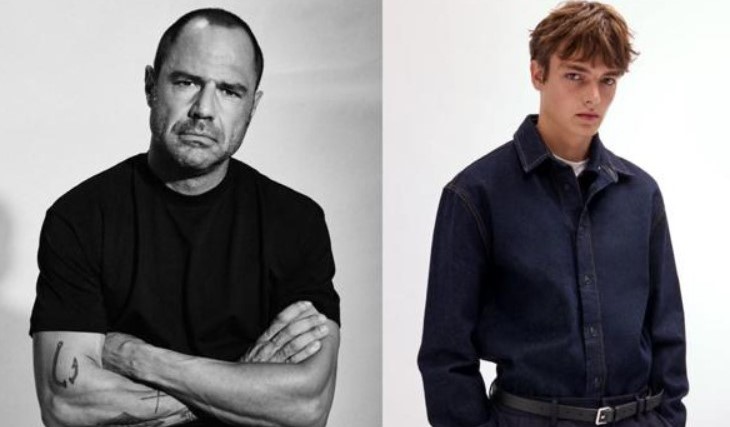
Tommaso Andorlini, long-time fashion insider and CEO of the iconic Florence and New York store and e-commerce Luisa Via Roma, has acquired a controlling stake from Style Capital in the midst of the restructuring process. He has also revised the share structure and is presenting his relaunch plan.
Tommaso Andorlini, now CEO and majority shareholder of LuisaViaRoma, envisions a completely different model: “Less traffic, more quality,” more content, and above all, a strategy that brings the platform back to its historical DNA, made up of discovery, newness, and products that are truly “worth the price.”
The transformation is based on three pillars: brand selection, the launch of premium house brands—four today, ten in 2026—and the creation of a marketplace in collaboration with Camera Buyer Italia. We talked to him about numbers, markets, the role of Andrea Panconesi, former owner and president, the United States, corporate structure, and the new balance of e-commerce, which can no longer function as it has for the past 20 years.
Your plan starts with a radical change in the business model. What is no longer working in the current fashion retail system?
The path has become too long, too expensive, and too poorly aligned with what reaches the end consumer. Between suppliers, brands, distributors, agencies, and multi-brands, a huge amount of value is lost. Above all, the final product often does not live up to its price. For years, the idea that “the more it costs, the better it is” worked in the luxury sector. But today’s wealthy customer is no longer willing to accept this: they are rich, not stupid. We realized too late that the business was not based solely on top clients but also on the aspirational, the “belly” of the pyramid.
So which model needs to be overcome?
The one based on the classic seasonal cycle, on preseason and season, and on a very long value chain. This means we are not competitive with “retail consumers” such as Zara/Inditex, which are no longer fast fashion, but perfect production and distribution machines. We online multi-brands risk being caught in the middle, suffering both from the industry side and the mood of the end consumer.
How do you plan to really reconnect with customers?
With two clear choices: reducing brands and geographies. The idea of selling everything to everyone in every country is dead. It was a huge dispersion of value, specialization, and authenticity: let’s go back to LuisaViaRoma’s DNA, which is discovery, newness, the search for rising stars, and products that you can’t find everywhere.
In addition, we need to radically improve how we present the product: shooting, styling, content. We must evolve from a multi-brand retailer to a media agency. Because with AI, the way we browse and shop will change completely.
Many “big” commercial luxury brands have left LVR. Aren’t you at risk of losing traffic?
It’s true that well-known brands drive traffic. But if that traffic isn’t sustainable or doesn’t convert, what value does it have? And LuisaViaRoma has never lived off reflected glory. Our value has always been to bring brands to Europe that no one else had. Today, we want to work with those who have potential, not those who are too established.
Which brands are really working for your customers today?
There are several, in different segments: brands from the OTB universe, such as Maison Margiela and Jil Sander, are doing well, as are Lemaire, Acne Studios, Sakai, and Tom Ford in the luxury world.
Nike, Arc’teryx, and Satisfy are also strong in sportswear, and Willy Chavarria and Namacheko are among the emerging brands. The pattern is clear: a mix of formal and sneakers, research and wearability. It’s our natural territory.
Let’s talk about house brands, which are perhaps the most innovative part of the plan.
Exactly, they are a strategic pillar for us. I don’t call them private labels: that’s reductive. They are real, well-rounded brands, as Japanese department stores such as Tomorrowland, United Arrows, and Beams have been doing for decades.
Today you have four lines. What are they?
The Core, which, as the name suggests, focuses on the essence of the male wardrobe. Anna Greta, named after Anna Greta Panconesi, Andrea’s daughter. SOTF, the youngest of the brands, with two single-brand stores (Forte dei Marmi and Florence) and 1929, the brand that recalls the year of our foundation: it debuts this week with Cariaggi cashmere knitwear and in June 2026 the total look will arrive. The 1929 brand will play a central role in the development of events related to the centenary.
And what about the other six brands that will bring the total to ten in 2026?
They are already in the pipeline. They will cover pretty much the entire wardrobe: there will be a line dedicated to women’s leather goods and a tailoring line, not to mention the California style lifestyle project and then three other vertical initiatives targeting specific niches. Each brand will be exclusive to LVR. And we will be able to launch them very effectively: we have 6 million customers in our database.
Also, thanks to the focus on house brands, have you reduced the number of brands by 30%?
The percentage is an estimate, but the idea is that: less breadth, more depth. We are moving from a horizontal to a vertical model: more time on each garment, more care in styling, more quality in presentation.
Let’s talk numbers: how many visits do you get today? Some data we have says 700k unique visitors in a month?
Plausible, but data from external tools is never accurate. Our real numbers are: 60-70 million visits/year, with a controlled downsizing target for 2026. We want less traffic, but more qualified traffic. The model is changing, and to change, you have to work on measurable dimensions.
Let’s talk about the corporate structure: what is the current situation?
It’s easy to say, less easy to explain: Panconesi has 50% and 30% of the voting rights. I have the rest, through Holding 1 and Florence: I represent 70% of the voting rights. Panconesi remains chairman of the board of directors, not operational but fundamental as an inspiration. I would like to do in the 2020s what he did in the 1990s.
How is the restructuring process going?
It is energy-consuming, but it was necessary. We aim to complete it in the spring, return to normal operations, and begin the new phase.
What is the turnover for 2024?
At the consolidated group level, we will close between €220 and €230 million.
The third pillar is a marketplace with Camera Buyer Italia. When will it start?
We are well ahead of schedule, with a target date of the end of January. It is a strategic project: part of the LVR platform will become a marketplace for the best Italian boutiques.
The United States has always been a key market for you. What happens after tariffs and de minimis?
What happens is that the US market has shrunk dramatically. American consumers today don’t understand how much they will pay; they are asked for their Social Security Number with every transaction. It has become a continuous customs process. It is pure deglobalization. I do not foresee growth in e-commerce in the US in the coming years, but New York remains open: the store works, the clientele is wonderful, and the location in NoHo is perfect.
The ideal situation would be to have logistics dedicated to the US, perhaps in a local partnership. But we need a sustainable structure: the proliferation of warehouses is one of the reasons why many competitors have exploded.
How are you doing with your inventory?
Very well. When I arrived, we had a huge warehouse; today it is completely normalized in relation to turnover.
What will be the most promising markets for you in the coming years?
Honestly, the world today offers few truly open geographies. North America is in a very complicated situation, Central/South America remains protectionist. In Africa, infrastructure is insufficient. If we think about the Middle East, it works, yes, but this market is dominated by local players.
In Asia, China is still very “closed,” Japan has little e-commerce, and Korea is struggling to recover from the crisis. The truth is that the focus has returned to Southern Europe, where we are strongest. We also remain ready to seize opportunities when they arise. Let’s say that right now, the rule that applies in the world of soccer applies to us: you can’t compete internationally if you don’t win at home first.
READ ALSO:


About the Author