A decisive shift is reordering the market for productivity software: Arabic‑first, AI‑centric design is becoming a must‑have as the Gulf’s user base scales from startups to state entities.
Notion—used by over 100 million people globally and now available in 21 languages—frames the Middle East as “one of our most engaged communities”, according to EMEA GM Mick Hodgins, citing millions of users regionally and hundreds of thousands in the UAE as evidence that the centre of gravity for modern work is tilting toward the GCC.
What’s different about the region isn’t just enthusiasm—it’s operating model. “The difference between ‘busy’ and ‘productive’ is whether decisions, context, and ownership live in one shared workspace that everyone can access and build on,” says Yann Petretti, Notion’s GTM Lead for Startups and Community EMEA. “Because of course, the less fragmentation you have, the more AI can communicate better within your knowledge base and your tools.” That philosophy maps neatly onto the UAE’s push for flexible and remote‑friendly work across government and the private sector, where a single source of truth is becoming the new baseline for collaboration.
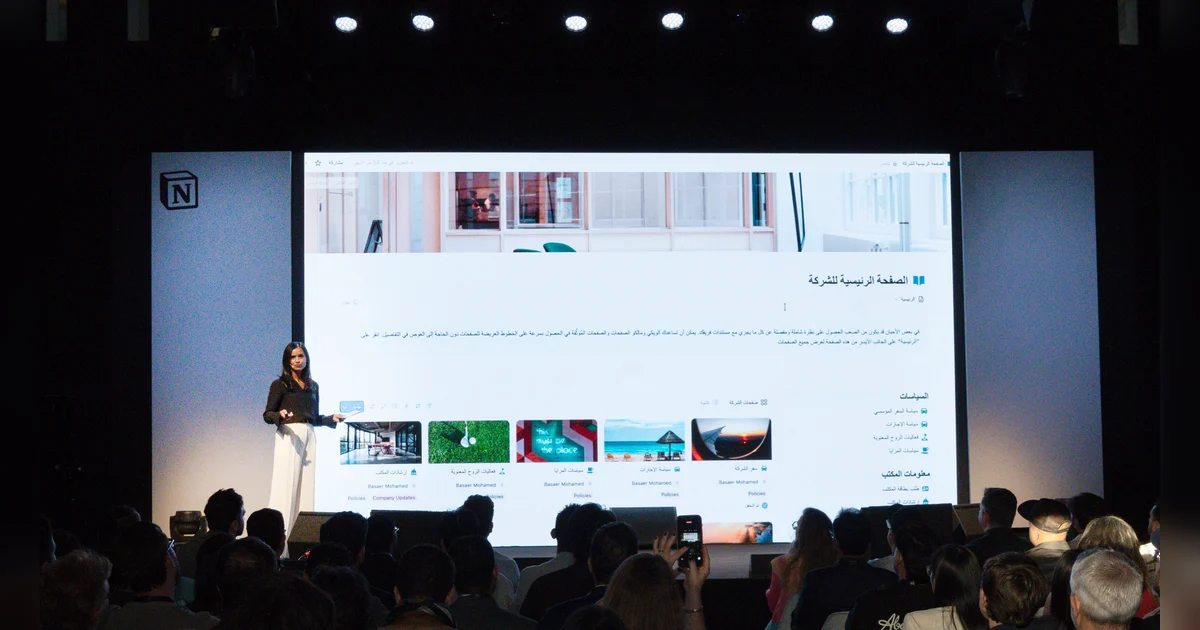
Crucially, localization here isn’t a cosmetic toggle. “Right‑to‑left support is not just a translation within the tool. It has to be a full adaptation of the way people use your tool,” Petretti argues. “It’s not ‘Arabic as a translation layer,’ but Arabic as a primary design principle.” He points to the UAE’s broader Arabic‑first AI momentum—models trained on dialects and culturally grounded content—as proof that the market will reward products designed natively for Arabic, not retrofitted for it. Notion’s move to add Arabic across desktop, mobile, and web reflects that same principle—and underscores why the Middle East is now a proving ground for global SaaS.

Adoption in the GCC is also unusually horizontal. “In more traditional ecosystems, we tend to see adoption transferred progressively from very young startups to enterprises to government,” Petretti says. “Because the UAE has built such a forward‑looking infrastructure and mentality, implementation of AI is way more horizontal than vertical.” Engineering, product, and design teams often lead the charge, but uptake is spreading across sectors—from fintech and deep tech to HR, real estate, and investment—mirroring the cross‑industry panel the company convened in Dubai.
The numbers add commercial weight to the trend. Petretti notes the company’s 80% non‑U.S. user base, cash‑flow positivity, $500 million+ in annual recurring revenue, and a $10 billion valuation, a combination that helps explain why vendors are racing to localize for the Gulf’s growth curve. “We are seeing hundreds of thousands of users in the UAE, and thousands of startups through the Notion for Startups program,” he says, adding that local collaborations—such as with accelerators tied to the Mohammed Bin Rashid Innovation Fund and DIFC’s Ignyte—are part of a push to meet the region where it builds. Those signals line up with the company’s own tally of 1,000+ UAE startups engaged and customers including Emirates Foundation and Emirates Investment Bank.
Community is the accelerant. Beyond shipping Arabic, the firm convened a “Make with Notion Showcase” in Dubai to spotlight founder‑led use cases—what EMEA GM Mick Hodgins calls a “foundation for what comes next” as users co‑create an AI‑ready playbook for work. Petretti’s verdict is blunt: “The UAE is the future. We should move there,” he recalls telling his partner after GITEX—half joke, half thesis for why global platforms are treating the Gulf not as an add‑on market but as a template for how work software will be built next.
If the trajectory holds, expect more vendors to follow suit: Arabic‑first interfaces, right‑to‑left by default, cross‑language collaboration, and AI that reasons over unified knowledge bases—designed in and for the Gulf, then exported to the world.

About the Author