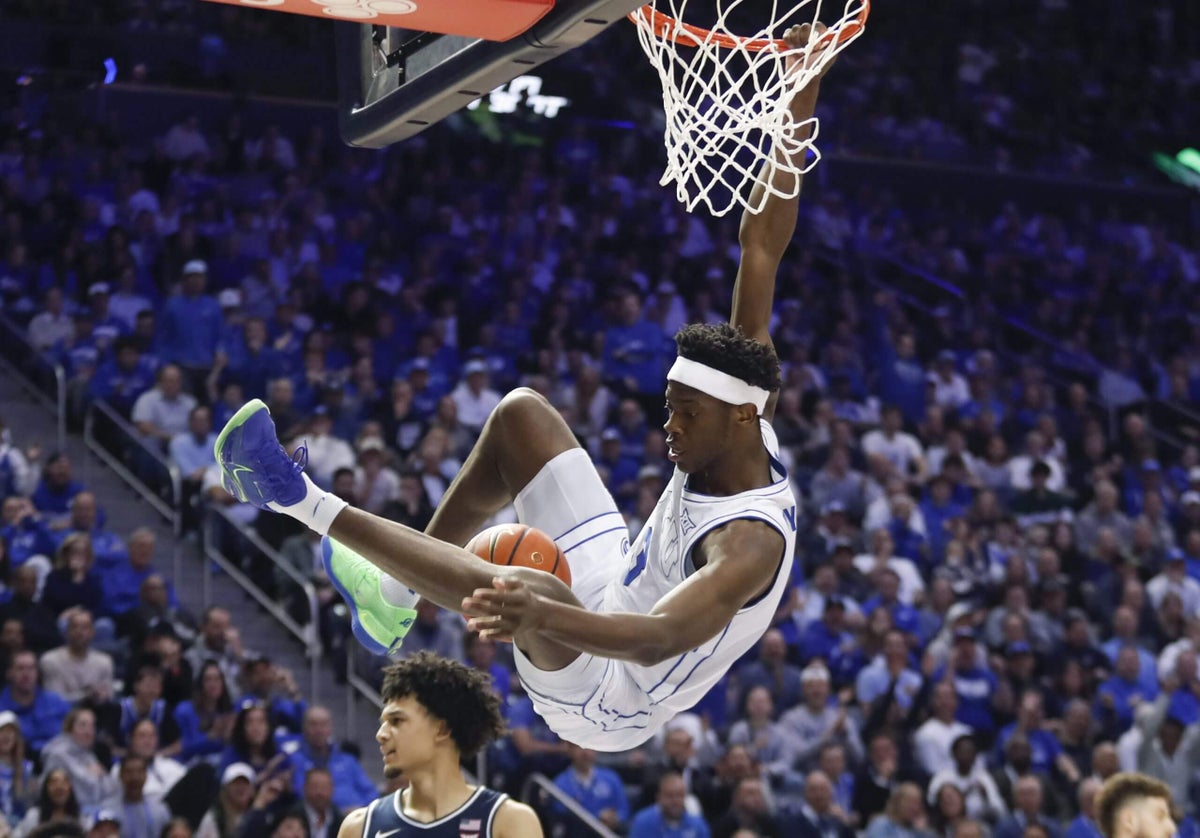
Coming off arguably the greatest college basketball Saturday for freshmen and NBA Draft prospects in the last decade — when three potential top-10 picks scored 40-plus points, two others dropped 30-plus, multiple other potential lottery picks went for over 25 and two other freshman guards had over 20 — it felt like time to give a quick NBA Draft update. What are scouts looking for heading into February? Here are two topics that are starting to bubble up as we get into the meat of conference play, as well as two players who have helped themselves recently with their performances, plus two who have raised some questions.
Do Dybantsa’s Big 12 struggles matter?
BYU’s AJ Dybantsa is going to go in the top three of the draft; that much is certain. His tools are genuinely terrific as a 6-foot-9 wing who can initiate offense and create his own looks seemingly at will. NBA teams still clearly view him as one of the consensus top-two players. There are certainly executives and scouts who prefer Duke’s Cameron Boozer and/or Kansas’ Darryn Peterson, but Dybantsa’s scoring ability at his size with his athleticism is still highly regarded by NBA decision-makers.
His numbers look strong on their face. He’s averaging 23.6 points, 6.7 rebounds and 3.6 assists while shooting 53 percent from the field and 76.2 percent on nearly nine free-throw attempts per game. You can essentially count on one hand the number of high-major freshmen who have done that. Dybantsa been absurdly productive for the 17-3 Cougars.
And yet, there are also clear flaws when Dybantsa takes the court against high-level competition. Overall, he has a true-shooting percentage of 61.5, well above the national average. However, against what KenPom defines as Tier A and B competition, Dybantsa’s true-shooting percentage plummets to a below-average 53.3 percent. His assist rate drops from 21.9 percent overall to 17.4 percent against Tier A and B teams. He’s had great games against good competition, like his monster performance against Clemson when he had 28 points, nine rebounds and six assists. His second half when he dropped 21 points against Connecticut was excellent, too. But his games against Texas Tech and Arizona particularly have raised some eyebrows among scouts.
Against Texas Tech, he only had 13 points and went 6 of 17 from the field. The Red Raiders played in the gaps and made it hard for him to get to the rim. He only went to the foul line once that game. On Monday at home against No. 1 Arizona — a team essentially built to stop him with physical defenders such as Koa Peat and Ivan Kharchenkov, as well as an elite rim protector in Motiejus Krivas — Dybantsa scored 24 points. But he went 6 of 24 from the field and needed to go 11 of 16 from the line to get there.
So what’s going on with Dybantsa against good teams? The tape shows that he has been getting to the rim much less and is being forced to settle in the midrange more. According to CBB Analytics, Dybantsa is taking 26.2 percent of his attempts at the rim in seven Big 12 games, a marked drop from his nonconference mark of 36.4 percent. He’s also taking more shots inside the paint but outside of five feet in conference play, and his shooting percentage on midrange jumpers has drastically declined from nonconference play, as he’s being contested by bigger, longer, stronger defenders.
AJ Dybantsa Shot Distribution
| Non-Conference | Big 12 | |
|---|---|---|
|
% of Attempts |
36.4 |
26.2 |
|
FGA Per 40 |
6.3 |
5.6 |
|
FG% At Rim |
76.6 |
78.8 |
|
% of Attempts |
26.7 |
30.2 |
|
FGA Per 40 |
4.6 |
6.5 |
|
FG% In Paint |
61.7 |
39.5 |
|
% Of Attempts |
18.2 |
18.3 |
|
FGA Per 40 |
3.1 |
3.9 |
|
FG% Midrange |
46.9 |
21.7 |
Dybantsa’s handle is not all that good in a crowd. He struggles to keep his dribble alive when he’s inside the arc, meaning he doesn’t separate as well as you’d want. He often picks up his dribble on his drives to try to gather and get to the rim or to pivot for a jumper. He doesn’t break defenders down often off the bounce. Rather, he relies on his physical tools to out-stride them and either finish around them or over the top of them or draw a foul.
Here’s a prime example against Arizona on Monday. BYU’s offensive architecture and spacing are great here. With Richie Saunders one pass away on his left side, Kharchenkov can’t help off into the gap because of how lethal Saunders is off the catch as a shooter. Because of that spacing advantage, Dybantsa assumes he’ll just get around Tobe Awaka, who uses his chest to body him up while retreating and holding his ground. For people who think Dybantsa will thrive once he reaches the NBA and its wider driving lanes, this is a rep that should at least give some pause:
Teams are playing gap-heavy coverages like the one we see below from Arizona. They’re daring him to pass or shoot midrange jumpers. Here’s a great example in semi-transition, as Dybantsa grabs the rebound and brings the ball up on the empty side of the court. Brayden Burries plays in the gap here for Arizona and stunts to make Dybantsa uncomfortable. All Dybantsa has to do is time Burries’ stunt properly with his ball pick-up and hit the pass up top to Rob Wright for a possible catch-and-shoot 3, but instead he decides to gather into a fadeaway midrange jumper with 22 seconds left on the shot clock:
Dybantsa is making pull-up shots from 7 to 20 feet at a 45 percent clip, per Synergy. That’s a great number for a freshman and showcases serious potential for him to become a true midrange artist as a professional. But the shot above is not a good decision (especially given that Arizona had just started a run). You tell me what’s better: one that averages 0.9 points per possession, or the potential Wright catch-and-shoot 3, which he’s making at a 40.8 percent clip that would result in an expected points-per-possession of 1.22? Even if Wright resets the offense, BYU’s average half-court offensive possession in Big 12 play is averaging 0.95 points per possession, per Synergy. Any way you slice it, that’s not a good enough shot.
The good news is that Dybantsa started seeing the court better in the second half and started kicking out a bit quicker. But all this has resulted in BYU’s offense feeling stagnant. In conference play, BYU’s 48.8 percent assist rate is second-to-last in the league. That’s not just on Dybantsa. Wright, as the lead guard, needs to do a better job of moving the ball, too. But Dybantsa’s desire to dribble into tough shots or drive into crowds in a straight line hasn’t helped. It’s also not ignorable that BYU’s offensive efficiency has plummeted against good teams; of their 11 best performances on offense, 10 came against teams ranked outside of KenPom top 75, and nine came against teams ranked outside of the top 110. They have yet to score at a rate of 110 points per 100 possessions against a Big 12 team that isn’t Arizona State or Utah.
So what does this mean for Dybantsa’s draft stock? It’s absolutely something that has raised some alarm bells, given Dybantsa’s struggles shooting 3s (31.8 percent on the season) as well. Not so many alarm bells as to make anyone question whether he’s worth a top-three pick, of course. But scouts are holding Dybantsa, Boozer and Peterson to a different standard than everyone else. They expect true greatness across the board because of how good they’ve been not just to start this season, but also throughout their prep careers. These issues are enough to at least want to see further growth and development from Dybantsa against high-level competition as the year goes on. His power game is thriving against bad teams like Utah, against whom he dropped 43 points over the weekend, but it isn’t standing up the same way against the big boys because he doesn’t have a way to counter what defenses are showing him.
It’s all gas, no brakes, which leads to mixed results. The good news is that Dybantsa has the horsepower of a Bugatti, and sometimes he can straight-up overpower the opposition. NBA teams will always feel like they can figure out how to work through his passing reads, jump shot and handle when the other tools are this strong. It’s also worth mentioning that big wings can often take a bit longer to figure out their games.
No one I’ve talked to across the league thinks that Dybantsa has anything less than All-NBA upside if he works through some of these skill-based worries. But to ignore them would be doing a disservice to the process, especially when he’s going up against two other guys with legitimate cases to be the No. 1 pick.
Hopefully, Peterson can recover from his ankle injury in time for Saturday’s showdown between BYU and Kansas.
Could NIL thin the depth of this draft?
This is shaping up as a loaded draft class, with big-time freshman producers performing deep into the lottery. North Carolina’s Caleb Wilson, Houston’s Kingston Flemings and Illinois’ Keaton Wagler are all dominating and yet aren’t seen as candidates to go in the top two. Arizona’s Koa Peat is one of the best players on the best team in the country. Darius Acuff Jr. is carrying Arkansas while averaging 20 points and six assists. Washington’s Hannes Steinbach is averaging 18 points and 11 rebounds in his first season in the Big Ten. Tennessee’s Nate Ament has a ton of tools and just put up his best game of the season over the weekend against Alabama, while Arizona’s Brayden Burries (more on him later) is excelling after a slow first five games of the season. Throw in all of the sophomores and upperclassmen who are performing like Michigan’s Yaxel Lendeborg, Iowa State’s Joshua Jefferson, and this upcoming draft has a chance to be a monster.
But the depth of this class could also be affected by the college NIL market. While the upcoming revenue-sharing system and the NIL Go clearinghouse which is supposed to vet player agreements are theoretically going to limit funds for players, most of the high-level programs I’ve spoken with are planning to have access to large budgets to retain their talent. The market for many of the best players who choose return to school is slated to be over $3 million, not dissimilar to the price tag that Texas Tech forward J.T. Toppin received last spring to go back to Lubbock.
That creates an interesting conundrum for players. The 23rd pick in the 2025 NBA Draft, Asa Newell, is making about $3.2 million this season for the Atlanta Hawks. The 30th pick, Yanic Konan Niederhauser, is making $2.7 million for the LA Clippers. And while the 2026 draft looks strong, the 2027 draft is not viewed as having the same level of top-end talent. The 2027 draft pool looks like a below-average class based on the incoming freshmen. So could some surprising players who are projected as first-round picks return to school and try their luck in a weaker 2027 draft class while getting paid big money?
Scouts are particularly watching the point guard class for this reason. There are at least 10 lead or combo guards who are as realistic first-round talents, including Peterson, Flemings, Wagler, Acuff, Louisville’s Mikel Brown Jr., Alabama’s Labaron Philon, Burries, Texas Tech’s Christian Anderson, Iowa’s Bennett Stirtz, and Vanderbilt’s Tyler Tanner. There’s also a terrific senior class of lead guards, including Purdue’s Braden Smith, Iowa State’s Tamin Lipsey, Arizona’s Jaden Bradley, Houston’s Milos Uzan and Ohio State’s Bruce Thornton.
Given how it’s become even harder for smaller guards to get on an NBA court, and given the trade values we’ve seen for even some of the most talented smaller guards in the league such as Trae Young and Ja Morant, it feels unlikely that 10 guards like these would be picked in the first round. It’s not impossible, but it would be tough. In an era when the NBA is trying to go bigger on defense, does it make sense for there to be a massive influx of smaller guards, many of whom — such as Anderson, Stirtz, Tanner, Brown and Acuff — would likely struggle to defend because of their size or other factors?
The center class is another position scouts are watching, with bigs such as UNC’s Henri Veesaar, Houston’s Chris Cenac Jr. and JoJo Tugler, Arizona’s Krivas, Michigan’s Aday Mara and Morez Johnson Jr., Virginia’s Johann Grunloh, Florida’s Rueben Chinyelu and more possessing at least one more year of eligibility. But since the NBA is always on the lookout for talented players with size, it’s possible that more of this kind of player could rise up the board.
The NBA rookie minimum salary is slated at just around $1.4 million next season, so it doesn’t pay to be an early second-round pick compared to what the best college basketball players make. Anyone who doesn’t feel like they have a first-round guarantee will be heavily incentivized to return to school by the time the NCAA eligibility deadline comes around to lock in significant cash versus risk getting drafted into a disadvantageous situation for less money.
That is, uh, assuming the NCAA eligibility deadline still exists by the time May arrives.
Two players who have raised their stock
Brayden Burries, 6-4 freshman guard, Arizona
I had Burries projected as a top-15 player coming into the 2026 NBA Draft cycle, but he struggled so much out of the gate that it looked like he might still be in Tucson as a senior. He averaged 7.8 points in 25 minutes, shooting 33 percent from the field and 29 percent from 3, and didn’t get much penetration into the paint.
But things clicked for Burries in a couple of buy-game matchups against Denver and Norfolk State, and he hasn’t looked back since. In the past 16 games, he’s averaging 17.6 points, 5.3 rebounds and 3.1 assists versus only 1.1 turnovers while shooting 53.8 percent from the field, 39 percent from 3 and 81 percent from the line. He’s taking over games for stretches, such as in the first half against BYU on Monday and in his 28-point masterpiece against Kansas State. Everything has slowed down for him, and it’s clear he’s not pressing anymore.

Brayden Burries has lived up to expectations after a slow start for Arizona. (Aryanna Frank / Imagn Images)
Burries was known as an elite scorer in high school with great footwork and an improved jumper, and all that has come to fruition over Arizona’s undefeated season. But more than that, he’s also aggressively rebounding the ball and seems to make the right decision every time he touches it. He also works hard on defense. He’s the perfect scoring complement to his backcourt mate Bradley and looks like the top-10 recruit that Arizona thought it was getting.
Most NBA people see him as a solid first-rounder somewhere outside of the lottery. If the Wildcats go on the kind of deep run that they look poised to achieve, don’t be surprised if his projection goes even higher.
Keaton Wagler, 6-6 freshman guard, Illinois
Enough has been written about Wagler recently at The Athletic, between C.J. Moore’s outstanding feature last week and John Hollinger’s scout earlier this week. I did a long video on Wagler after his 46-point explosion over the weekend against Purdue:
Broke down Keaton Wagler in-depth over on @GameTheorySamV.
His 46-point game vs. Purdue was the best performance I’ve seen from a draft prospect given the circumstances in at least a few years. He completely dominated the game.
He had answers for everything Purdue presented. pic.twitter.com/ZNII6OfbGB
— Sam Vecenie (@Sam_Vecenie) January 26, 2026
Wagler’s game against Purdue stands among the best I’ve seen from a freshman draft prospect in the last five or so years, largely because of the situation he was thrust into. Here was a first-year player in the notoriously loud Mackey Arena thriving against a top-five team in the country. Yes, you can complain about Purdue choosing to switch all screens for essentially the first 25 minutes of the game, leaving Wagler to toast slower players like Oscar Cluff, Daniel Jacobsen and Trey Kaufman-Renn. But the reality is that he did it without getting sped up, showcasing the sudden moves off the bounce that make him special on the ball despite a lack of strength and traditional explosiveness athletically, and while making seemingly every right decision and drilling nine 3s.
Illinois’ season has completely changed since Brad Underwood decided to move the unheralded recruit on the ball following the Nov. 28 Connecticut game. Since then, the team is 11-1, with Wagler averaging 20.1 points, 4.8 rebounds and 5.3 assists versus only 1.7 turnovers, while shooting 50 percent from the field, 47 percent from 3 and 83.8 percent from the line.
To say that Wagler’s stock has exploded over the last month would be an understatement. When I ranked him No. 11 on my board earlier this month, I got a couple of calls from NBA scouts telling me that they thought that was a bit aggressive. Their tune has changed. Most of the conversations I have now place Wagler in the No. 4 through No. 8 range, firmly entrenched with UNC’s Wilson and Houston’s Flemings as the next prospects to watch outside of the top three.
Two players who have questions to answers
Mikel Brown Jr., 6-5 freshman guard, Louisville
Brown entered the season as one of the players NBA scouts were most excited to track following a monster Under-19 World Cup in which he helped lead Team USA to a gold medal. But as the wheels have fallen off a bit with Louisville, Brown’s injury and return to play have raised some questions.
Considered an elite shooter entering college, Brown is making just 27 percent from 3 so far this year and is coming off his worst game of the year, a 1-of-13 performance in a 30-point blowout loss at Duke. It was Brown’s second game after a back injury held him out of competition for about a month and a half, and after a good start against Virginia Tech over the weekend, the wheels came off.
Teams aren’t as worried about the shooting as the percentages would make you believe. They still believe he’s likely to knock down shots at a high level in the NBA. The flashes of his explosiveness have been there, along with the superb live-dribble passing ability. It’s everything else that scouts have questions about, with Brown’s defense raising the brunt of their ire. Simply put, Brown has been awful on that end this year and doesn’t have much of a track record on defense from previous levels. He consistently got driven during the under-19 World Cup, and before that he was a late bloomer physically who often got overpowered to the rim. Unfortunately for Brown, he’s embodied a lot of what has made this a rough season with Louisville; the Cardinals have felt largely like a lot of perimeter players who aren’t capable of getting their hands dirty, guarding on the perimeter, protecting the rim and rebounding. They’re currently eighth in the ACC in adjusted defensive rating, according to KenPom. They have yet to hold a team ranked in the top 60 under one point per possession and have given up a 115 defensive rating to Kentucky, Arkansas, Virginia, Tennessee, Stanford and Duke.
Brown was seen as close to a surefire top-10 pick in the 2026 NBA Draft when the season began. I still largely get feedback in the back half of that range. But with how loaded the point guard class is, it would behoove Brown to start showing that he cares on defense. The shots are going to fall at some point — even the best shooters go through cold spells that they can’t control. But sitting down and guarding while making the right reads and rotations is something that Brown can control, allowing him to make an impact even in the games when the shot isn’t dropping.
Neoklis Avdalas, 6-8 freshmanwing, Virginia Tech
Remember the over-the-moon excitement regarding Avdalas early in the season, when some projected him as a potential top-10 pick based on beating up a Providence defense currently ranked 202nd nationally and dead last in the Big East during conference play? Well, he has officially come back down to earth. In eight conference games for Virginia Tech, Avdalas is averaging 11 points, five assists and three turnovers while shooting 33 percent from the field and 18 percent from 3. Yikes.
Against real athleticism and length, he’s struggling to get into advantageous spots. Avdalas is taking just 16.8 percent of his shots at the rim and 20.8 percent of his shots from the midrange outside of the paint. It’s never a good sign when the midrange attempt percentage is higher than the rim attempt percentage, especially when a player is averaging under four free-throw attempts per game. Avdalas has played six games against teams currently ranked outside of the top-200 in KenPom’s adjusted defensive efficiency metric. If you remove those games, Avdalas is averaging just 10.4 points. Simply put, he can’t score effectively or efficiently against athletic defenses. He looks like a player who could use another year to keep ironing out his jumper.
The Greek wing has time to turn his season around. Avdalas remains intriguing because of his passing ability at 6-foot-8. He’s a very gifted and skilled player. But until he can consistently knock down 3s, it’s just too difficult for him to bend defenses and take advantage of that skill set. I would bet that he’s an NBA-caliber offensive player if and when the jump shot comes around. Maybe he’ll showcase improvements in the pre-draft process like a player he’s often compared to: Brooklyn Nets rookie Egor Demin. Or maybe it’ll take a couple of years. There’s still plenty of time in this cycle. But for now, I’m not convinced Avdalas is a 2026 prospect.
About the Author