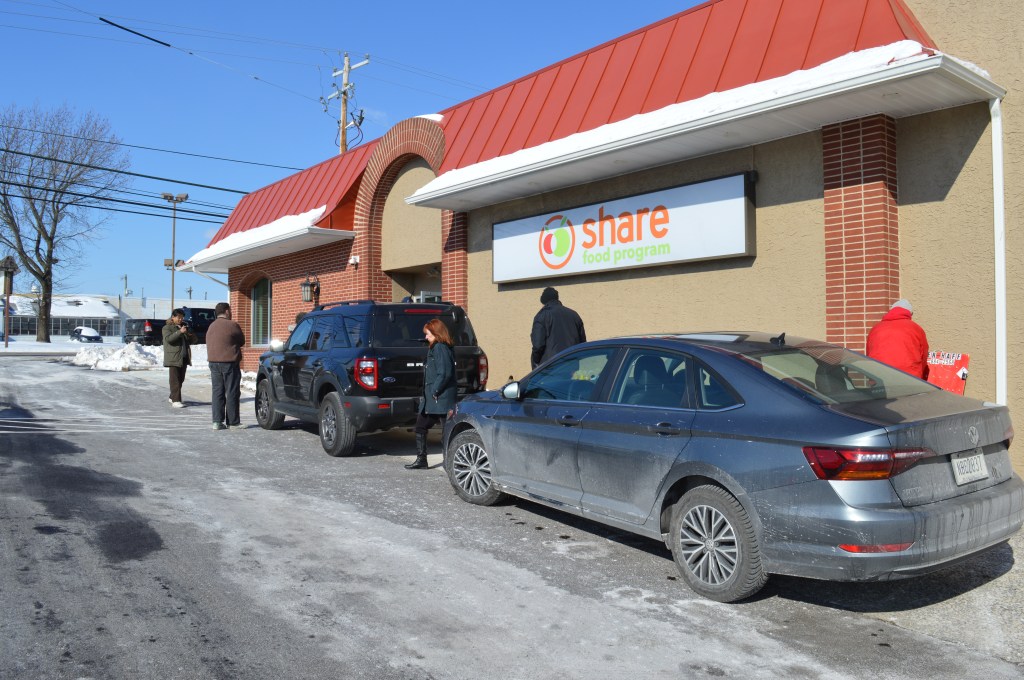
HATFIELD TOWNSHIP – In the ongoing fight against hunger in Montgomery County, elected officials and advocates secured a huge win Thursday, cutting the ribbon on a food storage facility to assist food pantries which serve local communities.
Operated by the Philadelphia-based Share Food Program, the 27,000-square-foot warehouse along North Broad Street in Hatfield can hold thousands of pounds of fresh, frozen and packaged food to help more than 70 area food pantries.
“It’s a huge deal for us,” Share Food Program Executive Director George Matysik said following the Thursday afternoon ribbon cutting ceremony.
Montgomery County designates $500K in food assistance amid shutdown
Matysik stressed “this is a warehouse for all of Montgomery County” and emphasized the importance of having a centralized food bank amid rising costs, resulting in some 85,000 people experiencing food insecurity.
“We want to be able to serve them better, and be able to get more food and more fresh, nutritious food here within the county so that we can solve this problem locally,” Matysik said.
The initiative was years in the making as county commissioners designated millions of federal COVID-19 relief dollars to secure the 1111 N. Broad St. property back in 2022. The Philadelphia-based agency transformed the former Colonial Electric building into a food storage facility with designated office space for a handful of employees focused on operations in the suburban county and partnerships with dozens of area food pantries.
“It gives those pantries so much more capacity because we can store additional product,” Matysik said. “One of the challenges that a lot of our food pantries [have] … is that the storage on site at those locations is somewhat limited.
“If they want to keep additional product, it’s often challenging, because they might only be able to keep a week’s worth of food on site at their locations … if they have this additional location that they could be able to use as a resource, we can store some of their product for them and then ship it out to them as needed.”
Among their partners was the Bethel Community Church of Pottstown’s food pantry. Rev. Dr. Vernon Ross, a senior pastor at the Pottstown-based church, stressed the vital role the agency plays “as a lifeline” to people in western Montgomery County.
“Even during the pandemic and the cut to SNAP, Share [Food Program] was most responsive to our needs and in a very timely fashion,” Ross said. “With the help of Share, our efforts as a pantry have represented hope, dignity and the reassurance that no one in our community has to face hunger alone.”
The ceremonial proceedings marked “a significant turning point” noted Montgomery County Commissioners’ Chairwoman Jamila Winder as officials continue their work to mitigate food insecurity in the state’s second wealthiest county.
Despite the level of affluence in the county, Winder said “we cannot reach our full potential until we meet the basic needs of our friends and neighbors.”
-

Elected officials and advocates applaud as they celebrate the ribbon cutting of a new Share Food Program warehouse on Jan. 29, 2026 in Hatfield Township. (Rachel Ravina – MediaNews Group)


1 of 8
Elected officials and advocates applaud as they celebrate the ribbon cutting of a new Share Food Program warehouse on Jan. 29, 2026 in Hatfield Township. (Rachel Ravina – MediaNews Group)
Montgomery County Commissioner Tom DiBello posed a question to attendees during his remarks as efforts to curb hunger across Montgomery County carry on.
“Wouldn’t it be amazing to see facilities like this have to go away or be able to turn their efforts towards something else?” DiBello said. “That’s … what our goals and our objectives need to be focused on, and everything that we’re doing in Montgomery County is trying to move in that direction.”
“The Share Food warehouse is a transformative upgrade to our food system here in Montgomery County, and it’s a promise,” Winder said. “A promise to our most vulnerable friends and neighbors, families in need, people living with disabilities and our seniors who are living on fixed incomes. No one — I mean, no one — is immune to need.
“We know that we are all just one job loss, one illness, one rent increase away from something unmanageable,” Winder said, adding that “food insecurity is all around us.”
“We cannot be blind to our friends and neighbors who rely on SNAP or on food pantries to make ends meet. They are not invisible,” Winder said.
Food pantries across the county reported an uptick in demand in recent years, particularly during the longest running federal government shutdown that temporarily suspended SNAP payments for 42 million people across the nation.
Commissioners Vice Chairman Neil Makhija stressed the importance of working in bipartisan fashion and maintaining a “commitment to ensuring that no one in our community should go hungry,” and placing the needs of constituents above the “partisan dysfunction” in Harrisburg and Washington, D.C.
“But in spite all of that uncertainty, it’s been our commitment at the local level to create this kind of infrastructure so that no matter what’s happening, we make it possible that those who want to support families and neighbors in our community are able to do that, and going forward, we’ll be able to do that,” Makhija said.
In reaction to the federal government shutdown and months-long state budget impasse, county commissioners designated some $500,000 in emergency food assistance for local pantries on Oct. 31, 2025.
Matysik applauded the “unprecedented” cash infusion from the Montgomery County government to bring this project to fruition.
“When we are seeing so much dysfunction and inaction from Washington,” Matysik said, “it makes my heart feel good to know here in Montgomery County, we don’t play that.”
Matysik expressed his appreciation for a number of elected officials during Thursday’s ceremonial proceedings who backed the creation of the Share Food Program warehouse. Among them was state Rep. Steve Malagari, D-53rd Dist., whose legislative district encompasses the facility in Hatfield Township.
Malagari acknowledged that dozens of people are gathered “here today because an unfortunate truth” of people facing hunger across the country. Around 47.9 million people, or one in seven households in the U.S. in 2024 were considered food insecure, according to findings from the Food Research and Action Center.
Malagari observed “an uptick in folks that just need food” across “every sector.” Access to food, Malagari said, is the “difference between getting by and slipping through the cracks.”
“Today we are one step closer … to eradicating hunger in our community,” he said.
About the Author