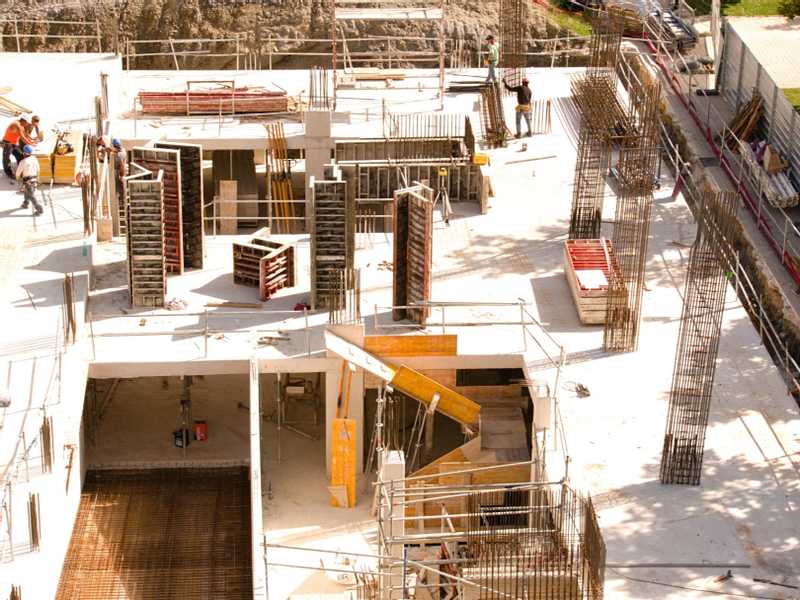
GlobalData, the London-based analytics firm, has projected that Kuwait’s construction sector will record an average annual growth rate of 4.9% between 2026 and 2029, supported by sustained government investment in renewable energy initiatives and transport infrastructure projects.
According to a report by regional project tracker MEED, the Kuwaiti government allocated 1.3 billion dinars (around $4.2 billion) in September 2025 to finance 141 projects under its capital expenditure plan for the 2025–2026 fiscal year.
The allocation covered 162 ongoing projects and 17 new ones. Government data cited by MEED shows that Kuwait had nearly 300 active projects as of September 2025, with a combined value of approximately 35.3 billion dinars ($115 billion), about half of which is tied to major infrastructure developments, reports Al-Qabas daily.
The positive outlook for Kuwait’s construction sector is underpinned by several factors, including flagship projects under the “New Kuwait 2035” vision, a faster pace of project awards, improved corporate credit growth, and a more active real estate market.
Expectations of future interest rate cuts also add to the momentum. Despite a slight reduction in overall capital spending in the current budget, government expenditure on development plan projects rose to 406 million dinars during the first eight months of the 2025–2026 fiscal year, out of the allocated 1.3 billion dinars.
A Pivotal Shift in the Region
At the regional level, amid questions over the future of Gulf mega-projects and mounting pressure from global economic shifts and tighter fiscal policies, debate has intensified over whether the Middle East construction sector is slowing down or redefining its growth path.
MEED notes that the region is not witnessing a contraction, but rather a strategic transition from rapid expansion toward a more disciplined, efficient, and selective growth model. The year 2026 is expected to mark a turning point in planning practices, risk management, technology adoption, and capital allocation.
While concerns over Saudi Arabia’s mega-projects, rising public expenditure, and geopolitical risks may suggest a loss of momentum, MEED stresses that the reality is more nuanced. The region is entering a phase characterized by greater selectivity, increased reliance on digital solutions, and more mature risk management frameworks.
Saudi Arabia stands out as a key example of this transformation, supported by expanding non-oil economic activity, controlled inflation, and unemployment falling to record lows—clear indicators that the reforms under Vision 2030 are beginning to yield tangible results.
Project Activity and Market Dynamics
MEED data shows that the total value of construction contracts awarded across Gulf countries during the first five months of 2025 fell 39% year-on-year to $67 billion, compared to $110 billion in the same period last year. The decline is largely attributed to a temporary slowdown in Saudi mega-project spending and a broader recalibration of expenditure.
However, MEED emphasizes that this does not indicate project cancellations, but rather a rescheduling of spending and an adjustment in execution timelines to reflect revised financial priorities.
Strong Foundations Remain
Despite short-term fluctuations, the report affirms that the fundamentals of the Middle East construction sector remain strong.
Data from Marsh projects Saudi Arabia’s construction market to grow at an average annual rate of 5.4% through 2029, driven by transport, energy, industrial, and housing projects, including infrastructure linked to Expo 2030 Riyadh and the 2034 FIFA World Cup.
The outlook for the UAE also remains positive through 2026, supported by investments in logistics, energy, and commercial real estate. Even amid a global slowdown, the Middle East continues to rank among the world’s fastest-growing construction markets, backed by a substantial pipeline in energy, water, electricity, and transport infrastructure.
Risk Management Takes Center Stage
MEED highlights that the sector’s transformation lies less in scale and more in the quality of risk management. Mercer’s 2026 forecast expects steady global economic growth, partly fueled by AI-driven investments estimated at $500 billion annually, much of which will be directed toward data centers, energy, and network infrastructure.
With inflation in major economies expected to stabilize near central bank targets, cost predictability for materials and financing is improving. The Middle East construction sector is already playing a central role in delivering the digital and energy infrastructure required for this next wave of investment.
Studies cited in the report indicate that 28% of global contractors now view inflation and economic volatility as their primary risk, surpassing concerns over material costs, labor shortages, and supply chain disruptions. Cybersecurity risks are also emerging as a growing concern. In response, companies are tightening bid selection, revising contract structures, and strengthening supply chain due diligence.
Redistribution, Not Retreat
GlobalData figures show that the region’s construction momentum index peaked at 1.01 in June 2025, the highest globally, before declining to 0.77 in July due to slower activity in Saudi Arabia.
In contrast, the UAE’s index rose from 0.91 to 1.13 during the same period.
MEED notes that these shifts reflect a redistribution of activity within the region, rather than an overall decline.
Building for the Future
MEED concludes that the Middle East construction sector is transitioning from a phase focused on speed to one centered on resilience and sustainability.
With easing inflationary pressures, accelerating digital adoption, and renewed insurance capacity, 2026 is set to become a defining year, enabling the region to convert these changes into a lasting competitive advantage and build infrastructure that is better prepared for future challenges.
About the Author