NORFOLK — A federal judge on Tuesday ruled that the Norfolk Police Department’s Flock Safety surveillance program does not constitute an unconstitutional invasion of the privacy of city residents.
U.S. District Judge Mark S. Davis granted summary judgment in favor of the Norfolk police, tossing the lawsuit a couple weeks before a scheduled trial in federal court.
The plaintiffs — two local residents represented by the Institute for Justice law firm — filed a lawsuit in October 2024 contending Norfolk’s warrantless use of its 176 Flock cameras and a related photograph database violate Fourth Amendment protections against unreasonable searches.
But those plaintiffs “were not subject to an unconstitutional search,” Davis concluded in granting Norfolk’s motion to decide the case in its favor before trial.
The residents, Lee Schmidt of Norfolk and Crystal Arrington of Portsmouth, failed to demonstrate that Norfolk’s Flock cameras “capture enough data to reveal the whole or virtual whole of their or other citizens’ movements,” Davis wrote in a 51-page ruling.
“Many of these cameras are, to be sure, located in high traffic areas that capture thousands of vehicles,” Davis said. “But their arrangement does not ‘blanket’ the City” — as cell phone towers did to other cities in similar constitutional challenges.
There are now more than 700 Flock cameras in Hampton Roads.
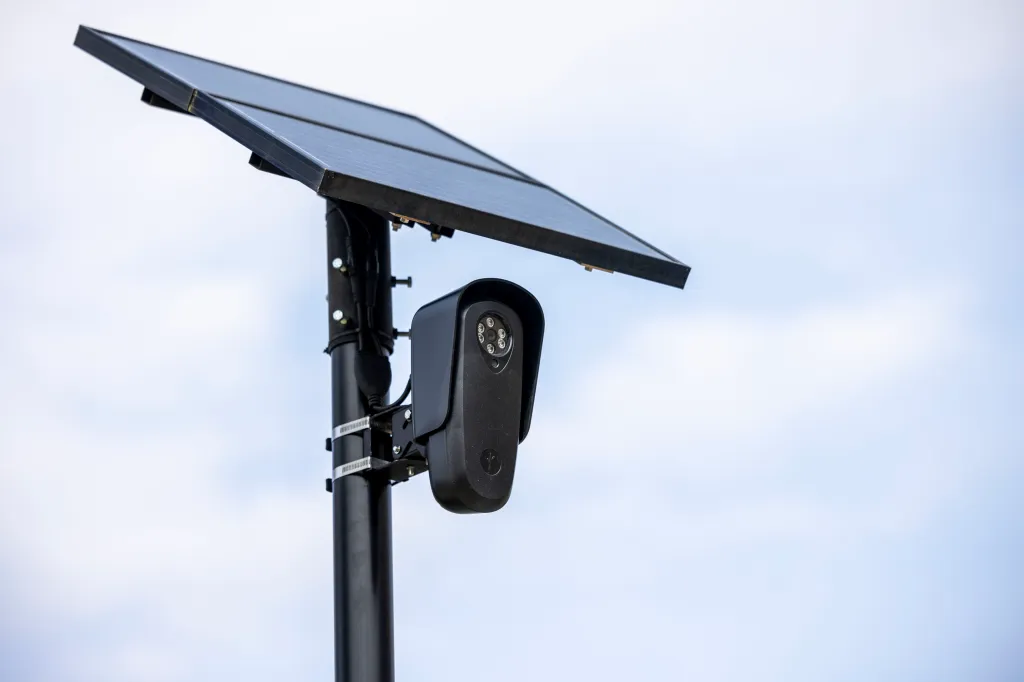
The cameras — typically mounted on 12-foot poles — take pictures of all cars that pass. The system logs license plates, a vehicle’s make, body type and color and such features as bike racks, dents and bumper stickers.
Detectives can query the database to find out which vehicles passed the cameras at certain times and places. The data is stored for 21 days and is widely shared among police agencies.
Flock Safety, based in Atlanta, praised Davis’ ruling Tuesday.

The company said that more than 30 state and federal courts nationwide have now determined that Flock cameras “do not infringe on an individual’s reasonable expectation of privacy, and therefore do not constitute a search under the Fourth Amendment.”
“This decision aligns with strong national precedent,” the company said, noting that nearly all courts have ruled that Flock cameras don’t constitute “continuous tracking.”
But the Institute for Justice, based in Northern Virginia, said it would appeal the ruling to the 4th U.S. Circuit Court of Appeals.
“The government cannot monitor someone’s daily movements without a warrant based on probable cause, which is why we’ll appeal today’s decision,” attorney Michael Soyfer said.
Though Davis’s ruling said the cameras weren’t numerous enough to track the whole of one’s movements, Soyfer noted a statement Norfolk Police Chief Mark Talbot made at a public meeting in 2024: “It would be difficult to drive anywhere of any distance without running into a camera somewhere.”
The law firm also asserted that the cameras are often abused by police nationwide.
“As abuses of these ALPR systems are mounting nationwide, it’s more important than ever to vindicate the people’s right to security from mass surveillance guaranteed by the Fourth Amendment,” Soyfer said.
In his ruling Tuesday, Davis said the plaintiffs had the legal standing to challenge the Flock surveillance system in federal court.

Peter Dujardin, Daily Press
A Flock camera on J. Clyde Morris Boulevard in Newport News captures images of cars heading into York County from the I-64 interchange.
In a test period of only a few months, Davis said, it’s “undisputed” that the plaintiff’s vehicles “were captured and stored” hundreds of times. Over time, he said, the number of times they are photographed will run into the thousands.
Still, Davis ruled, that’s not enough to show a constitutional rights violation.
Higher courts have said that some technologies — such as cell phone location data — are robust enough to track the “whole of one’s movements.” In other words, to pinpoint exactly where they are at any time.
And because people have “a reasonable expectation of privacy” in their movements, law enforcement officers must get search warrants to access such systems.
But Davis said Norfolk’s 176 Flock cameras are “grouped into 75 clusters” rather than scattered widely around the city. They are located at intersections, in commercial areas, and major thoroughfares in and out of the city. Some intersections have four such cameras.
Over 4 1/2 months last year, the plaintiffs’ two cars were photographed 475 and 325 times, respectively. That’s an average of more than three times a day for one plaintiff and 2.5 times a day for the other.
The photographs were taken an average of three miles and 45 minutes apart.
But Davis said that’s not enough to reconstruct someone’s movements.
The Flock system, he said, captures a vehicle “only when it passes one of a limited (though expanding)” number of cameras. Across the city, the system “has many thousands more blind spots than it has unblinking eyes,” Davis said.
“Unlike a cell phone or ankle monitor,” Davis added, Flock cameras “do not follow individuals inside buildings, homes, or anywhere else — they photograph vehicles on the public roadways.”
Flock cameras do provide useful leads for police to find people, he said. But merely because a technology “contributes” to the ability by police to track people, Davis said, doesn’t make it an invasion of privacy.
In fact, Davis said that the more work officers must do to “fill in the gaps” — asking more questions of witnesses, going to a suspect’s home or physically tailing a car on the road — the less a technology is tracking the whole of one’s movements.
Davis noted in his ruling that the Virginia General Assembly has considered the issue, with its decisions helping “to define the public’s expectation of privacy” in the state.
Last year, for example, Virginia lawmakers adopted certain guardrails on Flock cameras, including new auditing and reducing to 21 days from the 30 the amount of time that police could store the photographs.
And Davis held open the possibility that Norfolk could one day have enough Flock Safety cameras to unconstitutionally track people.
He noted that several federal judges have stated that as more and more cameras are added to the streets, “the constitutional balancing could conceivably tip the other way.”
There might come a time, Davis said, when Norfolk’s system might have enough cameras to “cross the line to an impermissible warrantless search” — becoming “too intrusive” and “running afoul” of constitutional privacy protections.
“But when?” Davis asked. “While a definitive answer to that question is elusive, what is readily apparent to this Court is that, at least in Norfolk, Virginia, the answer is: not today.”
Peter Dujardin, 757-897-2062, pdujardin@dailypress.com
About the Author