The Milano Cortina 2026 Olympic Winter Games is set take over Milan’s San Siro Stadium with an epic opening ceremony next week. The Games’ composer and musical director Andrea Farri explains how his soundtrack will set the tone for the opening ceremony and the competition beyond
We began working on the Milano Cortina 2026 Opening Ceremony about a year ago, and from the very start, I felt the scale of what this music has to do. An Opening Ceremony isn’t just a show in a stadium; it speaks to the world. For me, it has to be a tribute to Italy – its values, its imagination, and its future – and music has to sit at the heart of that message. When I started shaping the musical vision, I didn’t want to think in separate ‘numbers’ or isolated cues. My instinct, coming from film, was to treat it as a single story. Like a soundtrack, it needs recurring themes – musical ideas that return, change, and gather meaning as the ceremony progresses. If I succeed, the ceremony will feel powerful, youthful, and moving, with music that doesn’t decorate the images but carries them.

 ©Adobe Stock
On a personal level, contributing to the Olympics as an Italian composer touches something deep in me. Music can reach you immediately, bypassing analysis, going straight to the place where emotion lives. In the soundtracks I’ve written, I’m used to involving the viewer, taking them by the hand and leading them into the storytelling. That instinct doesn’t change here – it becomes more urgent. I have worked on every musical aspect of the ceremony to make everything as seamless as possible, because when the world is watching, any fracture in the musical language becomes a fracture in the story.
“Music can reach you immediately, bypassing analysis, going straight to the place where emotion lives”
 Classical orchestral writing cannot be overlooked in an event of this magnitude. There is a reason the orchestra remains one of our most powerful instruments of collective emotion. But my challenge is not to stop there. I want to work a lot with electronics, analogue synthesisers and drum machines – and mix them with classical and contemporary orchestral elements until they feel like one body. I was born in 1982. My generation grew up studying classical music in the morning, playing rock in the afternoon, and dancing techno in the evening. I grew up in a moment when styles coexisted together, when there were no prejudices – an ideal era for someone like me who has always listened to all genres. So for this ceremony, I’m not interested in choosing between musical styles. I’m interested in building a world where genres naturally coexist.
Balancing Italian heritage with a contemporary language is essential because the Olympics bring together cultures and audiences from everywhere. I prefer the challenge of modernity to the prudence of tradition. Aside from a few references to classical or pop tradition, my idea is for a ceremony that is focused entirely on the future. At the same time, my music has a very Italian taste because it’s always built on melody, a catchy theme – what in ancient times we called an ‘aria’. That melodic instinct is part of who I am, part of where I come from. I think being a composer is an adventurous profession, balanced between styles and eras. I chose to compose by muddying the waters, by mixing disciplines and languages, because that mixture feels honest to the time we live in.
“There is a reason the orchestra remains one of our most powerful instruments of collective emotion”
When it came to working with performers, my process began with the writing. First, I wrote the music, and then we found the performers, orchestras and soloists who could embody it. There will be extraordinary guests – what matters to me is that whoever steps into this score feels like a necessary voice inside the story I’m telling, not an ornament added afterwards.
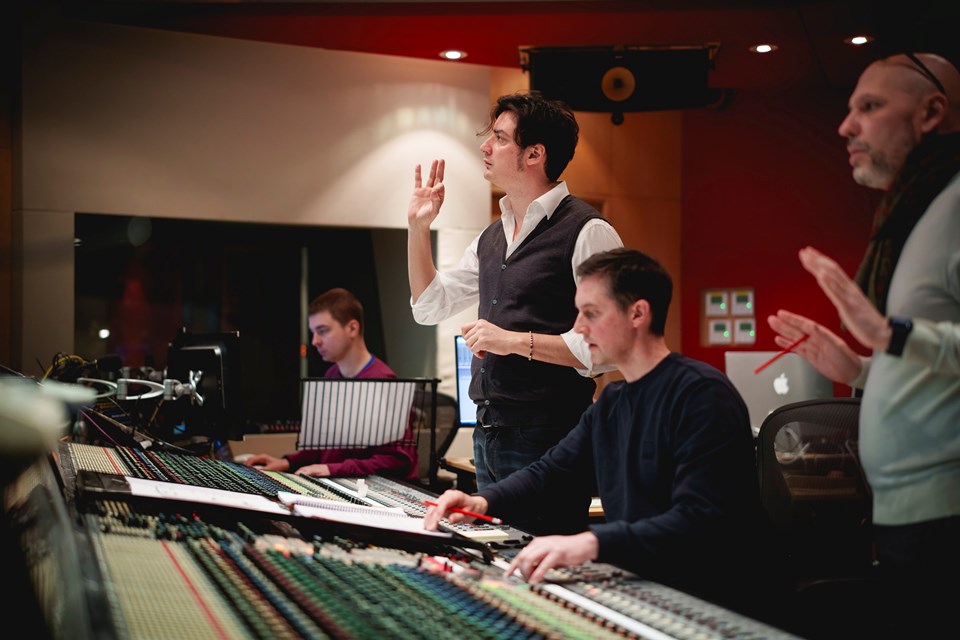
A ceremony of this scale has its own sonic challenges. You often need to combine live performance, pre-recorded elements, and electronic textures, and too often what I hear in ceremonies is that the music becomes blurry, the sound loses focus. My ambition is to create a very cinematic ceremony, with the music front and centre. The different layers will be tied together and balanced according to each moment, but always held inside a single musical identity. I’m working with an amazing team to make that happen, because music of this kind is never a solitary act—it’s a collective discipline, and the discipline is what makes the emotion land.

People sometimes ask about orchestral colour – whether there are specific sections through which I express the Olympic themes. For me, harmony itself is the balance between two forces: melody and dissonance, chaos and order, loud and soft. Like Yin and Yang, they are blended together, and they cannot exist without each other. Courage, for everyone, is unconsciously represented by the horns, and glory by the choir. This is something cinema teaches you: instruments carry memory and symbolism – just as a saxophone will always remind you of Manhattan. And when I think about the Olympic spirit, I think beyond spectacle. The Olympic spirit is a set of ideals – fair play, respect, brotherhood, loyalty – and it carries an ancient Greek tradition of suspending conflicts to allow the Games to take place. That symbolism of peace through sport may seem obvious, but it isn’t, especially in times like today. If music can help that message become felt rather than merely stated, then it has done something important.
“When the world is watching, any fracture in the musical language becomes a fracture in the story”
Being musical director as well as composer changes everything. In a film soundtrack, you often deal with one or two ensembles – an orchestra, an electronic group and maybe a quartet. Here I have to deal with many different groups and soloists, recording on three different continents. That alone tells you what the role entails: constant dialogue, many meetings, careful coordination, and the responsibility of ensuring that everyone speaks the same musical ‘language’. As musical director, I oversee interpretation, not in the sense of controlling every breath, but in the sense of protecting the story—protecting the emotional arc and the sonic identity – so that whatever the audience hears feels intentional, cohesive, and alive.
Storytelling has always been my home. When I was seven, I used to compose at the piano, imagining scores to the stories I read or adventures I invented. At the opening ceremony, music will help the Olympic Games speak to the world. It will be its voice, the spokesperson for its message of sustainability, harmony, and peace. If this Opening Ceremony is remembered as something that moved people, that felt youthful and powerful, that carried Italy forward rather than simply looking back, then the music will have done what I believe music is meant to do: not just accompany history, but help create it.
About the Author