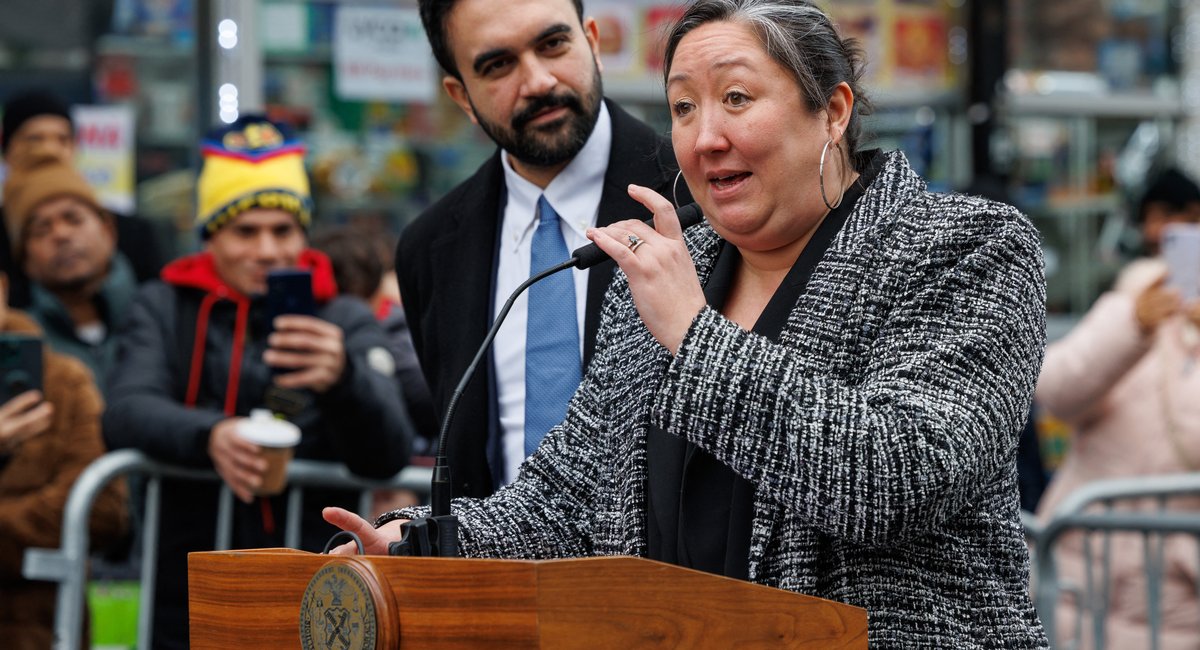
While President Donald Trump has gutted agencies tasked with investigating discrimination complaints, the New York City panel charged with enforcing human rights laws across the five boroughs is poised to get a boost.
Mayor Zohran Mamdani has appointed accomplished civil rights attorney Christine Clarke to lead the city’s Commission on Human Rights, or CCHR, which has long been plagued by understaffing and yearslong delays in investigating discrimination complaints.
Clarke told Gothamist in an interview she would work to speed up investigations, and a City Hall spokesperson said the administration plans to increase commission funding and staffing. No further details were immediately divulged.
“For nearly 82 years … CCHR has done the vital work of protecting human rights in our city, of delivering justice,” Mamdani said at a press conference announcing Clarke’s appointment at Diversity Plaza in Jackson Heights. “And that work has never been more important.”
Here’s what to know about Clarke and the agency she’ll lead:
Who is Clarke?
Clarke comes to City Hall from Legal Services NYC, a nonprofit legal aid group where she served as the chief of litigation and advocacy and previously as director of the group’s Civil Rights Justice Initiative. She has represented low-income New Yorkers in cases involving fair housing, employment discrimination, due process rights and language access issues.
“She has dedicated her life to fighting for working people, from factory workers to small business owners to immigrants planting their roots,” Mamdani said.
At Yale Law School, Clarke was a student editor of the Human Rights and Development Law Journal and a member of the Asian Pacific American Law Students Association. After graduating law school, she worked as a private employment lawyer at Beranbaum Menken LLP, working on behalf of employees suing employers over wage and hour, and anti-discrimination issues. She also worked as an attorney at Reavis Page Jump LLP, providing advice to small businesses on complying with civil rights laws.
She also worked as a lawyer for Planned Parenthood, challenging state abortion bans and working on other cases regarding access to reproductive health care.
“It’s with this life experience and this work experience that I come to this position and with a deeply held belief that New York City is a place where we can finally all belong and all thrive,” Clarke said at the press conference on Wednesday.
What else has Clarke done?
Clarke has sued various city agencies on behalf of low-income and immigrant New Yorkers — and in some cases won policy changes.
She sued the NYPD in 2013 over lack of Spanish-language interpretation for domestic violence victims. In a settlement agreement, the police department agreed to pay thousands in damages and legal fees and promised to bolster their interpretation services for domestic violence victims and train officers about how to approach individuals with limited proficiency in English.
She also won $130,000 in legal fees and damages in her 2015 lawsuit against the city Department of Finance for revoking the rental subsidies of elderly and disabled residents after their spouses or parents died. After the lawsuit was filed, the city also changed its policies that resulted in the residents’ benefits being revoked.
In her most recent role, she was part of a team that helped petition for the dismissal, in multiple courts, of a case brought by landlords to overturn the city’s rent stabilization laws.
Clarke has also previously petitioned the agency she will soon helm. In 2017, she filed a discrimination complaint with the Commission on Human Rights on behalf of a Honduran woman who was allegedly thrown out of a Goodwill in Chelsea for speaking Spanish.
What is the Commission on Human Rights?
The commission is charged with enforcing the city’s human rights law, which broadly prohibits discrimination in housing, employment, and policing based on race, creed, color, age, national origin, gender, sexual orientation, disability, immigration or citizenship status, and several other factors — and which is one of the strongest laws in the country. The law also offers additional protections against discrimination in housing and employment based on one’s criminal record, among other protections.
The commission is tasked with investigating and prosecuting complaints received about alleged violations of the human rights law. It also educates the public on the protections.
How will Clarke lead the commission?
Clarke says she plans to fix the extensive delays in reviewing and investigating discrimination complaints that have plagued the city Commission on Human Rights for years. A December audit by the state comptroller found that the agency allowed some housing discrimination cases to sit for years — sometimes two years or more — without resolution.
A 2023 report by Gothamist found that the agency, beset by a staffing shortage, was prematurely closing some cases without fully investigating allegations. Human rights advocates have said staffing shortages and lack of funding have been a central problem contributing to the delays. The commission’s budget has remained relatively stable in the last few years, hovering around $11 million to $12 million dollars, according to city budget documents. As of January, the commission had 109 employees and 27 vacancies, according to City Council budget documents.
“When it takes that long to come to a conclusion, then New Yorkers lose faith in their ability to actually report these kinds of discrimination to an institution like CCHR,” Mamdani said. “So the imperative that we have as city government is to follow through quicker.”
“As chair, it’s my responsibility to get decisions out faster, which I intend to do immediately,” Clarke said at her appointment announcement.
Clarke said she planned to work with existing agency staff to figure out ways to expedite the investigation process.
“There’s a certain amount of the process that basically comes across the commissioner’s desk, Clarke told Gothamist. “I promise to get the part that’s completely in my control absolutely out the door faster, too.”
Clarke, as chair of the commission, will be responsible for issuing final decisions and orders of the agency’s investigations.
Housing discrimination — including discrimination against renters using housing vouchers, which researchers say is the most common form of housing discrimination — will be a priority, Clarke said. She said she also plans to crack down on repeat-offender landlords and brokers, ensuring there are consequences for repeatedly violating the law.
Clarke said the agency’s “rapid response” team, which contacts landlords to ensure they’re following the law and avoiding a lengthy investigation process, has been “very effective” in helping prevent housing voucher or source-of-income discrimination.
Clark also said that the commission would also reach out to and educate small businesses to ensure they’re aware of the city’s human rights laws.
“We really are making a commitment to helping small businesses comply in advance, rather than letting them get caught up in laws that maybe they don’t understand or that they haven’t really been educated about,” Clarke said.
About the Author