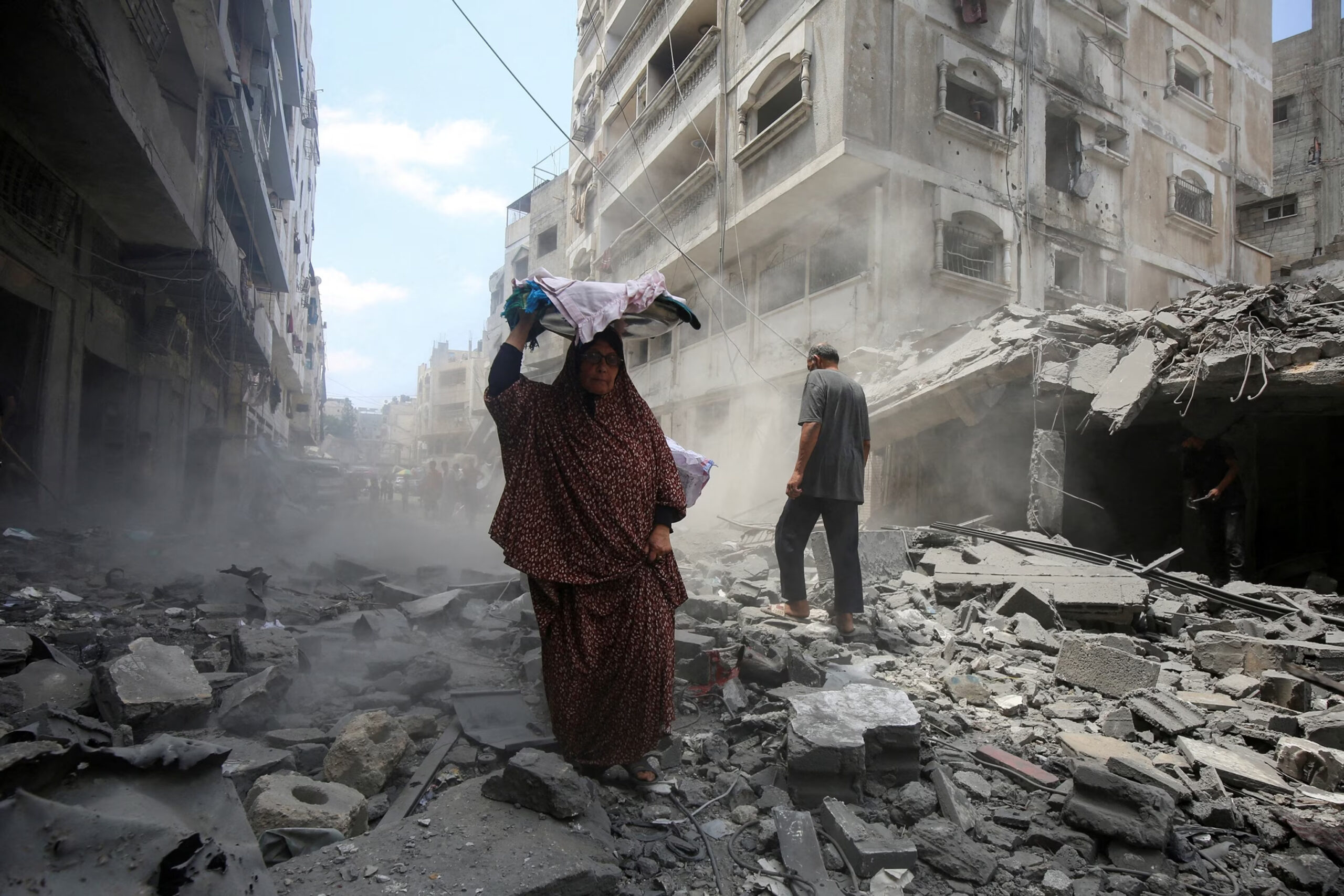
After months of waiting in the Gaza Strip, punctuated by continued Israeli attacks, the persistence of abject conditions in decimated neighborhoods and political wrangling over the future behind closed and distant doors, the United States announced on Wednesday night the “launch” of phase two of the ceasefire that began in October.
The announcement was made by United States President Donald Trump’s special envoy Steve Witkoff, who described phase two as “moving from ceasefire to demilitarization, technocratic governance, and reconstruction,” a continuation of the 20-point plan put forward by Trump and Israeli Prime Minister Benjamin Netanyahu in late September.
Phase one of the plan should have seen the return of all captives – living and dead – held by Hamas since October 7, 2023, the entry of significant quantities of aid through the Rafah crossing, a halt in Israeli hostilities in the strip and a partial withdrawal of Israeli forces to an area representing around 53 percent of the coastal enclave.
While the heinous scale of destruction was cut back and all captives returned excepting the remains of one, many of the other conditions have been partially implemented at best, with Israeli forces clawing back more territory beyond the yellow line – the unilaterally imposed withdrawal boundary marked by yellow-painted cement blocks throughout the strip – and continuing to strike Gaza regularly.
The announcement of phase two, however, brings about much bigger questions about features of the postwar governance plan, including the proposed international stabilization force, an expanded Israeli withdrawal, and Gaza’s governance model.
Wiktoff’s announcement came on the back of a flurry of meetings held in Cairo between representatives of Palestinian factions and Egyptian officials over the course of the past week and still ongoing, according to an Egyptian official briefed on the consultations, to iron out differences that have plagued talks toward the formation of a technocratic committee over recent months.
On Wednesday night, the delegation members issued a statement affirming their support for “mediators’ efforts to form a Palestinian National Transitional Committee to administer the Gaza Strip, while providing the appropriate environment for the committee to immediately assume all tasks/responsibilities in the Gaza Strip to manage daily life and essential services, in cooperation with the Board of Peace and its International Executive Committee, which will oversee the acceptance and implementation of reconstruction efforts in the strip.”
Witkoff similarly referred to the establishment of the “National Committee for the Administration of Gaza (NCAG),” the technocratic Palestinian administration outlined in the initial 20-point US plan.
Phase two, Wiktoff outlined, will see “the full demilitarization and reconstruction of Gaza, primarily the disarmament of all unauthorized personnel.”
But the US envoy did not say who would lead these efforts, nor clarify other points in the proposed post-war governance model that remain theoretical, patchwork or still under discussion, according to several Egyptian officials, Palestinian sources and members of the transitional committee who spoke to Mada Masr in the last week.
Nevertheless, phase two has arrived, by sheer force of US will. “The Gaza Administrative Committee was formed in response to a US request to launch the second phase of Trump’s agreement, even though phase one remains incomplete and challenges on the ground persist, most notably Israel’s unrelenting attacks on Gaza,” the Egyptian official close to the talks said.
“Honestly, no one agrees with the whole operation, including the Israelis,” the official continued. “But everyone followed the Egyptian proverb: ‘Tie the donkey where its owner wants.’”
***
The National Committee for the Administration of Gaza is one arm of a tripartite political structure that makes up the umbrella Gaza International Transitional Authority (GITA), the governing structure for the postwar strip outlined in a leaked document shortly before the ceasefire came into effect.
In that document, the NCAG is referred to as the “Palestinian Executive Authority,” and is described as the “service delivery arm” of the GITA.
Above the board sits the GITA International Board, or in Trump’s phrasing, the Board of Peace, led by the chairman or “senior political executive” and holding sole authority to issue binding decisions, approve legislation and major appointments and provide strategic direction — effectively commanding the strip.
The board will have direct oversight over several other supra-Palestinian bodies. The first is the Executive Secretariat, up to 25 people who report directly to the chairman, five of whom will serve as “commissioners” providing oversight, coordination and regulation across five governance domains: humanitarian supervision, reconstruction, legislative and legal supervision, security oversight, PA coordination supervision, and security.
This Executive Secretariat will preside over the “CEO” of the NCAG, the transitional committee mentioned by Witkoff and the Palestinian delegations on Wednesday night. The committee itself, at the bottom of the chain of command, will oversee a series of technocratic ministries. All nominations for technocratic ministries will be submitted by the CEO to the GITA International Board, which will have sole discretion over appointments and dismissals.

Former British Prime Minister Tony Blair, a chief architect of the plan alongside Trump’s son-in-law Jared Kushner, was widely expected to be appointed the head of the Board of Peace. But instead, following significant criticism of Blair’s involvement in the US-led invasion and occupation of Iraq, Nickolay Mladenov, a veteran Bulgarian and UN diplomat, has since taken his place.
Consultations over the Palestinian technical committee have played out in at least three consultative groups. The first has seen Egyptian officials sit down with Palestinian factions in Cairo. In the second, Egyptian officials have held talks with Israeli officials. And finally, there is the tight-knit group of architects of the whole plan which includes Trump, his son-in-law Kushner, Witkoff, Mladenov, and key Israeli officials.
It was Egypt, however, that took the first steps.
Almost as soon as the US 20-point plan was announced, Egypt began holding talks about how the border between Egypt and the Gaza Strip would be managed, internal security in the Gaza Strip and the strip’s civil governance.
At the conclusion of a first round of talks, Egyptian sources told Mada Masr that the two sides had reached initial understandings.
However, these quickly devolved into bitter disagreements between the Palestinian political rivals who have gone through successive rounds of political talks toward reconciliation in the last decade.
“At the last meeting between Egyptian intelligence and delegations from Fatah and Hamas [in early October], we agreed to the Egyptian proposal. We stipulated that any member of the committee must be from Gaza and must not have left during the war, and we agreed on that. Fatah agreed to the idea, but said that the committee should derive its authority from the PA. We said, as Hamas, we had no objection, but that the committee chair must be from the Gaza Strip and not be affiliated with any faction,” a Hamas source informed of the talks told Mada Masr at the time.
“The PA delegation gave its preliminary approval, which seems to have been merely a courtesy to the Egyptian leadership. Then, they launched a smear campaign against the committee chair we proposed, Amjad al-Shawa, and leaked his name to the media despite the agreement that it would not be announced. They launched an unofficial campaign against him and started saying, ‘We’re proposing [Health Minister] Maged Abu Ramadan,’ which violated the condition we had set that no one from outside the Gaza Strip could be appointed.”
Those disputes continued up until this week. The Palestinian Authority still rejects the formation of the technocratic committee and has reservations about the proposed names, two Fatah sources told Mada Masr earlier this week. The PA, they added, wants the committee to be directly under the authority of Prime Minister Mohamed Mostafa’s government in Ramallah.
Multiple Egyptian officials, however, said that Israel has so far refused any situation where the committee would be under PA leadership.
While none of the committee members have been officially announced, perhaps over continued disagreement about the names, differing lists of names have circulated among mediators.
Mada Masr contacted several of the proposed committee members to ask if they had received notification of their appointment. Three committee members named on lists obtained by Mada Masr confirmed that they had been contacted to inform them of their appointment but were told not to speak about the process in the media per American instructions.
Ali Shaath, a former deputy planning minister who has been presented as the head of the committee, appeared on a radio show in the West Bank speaking about his appointment on Wednesday.
One of the newly appointed technocratic committee members told Mada Masr that, to their knowledge, the selection process for committee members did not involve consultation with the nominees before their names were selected.
The member said they were contacted and informed that they had been nominated to join the committee without preamble or prior notice. They believed the same is true for the other members.
They said they were contacted by staff from Mladenov’s office management and notified of their appointment and were asked to prepare for a consultative meeting in Cairo soon.
So far, they have only been informed that the committee’s work will be limited to reconstruction and essential public services, and will have no decision-making power whatsoever.
As for their role in the committee, they said they were not given any further details and that they could not comment ahead of the upcoming meeting.
Another committee source, speaking on condition of anonymity, said the prohibition on speaking to the press was recommended by the US administration until it officially announces the committee.
The committee has not yet been fully approved, with several nominees declining to participate until the PA approves their appointment, the source added.
A number of portfolios the committee will manage, including whether it will have any role in security, remain unresolved, they said.
The source also confirmed that a meeting will be held soon in Cairo to discuss arrangements for the next phase and how Gaza will be governed. There is communication with Israel to facilitate travel for committee members in the strip.
With the final list of names unresolved, the larger concern pertains to their mandate, according to a second Egyptian official close to the consultations.
“The trouble is with the powers of the committee. They need to have the right to be and to act,” the official said, explaining that their role will be strictly limited to civilian administration.
“The first step is that they have to work on distributing sufficient aid material once it gets into Gaza. The next step is to provide decent shelters over the heads of people. We have a disaster there now. And then we will have to have some sort of civil police,” the official told Mada Masr.
The first Egyptian official close to the negotiations agreed, saying “the committee’s remit is strictly administrative, focusing on receiving and facilitating access to aid and distributing it to Gaza’s people, as well as providing services, which is contingent on the level, scale and seriousness of international support.”
In his interview with a West Bank radio station, Shaath voiced a similar line, saying that the focus will be on providing urgent relief for Gaza, including the provision of housing for displaced Palestinians, many of whom are living in makeshift tent shelters amid the rubble.
“If I bring bulldozers and push the rubble into the sea, and make new islands, new land, I can win new land for Gaza and at the same time clear the rubble. This won’t take more than three years,” Shaath said.
He also added that the committee’s mandate “begins with approximately 50 percent of the Gaza Strip, which lies outside the ‘yellow line’ and expands with the gradual Israeli withdrawal in the second phase of the ceasefire agreement to the eastern border of the Gaza Strip.”
Shaath indicated that the committee’s funding “is Arab and international, located in a special reconstruction fund at the World Bank and under its supervision.”
He added that armed groups in the Gaza Strip “fall outside the committee’s jurisdiction and are the responsibility of the UN-supervised international stabilization force” and state that “the committee has no involvement in political or military matters, including the possibility of ceasefire violations, which are the purview of the Peace Council.”
But two core issues remain, according to Egyptian and Palestinian sources.
The first is security in general.
“Security in the strip is a sticking point,” an Egyptian state official said. “Israel doesn’t want to allow this committee to be in charge of this part of Gaza exclusively because this would mean Israel will agree in theory that it shouldn’t be conducting any military attacks.”
Egypt has been training hundreds of Palestinians affiliated with the PA to be part of a force of up to 10,000 to provide security for the Gaza Strip in recent months.
However, Israel has so far waylaid any deployment and Hamas has led a violent security crackdown on rival groups contesting its monopoly on power since the ceasefire went into effect.
Without a realistic security arm, and as the composition and mandate of the GITA-affiliated International Stabilization Force remains in limbo, the NCAG faces an uphill battle to get situated in Gaza.
A PA source told Mada Masr that despite Israel’s rejection of the PA’s role in security, there are behind the scene conversations happening through Mladenov’s office. The proposal under discussion, according to the source, is that the transitional committee will be provided security personnel affiliated with the PA, who will operate out of offices across Gaza’s governorates.
Israel currently objects to the PA’s role in the committee’s work and is seeking to impose conditions before granting approval, including integrating members of Israel-backed armed groups operating inside the yellow line into the security cadres that would report to the committee — something the PA rejects, the source noted.
Moreover, according to a former Egyptian official close to negotiations, Israel will not consent to a diminishment of its freedom of military movement in Gaza. “Its hands are not tied at all, and this will not change with or without the committee,” the official said.
For Egypt and those in the strip in desperate need, the renewed operation of the Rafah crossing in both directions is also paramount for the committee to begin its work.
“After Netanyahu’s visit with Trump [in late December], we were told by the Americans that they had told the Israelis that the crossing needs to be operated. But the problem is that because the Israelis do not want the committee to be in charge of security and Egypt does not want to allow the crossing to operate without a Palestinian presence on the other side, things are stuck,” the Egyptian state official said.
Despite calls for the delivery of materials for the provision of permanent, weather-proof shelter to around 800,000 Palestinians currently housed in makeshift coastal camps, humanitarian organizations said in mid-December that Israel had blocked the delivery of all but around 50,000 tents.
As the weather has worsened over recent weeks with gale-force winds and floods affecting an estimated 50,000 households, organizations have redoubled calls for the provision of more permanent housing.
***
None of the four Egyptian officials informed of the negotiations expect the NCAG to begin work soon or even have much success in its limited mandate.
“There are many reservations over the manner, timing and choice of committee members, particularly since the US oversaw and pushed the process to reach this point,” the first Egyptian official close to the talks said. “Despite US statements, the committee will not start work immediately, due to the complexities on the ground and Israel’s intransigence, and disputes over the committee’s affiliation and proximity to political actors.”
Egypt has tried to overcome the hurdles on the ground by offering temporary offices for the committee in Arish, whether at the airport, port or other sites, in addition to operating the Rafah crossing, to facilitate its work, according to the source.
“Egypt will also prepare and construct administrative facilities for the proposed committee inside the Gaza Strip once it begins operating on the ground there, and will offer all forms of support, including logistics, to ensure the committee succeeds,” they added.
But pessimism is still pervasive.
According to two of the officials, even when the committee members do take up work, they will be doing so on a temporary basis.
“The committee’s composition will be reviewed after three months, when it is expected that its performance will be assessed by the international Board of Peace that Trump may announce during his participation in the World Economic Forum in Davos next week,” the first official added. “A reshuffle remains a very real possibility.”
While the details are still being ironed out, phase two must roll on, even in its barely fleshed-out version, because “if we don’t talk about phase two,” the Egyptian state official told Mada Masr, “then we will be talking about the collapse of the ceasefire.”
About the Author