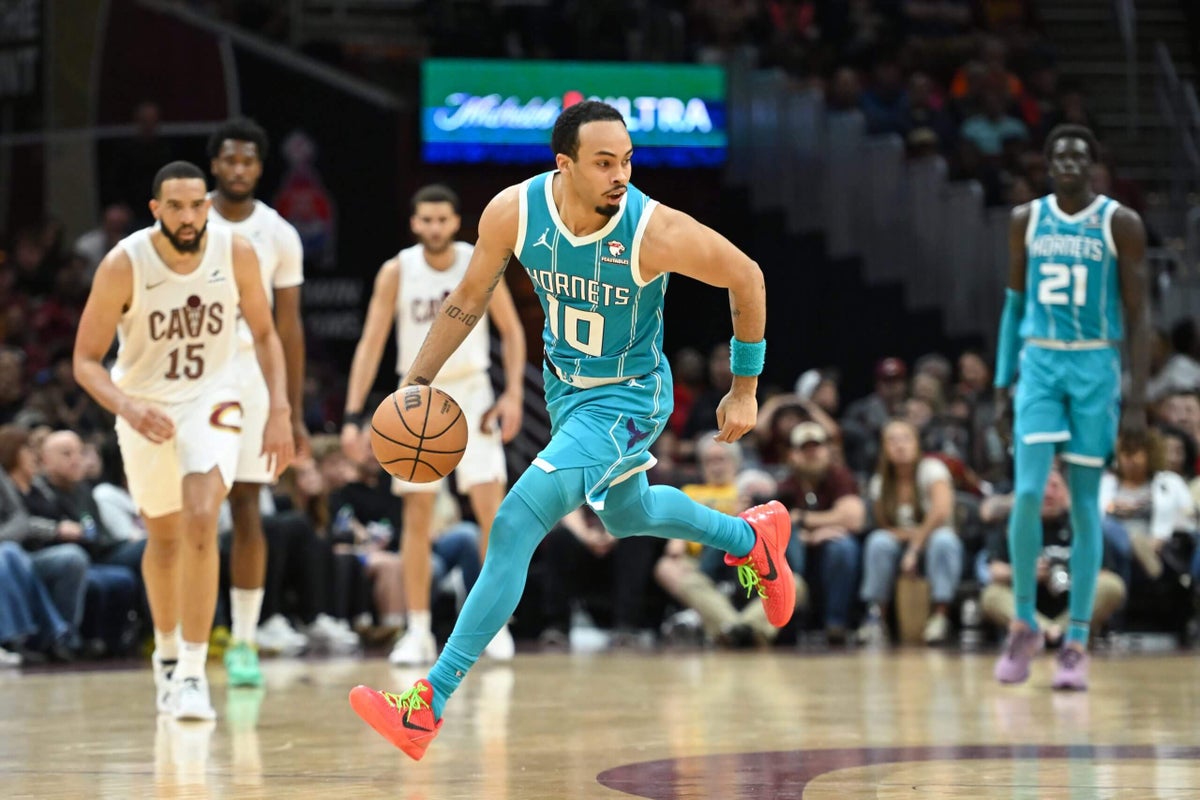
Former UCLA guard Amari Bailey, who played 10 games in the NBA as a member of the Charlotte Hornets, wants to be the first NBA player to make a college basketball return.
Bailey’s attorney, Elliot Abrams, confirmed to The Athletic on Friday that Bailey will pursue a return to college. ESPN first reported the news.
Bailey entered the 2023 NBA Draft after one year at UCLA, and Charlotte picked up the junior in the second round. He spent most of his rookie year in the G League with the Greensboro Swarm on a two-way deal. Bailey went on to sign with the Brooklyn Nets in 2024, but the team waived him a week before the season began, sending him back to the G League. The 21-year-old logged 6.5 minutes on an NBA court and averaged 2.3 points per game.
“Right now I’d be a senior in college,” Bailey told ESPN. “I’m not trying to be 27 years old playing college athletics. No shade to the guys that do; that’s their journey. But I went to go play professionally and learned a lot, went through a lot. So, like, why not me?”
Any college team interested in adding Bailey would need an NCAA waiver for him to play. If the NCAA denies his eligibility request, Bailey and his attorney could sue if his NCAA bid fails. He wouldn’t be the first to do so, and Abrams has experience navigating the process. Abrams represented former North Carolina wide receiver Tez Walker in his successful petition to restore his NCAA eligibility in 2023, and he was involved in the Ohio v. NCAA lawsuit that allowed multi-time transfers to play for new schools without having to sit out a season.
“In what world can a group of colleges get together to prevent a college-aged kid from returning to college simply because he signed a contract with a particular employer? The NCAA preventing Amari from returning would be all the more absurd now that the NCAA welcomes European professional athletes with open arms,” Abrams said. “In my view, our constitution and laws don’t allow entities to discriminate against American kids — and denying Amari eligibility would be exactly that.”
Bailey started 28 games in his lone season at UCLA, averaging 11.2 points and 2.2 assists per game. He averaged 16.7 points and 4.0 assists during the 2023 men’s NCAA Tournament, where the Bruins reached the Sweet 16.
Tim Buckley, the NCAA’s senior vice president for external affairs, reacted to Bailey’s announcement on X by calling on Congress: “The NCAA has not and will not grant eligibility to any players who have signed an NBA contract. Congress can strengthen NCAA rules so professional athletes cannot sue their way back to competing against college students.”
Issues about eligibility have percolated recently. In December, Nigerian forward James Nnaji — the 31st pick in the 2023 NBA Draft — was granted four years of eligibility by the NCAA and subsequently signed with Baylor. In doing so, Nnaji became the first-ever NBA draftee to play college basketball after he debuted in January, coming off the bench in a loss to TCU.
The NCAA gave two reasons for clearing Nnaji: The 7-footer had never signed an NBA (or two-way) contract, meaning he’d only ever played in the G League. And Nnaji had never played college basketball before, as he was drafted to the NBA straight from the Spanish ACB league. The NCAA ruled he didn’t violate its longtime early entry protocol, which states that players who declare for and stay in the NBA Draft past a certain deadline do so while acknowledging they are forfeiting the remainder of their college eligibility.
NCAA president Charlie Baker said in a statement after the Nnaji signing that “the NCAA has not and will not grant eligibility to any prospective or returning student-athletes who have signed an NBA contract (including a two-way contract).”

James Nnaji has made seven appearances for Baylor, averaging 11.3 minutes and 1.4 points per game. (Scott Wachter / Getty)
That has been tested almost immediately.
Former Alabama forward Charles Bediako — who last suited up for the Crimson Tide in 2023 before declaring early for the NBA Draft and going unselected — attempted to join this season’s roster earlier in January. Unlike Nnaji, Bediako previously signed an NBA two-way contract. The NCAA denied Bediako’s initial request for eligibility.
One day after Bediako filed a lawsuit against the NCAA, an Alabama judge, who was also a six-figure Crimson Tide donor, granted Bediako a temporary restraining order that allowed him to return to Nate Oats’ program. He made his season debut against Tennessee on Saturday, scoring 13 points in Alabama’s six-point loss to the Volunteers.
On Monday, the judge who granted Bediako’s initial restraining order, James H. Roberts Jr., extended it for another 10 days because inclement weather was likely to postpone Bediako’s injunction hearing originally scheduled for Tuesday.
That allows Bediako to play against Florida on Sunday and next week against Texas A&M, both pivotal SEC games, before the rescheduled hearing on Friday, Feb. 6.
On Wednesday, the Tuscaloosa County Circuit Court approved the NCAA’s request that Roberts recuse himself from Bediako’s case, citing the “impermissible appearance of impropriety.”
The new judge in Bediako’s case, Daniel Pruet, is also an Alabama graduate and is the judge in the murder trial involving former Crimson Tide basketball player (and Bediako teammate) Darius Miles. The defense team in the Miles case previously requested that Pruet recuse himself, but he declined to do so.
Bailey, then, would be the next frontier: the first player to play in NBA games — not just sign an NBA contract — before returning to college basketball.
University of Georgia President Jere Morehead, speaking Friday before the latest news broke, said the NCAA opened itself up to court challenges by having the waiver process. Barring Congressional action, Morehead said the NCAA is essentially at the mercy of the courts unless it changes the system.
“I think that is a concern for all of us, in athletics, that we need to try to maintain as much of the amateur status as we possibly can,” Morehead said. “I’ll certainly be interested in seeing how this case (Bediako) and other cases play out, because if they go in a certain direction, then you’re going to see other schools start pulling players from the G League. And then what does that do to college basketball across the board?”
No program has agreed to sign Bailey yet, nor has he filed any NCAA paperwork or eligibility lawsuit seeking to be reinstated.
About the Author