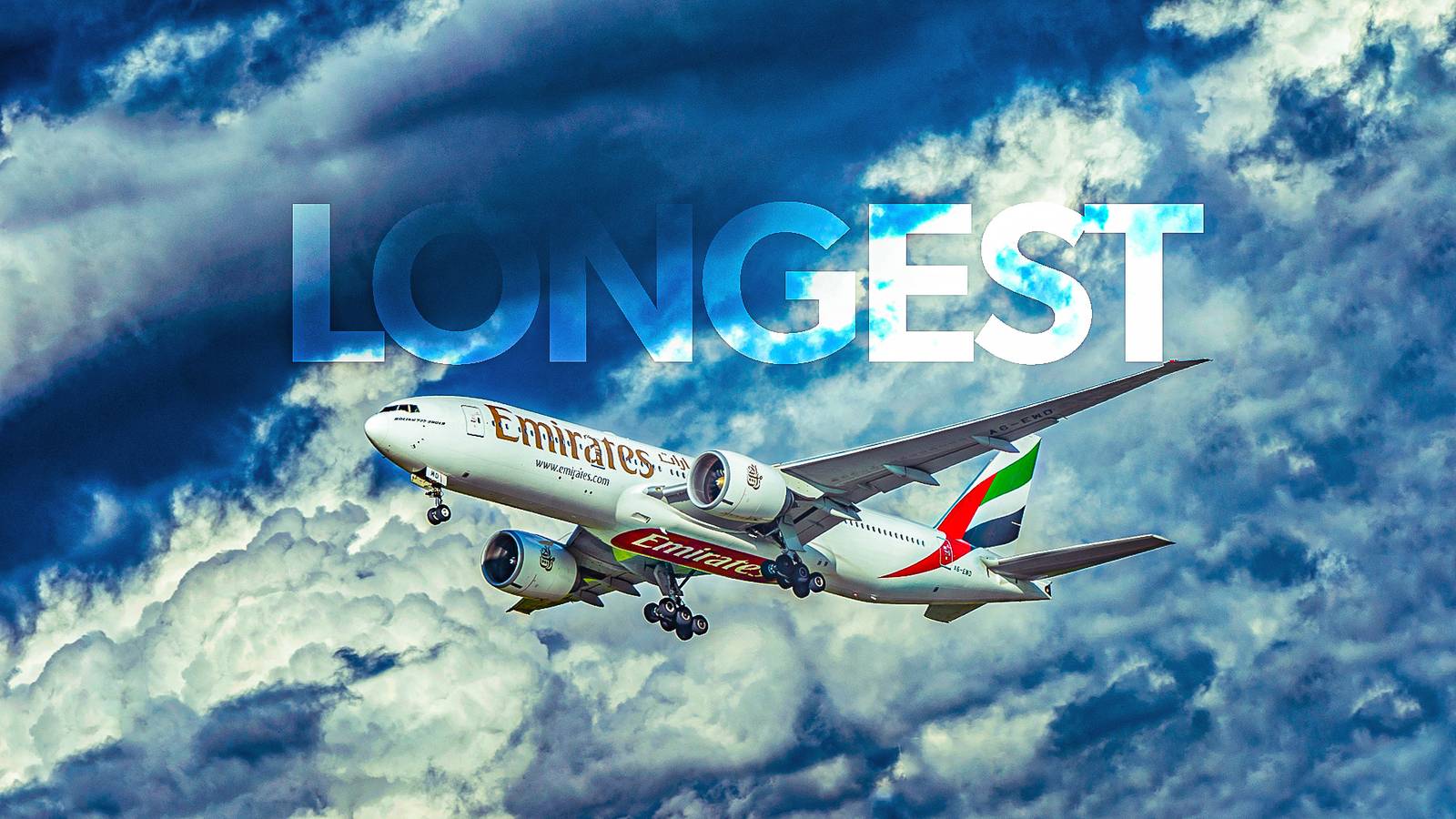
Few aircraft serve as the anchor of a global network the way the  Boeing 777 does for Emirates. From Dubai, the airline leans heavily on its combined fleet of Boeing 777-300ER and 777-200LR jets to connect far-flung city pairs that would be tough to serve nonstop for many airlines, stretching into the Americas, Australasia, and the far edges of both Asia and Africa. In 2026, these longest sectors are not just a mileage flex, but they also reveal several trade-offs that come along with ultra-long-haul flying. When deciding where and how to deploy the model, airlines need to carefully consider fuel burn and seasonal headwinds, crew staffing and duty limitations, as well as diversion planning. This cargo payload also significantly helps the carrier pay the bills.
In this article, we evaluate Emirates’ longest scheduled nonstop Boeing 777 routes for 2026, all while carefully unpacking what makes these services viable. We will look at both great-circle distances and scheduled block time, with winds and routing often reshuffling this order. These routes mix premium business demand, visiting friends and relatives (VFR) traffic, and strategic flights that help feed into Dubai’s connection banks. For these routes, we analyze the difference between how and when the two Boeing 777 variants are deployed. These are all missions that push the upper limits of the Boeing 777’s range, reliability, and seat discipline. We also discuss how the airline weaponizes its 777 fleet to carefully time sleep windows and arrival schedules to enable smooth connections through Dubai.
A Brief Overview Of The Dynamic Emirates 777 Fleet

The  Emirates Boeing 777 fleet is the backbone of the carrier’s day-to-day operations. A huge Boeing 777-300ER operation of around 119 aircraft is joined by a specialist subfleet of around 10 Boeing 777-200LR models designed mostly for longer-range operations. The Boeing 777-300ER does the heavy lifting across the airline’s global network because it combines long-haul range with big-seat, big-cargo capacity. Emirates configures these jets in multiple ways, with both three-class layouts and high-density two-class layouts, depending on the market being served.
The Boeing 777-200LR is reserved for the most demanding missions where extra range and payload margins matter, making it a natural fit for Emirates’ longest nonstop services. From a cabin perspective, the important wrinkle here is consistency. The airline’s Boeing 777s are in the middle of a large refurbishment push, so passengers can see noticeably different products by tail number. Refitted jets move toward a modern four-cabin standard, with First, Business, Premium Economy, and Economy all becoming bigger pieces of the Boeing 777 story.
It is also important to note that Emirates SkyCargo is also leaning on the Boeing 777F, and the airline expects to add up to 10 more freighters in 2026, adding a major boost to overall capacity. In the longer term, Emirates has Boeing 777X orders lined up, with first deliveries currently expected to start in 2027.
A Look At How Emirates Chooses To Deploy The Boeing 777

Middle Eastern carrier Emirates deploys its Boeing 777s as a flexible tool that makes the airline’s Dubai hub work at scale. The Boeing 777-300ER is the default choice when Emirates wants long-haul range and lots of seats, all without sacrificing strong belly cargo. This makes the aircraft especially useful on trunk routes where the airline runs multiple daily flights timed around Dubai’s connection banks. It is also the aircraft that Emirates uses to achieve the right-sized capacity in comparison to the Airbus A380.
If demand does not justify an Airbus A380 or an airport is not capable of handling the jet operationally, the Boeing 777 is the next-best way to keep widebody economics and premium cabins on the market. That flexibility ultimately means that seasonality can be addressed by using higher and lower density Boeing 777 layouts, all before swapping up to Airbus A380s when market conditions demand it. The smaller Boeing 777-200LR tends to appear on some of the toughest missions, especially on long nonstop flights and routes with persistent headwinds.
That aircraft is also used on routes where performance margins make payload tradeoffs significantly more sensitive. From an operational perspective, the Boeing 777 is also Emirates’ network problem-solver for irregular operations. The aircraft can easily be substituted in on many routes where the Airbus A380 cannot handle certain situations or maintain cargo commitments when passenger demand softens. This is exactly why the aircraft is a critical weapon in the airline’s fleet, especially during periods of operational challenges and high demand for cargo.

Emirates’ 7 Boeing 777 Layouts: What’s Inside?
The carrier’s different configurations for the 777 allow it to serve a wide range of passenger markets with the type.
What Are Emirates’ Longest 777 Routes?

Emirates’ longest Boeing 777 sectors resemble a collection of connections between Dubai and some of the world’s farthest-flung cities. The longest of these routes is from Dubai to Dallas/Fort Worth International Airport (DFW), a route that receives daily service and spans 8,038 miles (12,936 km). Flights from  Miami International Airport (MIA) to Dubai follow at around 7,833 miles (12,624 km), another year-round daily operation. The next-longest route on this list is Dubai to Orlando International Airport (MCO) at 7,754 miles (12,479 km), with fewer annual rotations but still a huge seat and ASM contribution, per route scheduling data provided to Simple Flying by aviation analytics company Cirium.
Brisbane Airport (BNE) to Dubai is the next-longest route on this list at 7,442 miles (11,977 km), and Seattle-Tacoma International (SEA) to Dubai sits just after at 7,425 miles (11,949 km). This is the technical standout here because it is a uniquely split operation, flown by both the Boeing 777-200LR and the 777-300ER. This is exactly the kind of deployment where performance margins really make a difference. Here are three other sectors that are among the airline’s longest 777 services:
|
City Served From Dubai With An Emirates 777: |
Route Distance: |
|---|---|
|
Rio de Janeiro (GIG) |
7,383 miles (11,882 km) |
|
Chicago O’Hare International (ORD) |
7,246 miles (11,661 km) |
|
Melbourne Airport (MEL) |
7,230 miles (11,636 km) |
These are all routes that reinforce the pattern of what kinds of destinations the airline chooses to deploy its Boeing 777 fleet to. These are all large global gateways that demand consistent frequency and enough belly cargo demand to require a stronger twinjet. Two final cities served by the aircraft that make our list of the longest include Boston Logan International Airport (BOS) and Montreal Trudeau International Airport (YUL).
What Can We Learn From Analyzing These Routes?

From this analysis, we can note that the longest routes for Emirates are not always the ones that are most important for the airline. Rather, the carrier cares the most about available seat miles (ASMs). The airline’s service from Cape Town International (CPT) to Dubai International (DXB) does not sit near the top of the airline’s list of 777 routes in terms of distance, at only 4,737 miles (7,619 km). The airline on this route, however, runs around 730 flights in each direction, meaning that it generates a massive amount of ASMs for the carrier.
Services from Dubai to Manila International (MNL) is the ultimate volume machine, with a route of just around 4,297 miles (6,915 km) seeing around 1,095 flights in each direction. This mid-length sector is thus one of the airline’s largest individual Boeing 777 commitments. This same logic appears all across Asia, with high-volume routes to destinations in Indonesia and the Philippines racking up huge amounts of annual seats due to consistent scheduling.
Service from Seoul Incheon International (ICN) to Dubai is similar at around 4,189 miles (6,742 km), but offering excessive frequency. Emirates also often uses the Boeing 777 for strategic long-haul links beyond Dubai, with fifth-freedom flights often being a good example. The aircraft, for example, is often used for flights like Athens International Airport (ATH) to Newark Liberty International Airport (EWR).

Over 8,100 Miles: Emirates’ Longest Nonstop Routes In 2025
Four of the airline’s top five longest routes are with the Airbus A380.
What Is Emirates’ Forward-Looking Vision For Its Fleet?

Emirates’ long-term fleet strategy is to keep Dubai’s hub model powered by widebody aircraft, refreshed cabins and an improved ground experience. The airline is also planning on transitioning to new aircraft as deliveries catch up. In the short term, the airline is extending the life of the Airbus A380, with full retirement dates now extending beyond 2040.
The carrier is also planning on spending around $5 billion in order to refurbish around 219 jets. This retrofit is designed to support extensive additional throughput of around two jets per month. This is because a Boeing 777 takes around 18 days to rework, while an Airbus A380 requires a full 22.
Emirates also has around 270 Boeing 777-9 models on order, with first deliveries expected to start in 2027. Emirates has also continued to push for optionality, potentially converting commitments for the smaller Boeing 777-8 to larger 777-10 models, should Boeing eventually build the type.
What Is Our Bottom Line?

At the end of the day, the Boeing 777 is a capable model. However, it is decidedly not the flagship of Emirates’ global fleet, a role that is filled by the larger and more recognizable Airbus A380.
Sure, the Boeing 777 does not have shower suites (although it does have some pretty impressive-looking first-class suites). However, the jet still serves a critical role in Emirates’ fleet, connecting some of the farthest-flung pieces of the airline’s network with its hub.
This means that, without extensive and carefully-managed Boeing 777 operations, Emirates, as it does today, would simply not exist. The carrier’s global reach is unquestionable, and the 777’s speed and efficiency are both factors that set it apart.
About the Author