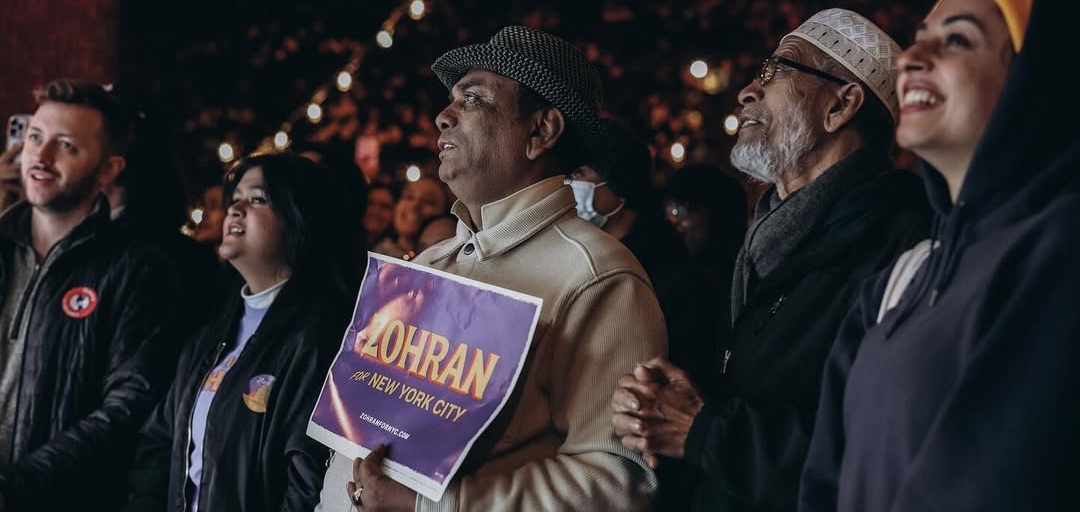

Election night party in Queens, New York, November 5. Photo by Walaa Yassien.
Zohran Mamdani has won the New York mayoral race, marking a turning point in American politics — and in global politics as well. Why is it a turning point? Let us begin from the roots of the story.
In 1961, John F. Kennedy (43 years old) was elected as the youngest president in the history of the United States at the time, and the first Catholic. The son of a prominent American Catholic family, educated at Harvard and winner of the prestigious Pulitzer Prize for his book Profiles in Courage, Kennedy rose to the presidency with an ambitious program to end racial discrimination against Black Americans.
One day, however, Kennedy read an article in The New Yorker by the renowned writer Dwight Macdonald reviewing a book titled The Other America. The book, written by Michael Harrington, a writer and activist in the Socialist Party at the time, was published in 1962. The Socialist Party had declined after the Democratic Party, beginning in 1933, adopted a series of effective social policies known as the New Deal, including the Social Security Act providing for pensions and unemployment benefits, and the Wagner Act granting workers the right to form unions and negotiate with employers after decades of management’s absolute power.
This drove the great American economist John Kenneth Galbraith to declare in his 1958 book The Affluent Society that poverty was no longer a problem in the US. Harrington, in The Other America, sought to expose what he called “the invisible poor:” migrant farmworkers in the rural south, Black people in their segregated urban neighborhoods, destitute elderly citizens, neglected psychiatric patients and the impoverished districts on the edges of cities.
Kennedy read Harrington’s ideas and immediately decided to design a program to fight poverty, including food assistance, developing marginalized regions and helping workers improve their skills and find jobs. After Kennedy’s assassination, Lyndon Johnson adopted his plan in what became known as the War on Poverty, culminating in the Civil Rights Act that outlawed racial discrimination. Once again, the Socialist Party lost its ground. In 1973, Harrington broke away to form the Democratic Socialist Organizing Committee, which by 1982 became the Democratic Socialists of America (DSA).
Socialists within the Democratic Party
Harrington was a Marxist, not a social liberal. But he was among the American Marxists who rejected the Soviet interpretation of Marx. For them, Marx was a democratic thinker — or at least his ideas could flourish within a democratic framework. Still, Harrington was firm in his conviction that socialism could not realistically take root in the US outside the Democratic Party. The DSA remained a marginal current within the party, which itself was drifting away from its social commitments amid the economic successes of the Reagan era. This shift gave rise to the so-called New Democrats under Bill Clinton.
Mamdani belongs to the Democratic Socialist movement. But how did this movement transform from a marginal current into one of the most striking political phenomena in the US? After the 2008–2009 global financial crisis, Barack Obama came to power with a vision reminiscent of Franklin Roosevelt’s New Deal: large social programs to alleviate the suffering of the poorest segments, most notably Obamacare (Medicare) offering health coverage to residents who were uninsured or unable to pay for care. Yet the Obama administration failed to curb the influence of financial institutions and big corporations.
In 2016, socialist senator Bernie Sanders ran in the Democratic primaries against Hillary Clinton, who represented the party’s traditional establishment — mainly the New Democrats. Sanders did not win the nomination, but he made it possible for the DSA to grow, with its membership swelling from a few thousand to around 80,000. Moreover, the movement attracted young and unconventional figures such as congresswomen Alexandria Ocasio-Cortez and Rashida Tlaib of Michigan.
The Democratic Socialists became a magnet for young people like Mamdani, offering a powerful promise of real change within the Democratic Party and a chance to absorb popular anger after the financial crisis — anger that had otherwise been captured by Donald Trump’s Make America Great Again movement.
The party leadership’s decision to push Joe Biden as a consensus candidate temporarily stalled the rise of the DSA. Yet the movement, alongside other progressive activists within the party, played a crucial role in the 2020 election — delivering a sweeping victory to an uncharismatic candidate over an incumbent president, with a margin of about ten million votes. They accomplished a miracle for a leadership that had long outlived its relevance.
But 2023 marked another turning point. The DSA’s internal elections brought a younger and more left-leaning leadership to power, and the movement’s National Political Committee included a member who had run on an explicitly anti-Zionist platform. For the American socialist left, Zionism had come to symbolize American imperialism more than a refuge for Jews against antisemitism.
Meanwhile, progressive factions in the Democratic Party clashed sharply with Biden’s unconditional support for Israel’s war on Gaza — a campaign that turned occupation into open genocide. The police crackdown on the student anti-war movement and the Democratic National Convention of 2024 that sidelined anti-war groups made the rupture between the party’s old guard — figures like Chuck Schumer and Nancy Pelosi — and its youthful progressive base, such as the DSA, unmistakably clear.
From crisis to creativity
Since the fall of the Soviet Union — and perhaps even a decade before — it has been evident that the left faced a profound political crisis. The first dimension was strategic: how could the left gain power amid the dominance of centrist parties across the Global North (the US and Western Europe) and the decline of labor unions as traditional manufacture moved to Asia? The second dimension was ideological: the left had lost a clear vision of what it could promise, since the socialist model exemplified by the Soviet Union had become something to flee from, not to aspire to.
Leftist thinkers sought alternatives. Slavoj Žižek, after much theoretical complexity, ended up rehashing Marxism-Leninism in a caricatural way suited more to media celebrity than to serious political militancy. Antonio Negri and Michael Hardt proposed that communality could only emerge by dismantling the sovereign state — and to dismantle sovereignty, no party or civil society was needed, only a multitude surging forward to erode authority and build non-sovereign institutions.
Finally — and more effectively — Ernesto Laclau and Chantal Mouffe, along with Nancy Fraser, proposed left-wing populism and radical democracy. Their view was that there can be no final utopia without social conflict, and what we must seek instead is more democracy in how conflicts are resolved — by extending democracy from the political sphere to the economic one, ensuring not only fairer distribution of wealth but also fairer competition in obtaining and managing it. The path to this lies in building a populist left party that mobilizes people around a polarizing frontier against the traditional power establishment.
Laclau and Mouffe’s theory inspired the rise of the new left in Latin America. After the global financial crisis, it also galvanized new left movements in Europe, producing a constellation of populist-left parties: Syriza in Greece, La France Insoumise in France, Die Linke in Germany, Podemos in Spain, and the Corbyn’s wing of Britain’s Labour Party. Their experiences mixed triumph and failure, but the momentum never vanished entirely.
Mamdani’s campaign and radical democracy
When Mamdani’s campaign took shape, its aim was precisely this: to build a program by gathering people’s concrete demands in New York City, uniting them under a common slogan, and presenting that slogan and its carriers as the counter-force to the city’s political establishment. This is exactly Laclau’s formula, translated from abstraction to practice: forming an equivalential chain of demands, inscribing them into an empty signifier, and creating an internal antagonistic frontier between the bearers of that signifier and the ruling elite.
If you ask anyone who has lived in New York what their biggest struggle has been, 90 percent would likely answer: housing. Rent rates have risen at an astonishing exponential rate. The solution: build social housing to compete with private real estate and force rents down. This might take years, so a short-term fix was needed — rent freezes.
Food costs, often considered trivial in affluent societies, are anything but trivial in New York, where grocery prices are extremely high. The solution: public grocery stores to bring prices down. The third issue is employment. What keeps many New Yorkers from working? Two main factors: difficulty commuting across the city’s far-flung neighborhoods separated by waterways like the East River, Harlem River and Hudson River; and the need for parents to stay home to care for children. The solutions: universal daycare services and fast, free local bus networks.
All these demands and this appealing program needed a slogan — and the choice fell on one word: affordability. A word outside the traditional socialist lexicon, but one every New Yorker understands, sympathizes with and desires.
Finally, what is the antagonistic frontier? Clearly, it is the class opponent. Mamdani often uses combative language. He does not try to please New York’s wealthy; he must lose them — turn them into adversaries — to rally around himself a mass of energized voters ready to confront that adversary.
Thus was Mamdani’s campaign formed: a campaign of remarkable wit, simplicity and strategic insight — modestly funded compared to his opponents’ lavish war chests, but powered by thousands of young volunteers passionate about this new form of politics: radical democracy.
Social media platforms worldwide now buzz with debates about Mamdani: is he an immigrant or an American? Muslim or secular? Pro-LGBTQ or an archetype of masculine charisma admired by young women? Mamdani is, ultimately, one among many activists — an element, a face, a fighter — whose priority is not to ignite endless cultural wars over race, migration, gender or sexuality, but to liberate all these choices from inherited cultural hegemony. And more broadly, to liberate human choice itself from material constraints: poverty, need and degrading, underpaid labor.
Let Mamdani be Jewish, Muslim or atheist; a woman, transgender, Black, white, handsome man, queer, or asexual; born in Germany or descended from Spanish Bourbons — it would matter little. Individual identity is not the point. What matters is freeing human choices from both cultural and economic domination. That is what Mamdani’s campaign sought, and what the Democratic Socialists of America continue to fight for.
About the Author