Rising violence has emerged as one of voters’ top concerns ahead of Costa Rica’s presidential elections, following a trend seen across Latin America that has vaulted security hardliners into power.
Costa Rica was rocked by a series of organized crime scandals in 2025, including the dismantling of the so-called “South Caribbean Cartel,” which local officials described as Costa Rica’s first transnational criminal organization, and the arrest of former security minister Celso Gamboa Sánchez on US accusations he led a regional drug trafficking network.
SEE ALSO: What’s Behind Costa Rica’s ‘First’ Transnational Criminal Organization?
Drug seizures also spiked in 2025, with authorities seizing more than 44 tons of cocaine, far surpassing the roughly 27 tons seized in 2024. Marijuana seizures increased to 19 tons, about two tons more than the previous year.
At the same time, homicide rates have surged in key drug trafficking zones such as Limón, the country’s main port. Once considered the safest country in the region, Costa Rica now has the third-highest homicide rate in Central America of 16.6 per 100,000 inhabitants.
Costa Rica has already begun implementing harsh anti-crime tactics, inspired by its neighbors. In early January, Costa Rica’s President Rodrigo Chaves invited El Salvador’s President Nayib Bukele to attend the inauguration of a new prison modeled on Bukele’s infamous Terrorism Confinement Center (Centro de Confinamiento del Terrorismo – CECOT).
Voters appear eager for the next president to take further action. A December 2025 survey published by the Center for Political Research and Studies (CIEP) at the University of Costa Rica (UCR) showed most voters put citizen security at the top of their priorities, and all the leading candidates’ security proposals point toward hardline measures, including expanding the police force, strengthening port security, and imposing harsher penalties.
There are 19 candidates in the running, and polls show one, Laura Fernández, as the clear frontrunner. Unless she earns more than 40% of the vote — which polls show is a possibility — the vote will go to a second round on April 5.
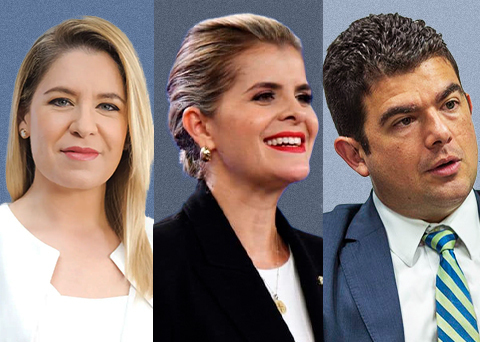
Here are the three candidates leading the polls and what their security policies would likely look like, based on campaign platforms and promises.
Laura Fernández, Partido Pueblo Soberano
Laura Fernández President Rodrigo Chaves’ former chief of staff and his handpicked successor. Much like Chaves, the leading conservative candidate has embraced a hardline approach to security and organized crime.
Her main proposals include expanding the use of cargo scanners at ports, airports, and land borders, as well as conducting regular operations against clandestine airstrips and illicit boat unloading points used for drug trafficking. She has also pledged to strengthen international cooperation with the Drug Enforcement Administration (DEA), Interpol, and Europol, while cracking down on the chemical precursors used to produce fentanyl and other synthetic drugs.
Her platform also includes measures to combat gender violence and cybercrime and to increase border security.
SEE ALSO: Will Costa Rica Follow the Same Criminal Path as Ecuador?
Additionally, Fernández has proposed implementing states of exception, in which civil liberties would be suspended to target hitmen and drug traffickers in violence hotspots, a clear nod to Bukele’s years-long state of emergency, which has since been unsuccessfully emulated in other countries in the region, including Honduras and Ecuador.
A separate component of Fernández’s plan focuses on judicial reform, including imposing term limits on judges, speeding up judicial proceedings, creating a system of sanctions, and requiring judicial officials to report their results to curb corruption.
Álvaro Ramos, Partido Liberación Nacional
A centrist candidate from one of Costa Rica’s traditional parties, Ramos places security at the forefront of his platform. He argues that “the country is no longer only a transit bridge for international drug trafficking. It has also become an attractive consumer market, a key warehouse for the temporary storage of drugs, and an important exporter of cocaine to the United States and Europe.”
His proposals include carrying out national “mega-operations” targeting the country’s 40 most dangerous neighborhoods, as well as tourist areas with the highest crime rates; hiring 6,000 new police officers; and creating a biometric ballistics laboratory to trace firearms and their owners.
To reduce drug flows, he also plans to purchase and install advanced scanners and electronic seals, or “smart containers,” to inspect cargo without opening containers and to trigger alerts when they are opened or tampered with by organized crime.
Some of his proposals are less concrete. Among them is the creation of a “Command, Control, Computing, Communications, and Citizen Contact Center (C5),” described as an advanced technological tool to improve security, technologically reinforce air, land, and maritime borders, and strengthen emergency response capabilities. While the proposal remains vague, it appears aimed at expanding Costa Rica’s technological capacity to combat crime.
Unlike candidates who advocate for building mega-prisons, Ramos has also proposed constructing a “Multilevel Institutional Care Center” to house low-risk incarcerated individuals, a move intended to free up capacity in the country’s already overcrowded prison system.
Claudia Dobles, Coalición Agenda Ciudadana
The former first lady to President Carlos Alvarado Quesada represents a coalition of progressive parties in Costa Rica.
Her platform emphasizes that insecurity is “not only a public order problem; it is also the consequence of structural inequalities, social exclusion, and the absence of opportunities. Therefore, fighting organized crime and violence also means strengthening the social rule of law, rebuilding trust in institutions, and ensuring that every community can develop without threats that undermine democracy, human rights, and social peace.”
She promises a range of preventive programs targeting at-risk youth, centered on expanding access to housing, boosting youth employment, and ensuring access to food, healthcare, and drinking water.
But there are some harder-line policies in her manifesto, too, including plans to increase the number of “mega-operations” in districts with high crime rates, introduce legislation to raise penalties for carrying illegal firearms, and strengthen traceability databases to prevent legally acquired weapons from being diverted to organized crime.
She also plans to expand the security forces by adding some 4,000 police officers, while increasing the presence and operational capacity of the Coast Guard, including reopening two Coast Guard stations to combat drug trafficking.
In addition, she explicitly proposes strengthening the government’s capacity to fight money laundering by bolstering the Financial Intelligence Unit of the Drug Control Institute (ICD) and supporting the approval and implementation of the Emerging Capital Law, which targets money laundering linked to drug trafficking and seeks to undermine the profit motive of organized crime.
Abby Pender contributed to the reporting of this article.
About the Author