Whether you’re planning a family electric vehicle road trip, working as a tradie on construction sites or travelling between client meetings as a sales rep, keeping food and drinks at safe temperatures throughout the day is essential.
The market has evolved significantly beyond the basic Kmart esky gathering dust in your garage, offering solutions across various price points and technological capabilities.
The Budget Options: Soft and Hard Coolers
Small soft and hard coolers represent the entry point into portable cooling, typically retailing between $20 and $50 depending on size and brand.
These small budget options serve adequately for short-term cooling needs, such as commuting to work where refrigeration is available upon arrival. However, their low price reflects minimal insulation, limiting their ability to maintain cold temperatures for extended periods.
The fundamental trade-off with cheaper coolers is thermal performance. Thin insulation walls mean ice melts faster and temperatures rise more quickly, particularly in Australian summer conditions where ambient temperatures regularly exceed 35-40 degrees.
Ice Versus Reusable Ice Bricks
The choice between traditional ice and reusable ice bricks offers practical benefits.
Reusable ice bricks eliminate the ongoing cost of purchasing bags of ice from service stations and prevent the accumulation of meltwater pooling at the bottom of coolers.
Different brands use varying internal materials, with some formulations maintaining frozen states longer than others, though specific performance data remains largely proprietary to manufacturers.
Car Cooling Innovation
Decathlon Quechua Fresh Compact Self-Inflating Cooler
The Decathlon Quechua Fresh Compact addresses storage challenges for users requiring occasional cooling capacity. Priced at about $140, the 35-litre model features a unique self-inflating design that collapses to approximately half its operational volume when not in use.
Inflation and Storage
The cooler measures 40cm x 30cm x 40cm when inflated but compresses to 21cm x 30cm x 40cm when deflated. Users open integrated valves to release air for storage, then reopen them for automatic reinflation in approximately five minutes. A few manual breaths through the valves complete the process.
Thermal Performance
According to EN 12546-2 standard testing, the unit claims it can maintain cold temperatures for 17 hours without ice packs, extending to 22 hours with 2.1 kilograms of ice packs. The construction uses 50 percent polyurethane and 50 percent polyethylene foam insulation within reinforced 600-denier polyester fabric.
Design Features
The cooler weighs 1.25 kilograms and includes adjustable shoulder straps, dual side handles, three external stretch mesh pockets, and one internal divider.
Warning this cooler is not waterproof. If you want to make it waterproof, you can add a $27 waterproof liner bag (Decathlon code 8502029) specially designed for this cooler. I think it should be included as standard.
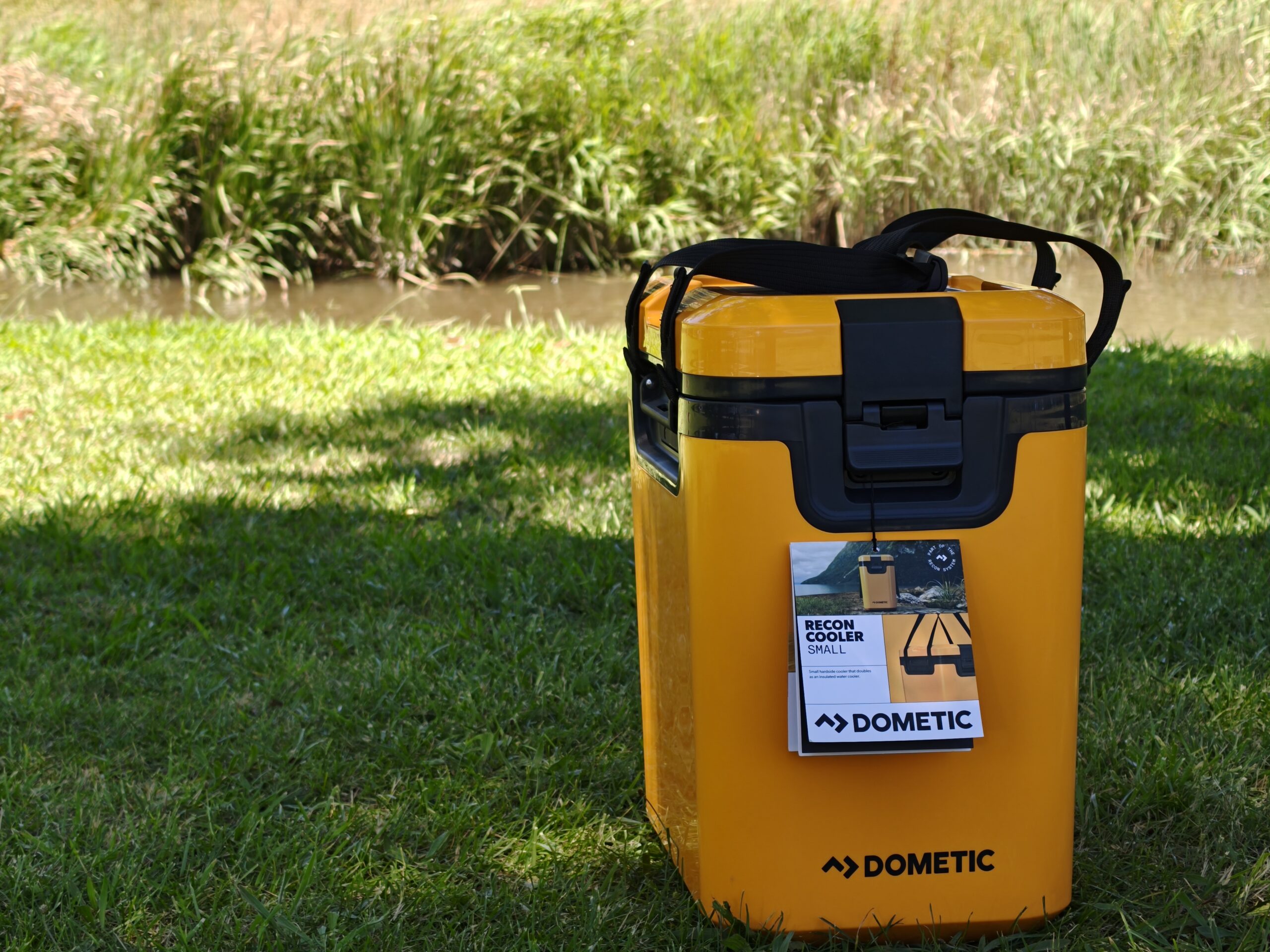
Dometic Recon Hardside 16L Cooler
The Dometic Recon 16L represents premium unpowered cooling at $325, featuring modular design with attachment points for accessories including water faucets. Real world testing on extended electric vehicle journey from Sydney to Melbourne in hot Christmas weather demonstrated sustained thermal performance.
Capacity and Build
The 16-litre interior capacity accommodated more than I expected including fresh farmer stall fruit, frozen vegetables and dairy including a big bottle of milk and several cheeses.
Two-inch insulation thickness maintained temperatures effectively, with yogurt remaining cold after many hours of summer travel without ice or icebricks. The structural integrity supports using the unit as a seat, withstanding even adult male weight without compromising seal integrity.
Practical Features
The dual-opening lid enables access from either side without repositioning, valuable when wedged between luggage. The bright yellow exterior prevents inadvertent abandonment at campsites. At full capacity, the unit reaches practical limits for one-handed carrying, with larger models possibly requiring two people to transport.
The Insulation Equation
Insulation thickness directly correlates with cooling performance and internal capacity in an inverse relationship.
The Decathlon cooler’s polyurethane and polyethylene foam supports 35-litre capacity with 22-hour ice retention, whilst the Dometic Recon’s two-inch walls sacrifice volume for multi-day performance at 16 litres.
Premium rotomoulded coolers with 50mm-plus insulation maintain ice for multiple days at prices from $300 to $800, whilst budget models with 20mm insulation provide 12 to 24-hour retention.
Organisational Features: Dividers
Dividers transform single-compartment coolers into staged storage systems. Items for end-of-journey consumption can sit beneath dividers, whilst frequently accessed items remain on top, reducing opening frequency and maintaining internal temperatures. Dividers also segregate loose items from larger objects, preventing transit damage.
Powered Solutions: 12-Volt Coolers
Traditional 12-volt powered coolers cost between $100 and $500, drawing power from traditional 12V car battery (either built-in or an extra battery). These units maintain cooling whilst vehicles operate but offer limited capabilities, generally operating within 15 to 20 degrees below ambient temperature. This kind of cooling proves adequate in mild conditions but may struggle during extreme heat when food safety requires stronger powered cooling.
The Electric Vehicle Revolution: Vehicle-to-Load Power
Electric vehicles introduce incisive capabilities through vehicle-to-load technology, often providing 240-volt power outlets internally and or externally.
This enables 240-volt plug powered coolers, refrigerators and heaters offering superior temperature control regardless of ambient conditions. Quality compressor-based units can be quite expensive and even well over $1,000, but they provide consistent performance in extreme heat or cold circumstances.
Built-In Solutions: The Integrated Fridge Trend
A growing number of electric cars now feature integrated refrigeration, representing a shift from aftermarket to factory-installed systems. This trend reflects consumer demand and the electrical capabilities of modern vehicles, particularly electric models with substantial battery capacity.
Kia EV5 GT-Line
The Kia EV5 GT-Line, features a unique rear sliding 4L storage tray with heating and cooling function exclusive to the top specification model. This versatile integrated compartment maintains items warm or chilled, adding comfort and utility for rear passengers alongside other GT-Line upgrades including ventilated front seats and panoramic sunroof.
The system differs from standard EV5 models which offer conventional storage, positioning the GT-Line as the premium variant with advanced convenience features. The rear-accessible location proves practical for passengers during extended journeys.
GAC Aion V
The GAC Aion V offers a 6.6-litre refrigerator compartment in the centre console armrest on Luxury trim models. This costs $2,000 extra than the base Premium version. The unit operates from minus 15 degrees Celsius to 50 degrees Celsius, functioning as refrigerator and warming box depending on requirements.
At 4 degrees Celsius refrigeration setting, GAC claims 0.5 kilowatt-hours consumption in 24 hours, representing less than one percent of the 75.26 kilowatt-hour battery capacity. The 6.6-litre capacity accommodates twelve standard drink cans, providing adequate cooling for day trips without separate portable coolers.
Camping and Utility Modes
Many electric vehicles incorporate camping or utility modes allowing systems to operate whilst stationary without excessive battery depletion. This maintains air conditioning and powers vehicle-to-load-connected devices, enabling 240-volt fridges to run overnight off the main car high voltage battery. The practicality for extended camping or mobile work situations represents genuine advantage over internal combustion vehicles requiring the use of extra 12V batteries which take up valuable space.
Making the Right Choice
Optimal cooling solutions depend on usage patterns, budget constraints, and vehicle capabilities.
People may prioritise quality 240-volt compressor fridges paired with vehicle-to-load-equipped electric vehicles.
Occasional road trippers may find mid-range hard coolers with quality insulation sufficient.
Tradies working remote sites without power access for multiple days could benefit from premium hard coolers like the Dometic Recon range combining thermal performance with structural durability.
Users prioritising space efficiency should consider self-inflating options like the Decathlon Quechua Fresh Compact, particularly when storage limitations make permanently deployed coolers impractical.
Those with electric vehicles featuring built-in refrigeration may find factory-integrated solutions adequate for daily commuting and short trips, though traditional portable coolers remain necessary for activities away from vehicles.
The Australian market now offers solutions spanning $20 budget soft coolers through to $1,500 premium powered refrigeration systems and factory-integrated electric car mini fridge/heater options.
About the Author