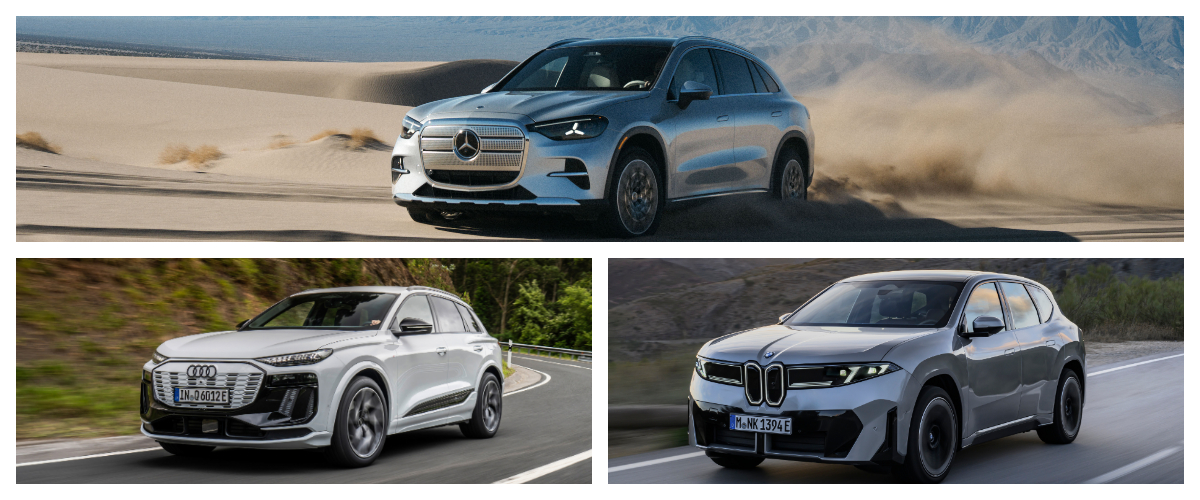
BMW remains the leader of the premium market in 2025 as well, increasing its lead over Mercedes and Audi, even though all three premium manufacturers recorded sales declines in 2025.
BMW remains the leader of the premium market in 2025, widening its advantage over rivals Audi and Mercedes. All three premium manufacturers saw declining sales, but BMW recorded the smallest drop.
In 2025, the Bavarian brand sold 1.4% fewer cars than in 2024, while Mercedes recorded a 9% decline and Audi a 2.9% decline.
Thus, BMW sold 2,169,761 units in 2025, which is 368,961 more than Mercedes and 546,210 more than Audi. This represents the largest gap in history between the three premium manufacturers, after BMW held a lead of 216,777 units over Mercedes and 528,959 units over Audi in 2024.
Audi’s decline is the most surprising, especially in a year when many new models were launched, such as the A5, Q5, Q3, and A6 e-Tron. While Audi had many models at the end of their life cycle in 2024, a rebound was expected in 2025—but it did not materialize.
The drop in sales is due to reduced demand in Asian markets, especially China, and in the American market, particularly the USA. In China, Mercedes sales fell by 19%, BMW Group sales by 12.5% (BMW reports only combined BMW and MINI sales by region), and Audi sales by 5%.
In the U.S. market, Audi recorded a decline of 12.2%, almost similar to Mercedes’ 12% drop, while BMW Group sales (BMW and MINI) increased by 5.7%.
BMW is the undisputed leader in the electric vehicle market
In the electric segment, BMW leads by a wide margin with 442,072 units sold (again, BMW reports only combined BMW and MINI sales), compared to 223,000 for Audi and 168,800 for Mercedes.
It is interesting to note that within BMW Group, electric vehicle sales account for 17.94% of total sales, compared to 13.7% for Audi and only 9.37% for Mercedes.
Audi benefited from the shared MEB platform with VW, Cupra, and Skoda, as well as the PPE platform with Porsche, allowing it to cover more segments than Mercedes.
For example, Mercedes did not have a representative in 2025 in the electric mid-size sedan and SUV segments; the new GLC EQ has only just been unveiled (sales begin in May 2026), and the C-Class EQ will debut only in September 2026.
By contrast, in the PHEV segment, BMW and Mercedes are almost tied, with around 200,000 units sold each, while Audi does not disclose PHEV sales data.
BMW is also the leader of high-performance models
In the high-performance segment, BMW is also the clear leader with 213,457 units sold. This marks the 14th consecutive year of growth for BMW M GmbH. It should be noted that BMW’s M division includes both pure M models and M Performance models, which sit between standard models and full M models.
The best-selling M model was the BMW M2, while the best-selling M Performance model was the new BMW X3 M50. Among the M models, the new BMW M5 and the M3 also delivered very strong results.
Mercedes-AMG also recorded one of the best results in its history, with 145,000 units sold, representing a 7% increase.
By contrast, Audi Sport posted a very weak result of only around 36,000 units, down 13% compared to 2024. Audi explains this result by the replacement of certain models and the discontinuation of some sport versions.
| Audi | BMW | Mercedes-Benz cars | ||
|---|---|---|---|---|
| Global sales 2025 | 1,623,551 | 2,169,761 | 1,800,800 | |
| Europe | 670,336 | 1,016,360 * | 634,600 | |
| from which Germany | 206,290 | 290742 * | 213,200 | |
| North America | 202,143 | 508221 * | 320,600 | |
| from which US | na | 417638 * | 284,600 | |
| Asia | na | 871550 * | 747,000 | |
| from which China | 617,514 | 625527 * | 551,900 | |
| Electrified models | na | 642,087 * | 368,600 | |
| – fully electric models | 223,000 | 442,072 * | 168,800 | |
| – PHEV models | na | 200,015 | 199,800 |
About the Author