
- Tokenized US Treasury debts have grown into a $9.75 billion industry in 2026.
- Ethereum has emerged as the most preferred chain for the issuers of these investment instruments.
- Ondo’s USDY has dominated the 30-day net flows in US Treasury debt tokens.
Tokenized short-term US Treasury debt has emerged as one of the biggest use cases of real-world asset (RWA) tokenization. Since their early adoption in 2023 and BlackRock’s involvement in 2024, these assets have exploded into a roughly $9.79 billion money-making machine by early 2026.
In this article, we will explore what tokenized US Treasury debt is, its growth, and why it’s bound to become the blueprint for sovereign financing. As a bonus, we will also touch on the chains associated with them for investors looking to get involved in the opportunities the sector brings.
What are US Treasury Debts?
US Treasury debts are low-risk securities in the form of bills, notes, bonds, Floating-Rate Notes (FRNs), and Treasury Inflation-Protected Securities (TIPS) issued by the US Department of the Treasury. The government uses these debt instruments to finance its spending for infrastructure, defense, and other public services.
US Treasury debts supplement taxation in funding the government. They help plug the budget deficit when national revenue falls short.
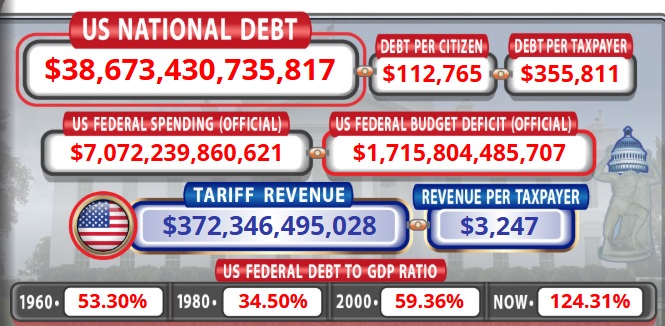
As of January 30, 2026, the US has already accumulated over $38.67 trillion in national debt, translating to approximately $112,765 debt per citizen based on US Debt Clock data. The figures come against a backdrop of $5.36 trillion in federal tax revenue, $372.35 billion in tariff revenue, $7.07 trillion in federal spending, and a $1.72 trillion budget deficit.
In simple terms, US Treasury debt is the government’s massive credit card balance. However, the loans come from the public and sovereign buyers. According to the US Treasury, the top buyers of these securities from the international community in 2025 are Japan, the United Kingdom, China, Belgium, and Canada.
In exchange, the government issues buyers of US Treasury debt an IOU or a security that promises to repay the loan within a given period, plus interest. It’s worth noting that yields are often higher than those of traditional bank savings accounts to entice people to invest in them.
Why Can’t the Government Just Print More Money to Finance Itself?
Some people tend to raise this question. They are either trolling or lack an understanding of the negative impact of uncontrolled central bank money printing.
The government could indeed print money out of thin air, but that money doesn’t actually create wealth unless it’s backed by hard assets like gold. Additionally, a sudden increase in the money supply without a corresponding rise in economic output leads to inflation.
Think of a whole pizza, which represents the goods and services in an economy. Then equate the money-printing activities to its slices. Fewer slices mean a larger share of the pizza, but more slices mean thinner shares. Of course, the bigger slices are more filling, but it will take more of them to achieve the same level of satisfaction as smaller slices.
Given that example, less money circulating in the economy means more purchasing power for those who wield it. On the other hand, its value depreciates when its supply rises without additional backing or increased productivity.
Tokenized US Treasury Debts
Tokenized US Treasury debts are digital tokens on the blockchain. Each represents a direct or indirect claim to a US government debt security or a Treasury-focused money market fund.
Instead of the government issuing a certificate or a brokerage account entry to buyers, it gives out a digital token that serves as proof of ownership. Like other RWAs, tokenized US Treasury debt is governed by smart contracts throughout its lifecycle, from issuance and interest payments to redemption.
Tokenization considerably enhances the portability, accessibility, efficiency, and transparency of RWAs.
Crunching Down the Numbers
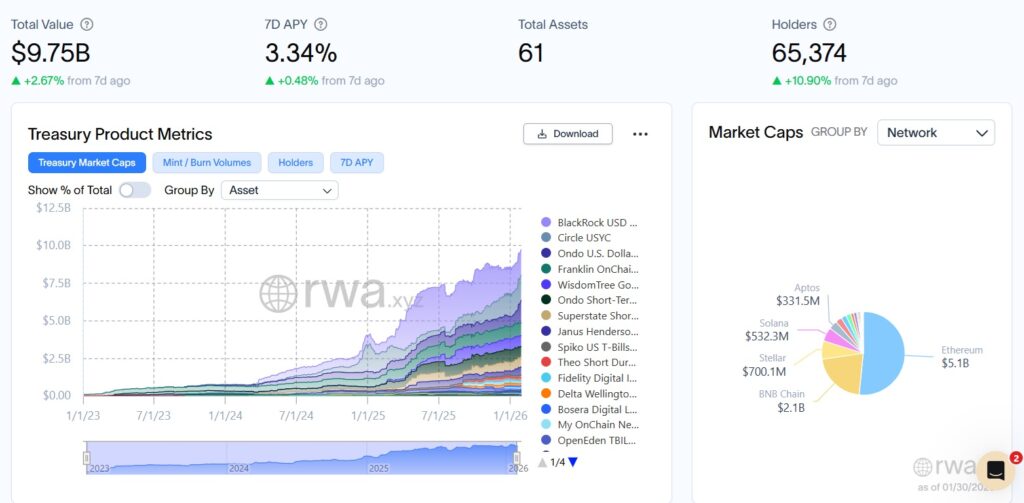
RWA.xyz indicates that there is already $9.75 billion worth of tokenized US Treasury debt. There are now 61 types of tokens in this space, held by 65,374 holders as of the end of January 2026. Meanwhile, the weighted 7-day annual percentage yield (APY) average of all tokenized treasury products in circulation is 3.34% as of writing.
Most holders of these assets are institutions, DAOs (Decentralized Autonomous Organizations), DeFi (Decentralized Finance) protocols, and corporate treasuries. The most significant contributors to the sector’s market cap are BlackRock with $1.71 billion, Circle with $1.68 billion, and Ondo with $1.48 billion shares.
Best Chains for Tokenized US Treasury Debts
If you’re looking to get exposure on the US Treasury debt sector, here are the top 5 chains for US Treasury debt tokenization by market cap:
- Ethereum (ETH) with $5.1 billion
- BNB Chain (BNB) with $2.1 billion
- Stellar (XLM) with $700.1 million
- Solana (SOL) with $532.3 million
- Aptos (APT) with $331.5 million
These networks with large market caps offer deeper liquidity, enabling users to trade tokenized US Treasury debt seamlessly with better pricing, tighter spreads, and faster entry or exit of positions. Moreover, it indicates a robust economy and enhanced value creation, attracting builders, validators, miners, and stakers, with secure on-chain incentives for community actors to act with integrity.
On the other hand, the top 5 products in the space in terms of 30-day net flows are the following:
- USDY by Ondo at $773 million
- JYRSY by Centrifuge at $282 million
- USYC by Circle at $158 million
- USTB by Superstate at $110 million
- BENJI by Franklin Templeton at $72 million
High netflows illustrate more capital flowing into the token’s ecosystem than out, suggesting that demand exceeds supply. The metric underscores investor confidence for the asset, issuer, or infrastructure, hinting at better growth potential in the future.
What’s your Reaction?
+1
3

+1
0

+1
0

+1
0

+1
0

+1
0

+1
0

About the Author