AI In Personalized Nutrition Market Summary
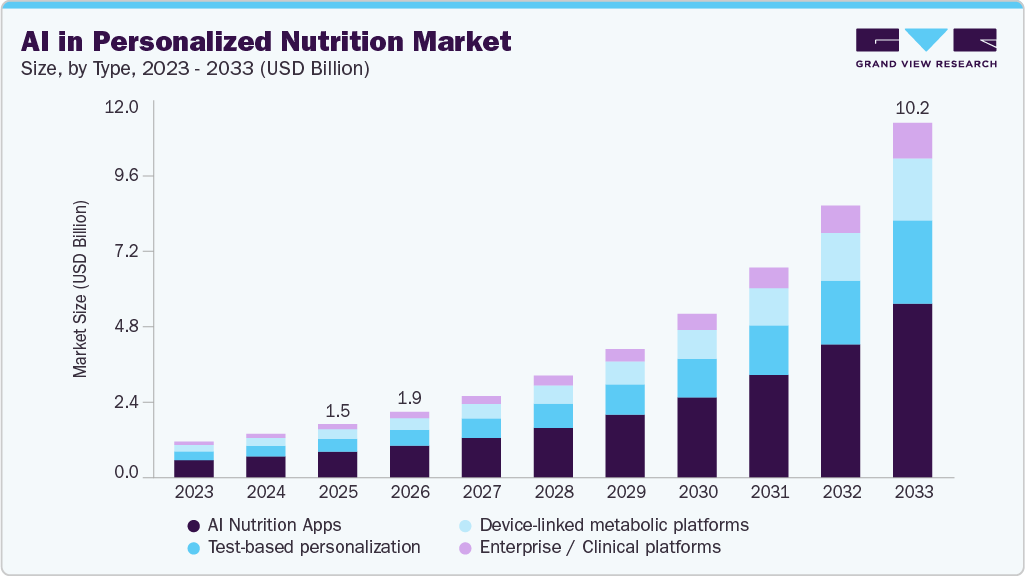
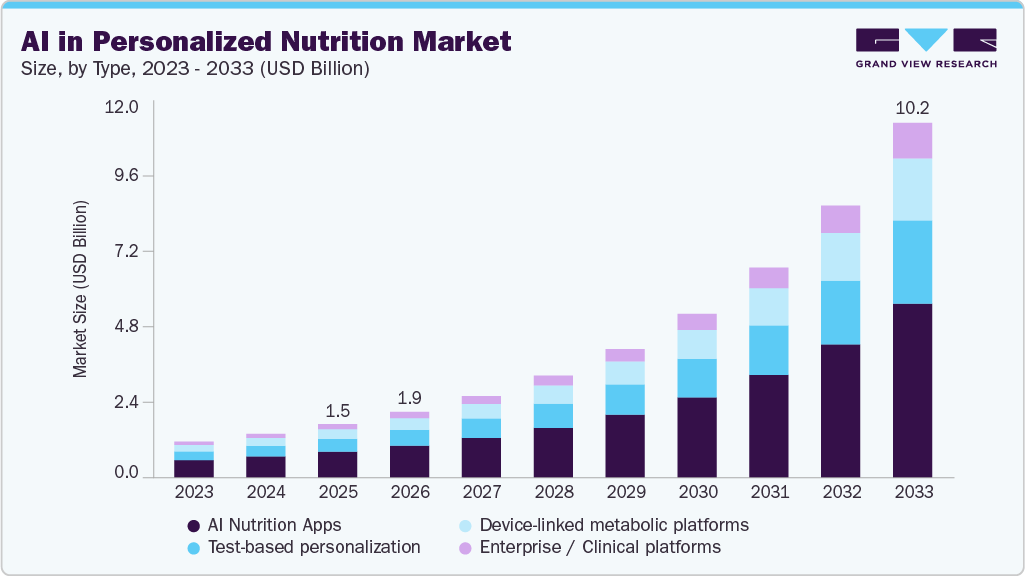
The global AI in personalized nutrition market size was estimated at USD 1.54 billion in 2025 and is projected to reach USD 10.21 billion by 2033, growing at a CAGR of 27.21% from 2026 to 2033. Rising prevalence of lifestyle-related and chronic diseases, advances in AI, data analytics, and omics integration, and growing consumer demand for preventive and personalized health solutions are significant factors contributing to market growth.
Key Market Trends & Insights
- North America AI in personalized nutrition market held the largest share of over 52% of the global market in 2025.
- The AI in personalized nutrition industry in the U.S. is expected to grow significantly over the forecast period.
- Based on type, the AI nutrition apps segment held the highest market share of over 48% in 2025.
- Based on application, the AI-based meal planning & recommendations segment held the highest market share of over 41% in 2025.
- Based on end use, the individuals/consumers segment held the largest market share of over 46% in 2025.
Market Size & Forecast:
- 2025 Market Size: USD 1.54 Billion
- 2033 Projected Market Size: USD 10.21 Billion
- CAGR (2026-2033): 27.21%
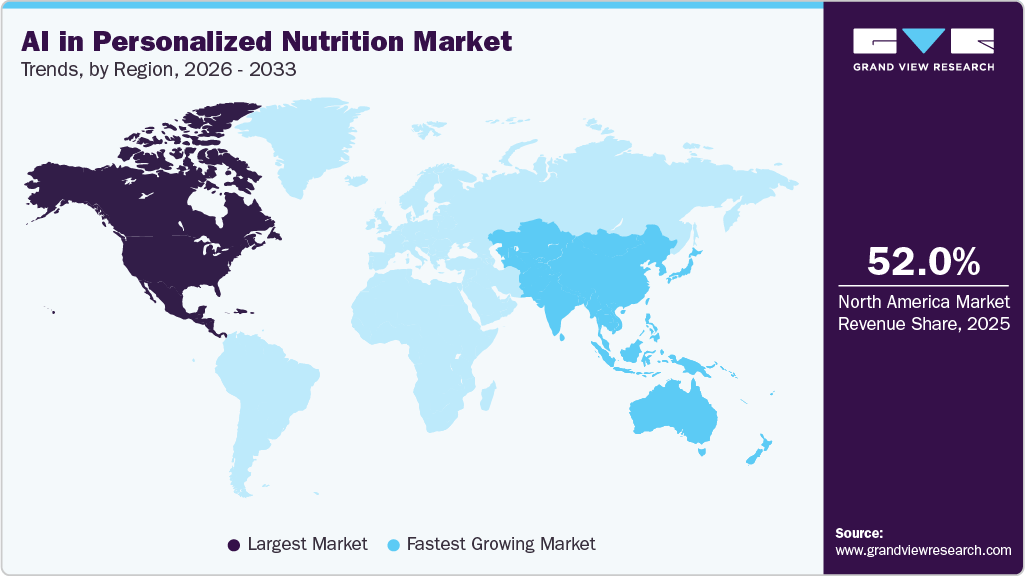
- North America: Largest market in 2025
- Asia Pacific: Fastest-growing market
Moreover, the expansion of digital health ecosystems and enterprise adoption is strengthening the market environment. The increasing prevalence of lifestyle-related and chronic diseases is a key factor driving market growth. Diseases such as obesity, diabetes, cardiovascular disorders, and metabolic syndrome are closely associated with poor dietary habits and sedentary behavior. For instance, according to the International Diabetes Federation (IDF), approximately 589 million people are currently living with diabetes, with an estimated number to reach 853 million by 2050. Conventional dietary guidelines frequently fail to account for individual differences in metabolism, genetics, and health status. AI-powered nutrition platforms facilitate precise dietary interventions by analyzing biometric data, clinical records, and lifestyle information. These technologies enable early risk identification and the development of targeted nutritional recommendations.
Healthcare systems and employers are adopting personalized nutrition tools to enhance preventive care strategies. The emphasis on reducing long-term healthcare costs through nutrition-based interventions is further accelerating market adoption. For instance, in December 2025, Avid Health partnered with Healthnix to strengthen chronic care programs for FQHCs and primary-care practices in Texas by making nutrition education and behavioral skills more accessible to patients. The partnership leverages Aivid’s MagSync platform, which aggregates clinical, RPM, and SDOH data, and integrates Healthnix’s Medical Nutrition Therapy tools, personalized dietitian advice, and curricula on gut-brain-pain connections.
Furthermore, the increasing availability of affordable wearable devices and at-home testing kits has expanded access to health data, supplying artificial intelligence models with longitudinal datasets for generating highly personalized recommendations. For instance, in May 2025, ŌURA launched Meals and Glucose features in its ring, integrating AI-driven meal photo analysis with Stelo by Dexcom’s FDA-cleared OTC glucose biosensor in the Oura App. Meals provides non-judgmental macronutrient breakdowns, protein/fiber insights, and Oura Advisor guidance for sustainable habits.
“Personalized guidance and insights are essential for helping people understand how their lifestyle choices affect their body, while also encouraging them to make informed health decisions that can improve their overall quality of life. By integrating with ŌURA, we’re bringing the first glucose biosensor and smart ring integration to the market, providing a one-of-a-kind and personalized metabolic health experience that allows users to better understand the link between activity, sleep, stress, nutrition, and their glucose. Through this partnership, we’re once again redefining the wearable technology category in the pursuit of empowering people to take control of their health.”
– Jake Leach, executive vice president and chief operating officer at Dexcom.
Moreover, microbiome analysis of stool samples supports individualized prebiotic interventions, while digital platforms update these recommendations weekly. Thus, such technologies enable dynamic nutrition recommendations that adapt to real-time physiological and behavioral changes, thereby further driving market growth.
Market Concentration & Characteristics
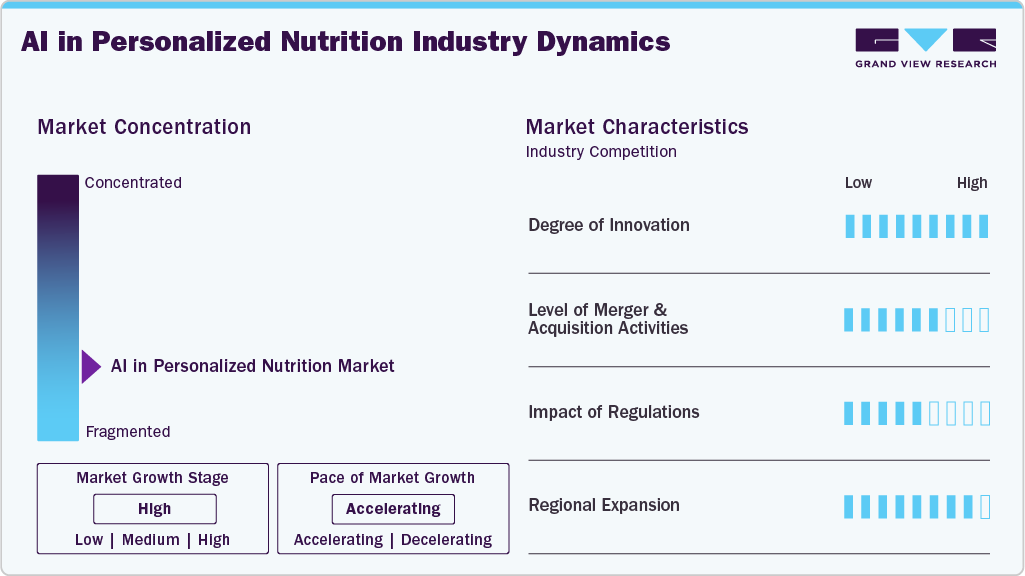
The chart below illustrates the relationship between industry concentration, industry characteristics, and industry participants. The x-axis represents the level of industry concentration, ranging from low to high. The y-axis represents various industry characteristics, including industry competition, level of partnerships & collaboration activities, degree of innovation, impact of regulations, and regional expansion. The market is fragmented, with several emerging players entering the market. The degree of innovation is high. The level of merger & acquisition activities and the impact of regulations is moderate. However, the regional expansion of industry is high.
AI in personalized nutrition industry is characterized by constant innovation, with a strong focus on launching new apps and platforms. In addition, companies are launching personalized nutrition plans featuring nutrient-specific meals, recipes, shopping lists, and dining-out menu scans to ensure individuals get the proper nutrients whenever and wherever they eat. For instance, in October 2023, Ahara launched a free Basic plan for AI-driven, personalized nutrition based on a health questionnaire. It delivers precise nutrient reports and food/supplement recommendations. Targets heart, brain, and metabolic health; app features recipes and scanning. Premium adds DNA/biomarker tests.
“Using Ahara gives each user a personalized nutrition guide that is practical and grounded in the latest science. This is a powerful tool for preventing disease and chronic illness. By leveraging the power of multi-omic inputs from the health questionnaire, genetic, epigenetic, and biomarker testing, Ahara fuses technology, nutritional science, and data science to deliver a proprietary personalized nutrition solution like no other.”
– Julie Wainwright, Co-founder and CEO
The industry is experiencing a moderate level of merger and acquisition activities undertaken by several key players. This is due to the desire to gain a competitive advantage in the industry, enhance technological capabilities, and consolidate in a rapidly growing market.
The regulatory framework for AI in personalized nutrition industry emphasizes data privacy, algorithmic transparency, clinical validation, and ethical deployment. In Europe, the AI Act categorizes high-risk AI systems, including those processing health data for nutrition recommendations, as requiring rigorous conformity assessments, risk management, and human oversight to mitigate biases and ensure explainability. In the U.S., HIPAA governs platforms that handle protected health information, requiring business associate agreements, security safeguards, and breach notifications, while the FDA evaluates AI-driven nutrition tools as Software as a Medical Device (SaMD) if they diagnose, treat, or prevent diseases through claims such as metabolic optimization.
The industry is witnessing high geographical expansion. Companies within the AI in personalized nutrition industry seek geographic expansion strategies to maintain their foothold in emerging markets and attract customers from these regions. For instance, in December 2025, Novo Nordisk India partnered with Healthify to launch an AI-enabled patient support program for obesity care. Featuring Healthify’s AI coach Ria, it provides nutrition tracking, personalized dietitian-guided lifestyle advice, and real-time intelligence across GLP-1 therapy stages. The initiative enhances adherence and outcomes for users in 300+ Indian cities.
Type Insights
Based on type, the AI nutrition apps segment held the largest revenue share of 48.81% in 2025 due to their accessibility, scalability, and direct-to-consumer delivery model. These apps use machine learning algorithms to analyze dietary habits, biometric data, lifestyle factors, and health goals to generate personalized meal plans and nutrition recommendations. Moreover, integration with wearable devices and smartphone sensors enables continuous data capture, allowing real-time dietary adjustments. For instance, in February 2025, Alma launched an AI-powered nutrition companion app featuring proactive, personalized tips, recipe/product discovery, and culturally diverse options.
“Nutrition tracking should empower people to improve their health and feel their best – it shouldn’t feel overwhelming. We created Alma to simplify nutrition tracking while celebrating each person’s unique journey. Alma provides accurate, meaningful insights while celebrating individuality. By acting as a personal nutrition companion in your pocket, one that truly understands and guides you, we aspire to spark a world where everyone can effortlessly enjoy better eating and better living.”
– Rami Alhamad, Founder of Alma.
The enterprise/clinical platforms segment is projected to grow at the fastest CAGR from 2026 to 2033. Enterprise and clinical AI nutrition platforms are designed for hospitals, clinics, wellness centers, and life sciences organizations seeking evidence-based, scalable nutrition personalization. Moreover, advanced analytics support clinical decision-making, risk stratification, and therapy optimization for chronic conditions, thereby further driving the segment’s growth.
Application Insights
Based on application, the AI-based meal planning & recommendations segment accounted for the largest revenue share of 41.45% in 2025. This segment employs advanced algorithms to generate individualized meal plans tailored to specific health goals, dietary preferences, medical conditions, and nutritional requirements. Growth in this area is primarily driven by the increasing prevalence of chronic diseases and the demand for structured, outcome-oriented nutrition management. Artificial intelligence facilitates scalable personalization while ensuring nutritional accuracy and compliance with clinical guidelines. As a result, healthcare providers and employers are adopting these tools to enhance preventive care and wellness programs.
The personalized supplement recommendations segment is anticipated to witness the fastest growth during the forecast period. The personalized supplement recommendations area uses advanced algorithms to analyze a person’s eating habits, test results, daily routines, and inherited factors to provide personalized advice on which vitamins and supplements to take. These programs identify missing nutrients, potential risks in absorbing them, and possible interactions with other supplements, making the advice more tailored than one-size-fits-all suggestions. Such factors are expected to contribute to the segment’s growth.
End Use Insights
Based on end use, the individuals/consumers segment held the largest market share of 46.84%, driven by growing health awareness and demand for self-managed wellness tools. AI platforms deliver tailored dietary insights using inputs such as lifestyle data, fitness metrics, food preferences, and health objectives. Mobile apps and wearables enable continuous tracking and real-time feedback. Accessibility and ease of use support broad consumer penetration.
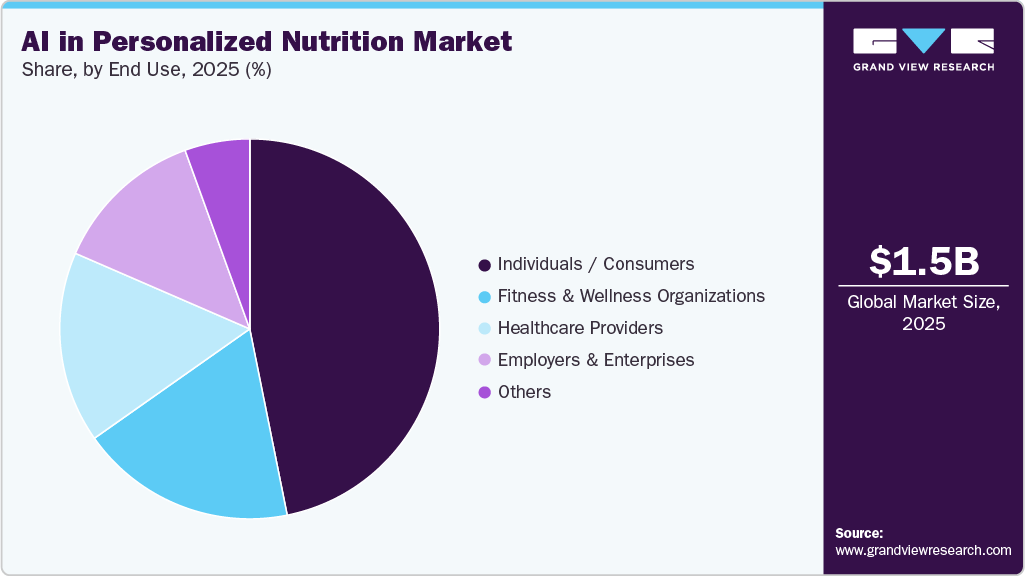
The employers & enterprises segment is likely to witness the fastest CAGR over the forecast period from 2026 to 2033. The employers and enterprises segment is gaining traction as organizations integrate AI-driven personalized nutrition into corporate wellness and population health programs. These platforms analyze aggregated employee health data and deliver customized dietary guidance that supports productivity, disease prevention, and workforce wellbeing. Integration with health risk assessments and wearable data enables scalable, data-driven interventions. Employers use these tools to reduce healthcare costs and absenteeism.
Regional Insights
The North America AI in personalized nutrition market held the largest market share of 52.84% in 2025. The market is driven by high consumer health awareness and widespread adoption of digital health solutions. The high penetration of wearable devices and health apps generates continuous lifestyle and biometric data, enabling AI systems to deliver more accurate, personalized nutrition insights. In addition, advanced genomics infrastructure supports nutrition plans based on genetic and metabolic profiling. Moreover, the robust presence of leading AI, biotech, and nutrition technology companies accelerates innovation and commercialization.
U.S. AI In Personalized Nutrition Market Trends
The AI in personalized nutrition market in the U.S. held the largest market share in 2025. The market is expanding due to the rising prevalence of obesity, diabetes, and cardiovascular diseases, which drives demand for individualized nutrition interventions. Moreover, consumer willingness to pay for premium health services supports subscription-based AI nutrition platforms and services. For instance, in January 2025, Walmart and Soda Health launched the Everyday Health Signals program for select Medicare Advantage and Medicaid flex card members, leveraging AI to analyze opt-in Walmart.com shopping data for personalized nutrition insights. Furthermore, the country benefits from advanced direct-to-consumer genetic testing, thereby expanding data availability for personalization.
Europe AI In Personalized Nutrition Market Trends
The AI in personalized nutrition market in Europe is driven by preventive healthcare priorities and an aging population. Public health systems increasingly emphasize diet-based disease prevention. High adoption of functional foods and nutraceuticals complements AI-based nutrition guidance. Moreover, strong academic research in nutrition science and AI supports evidence-based solutions. For instance, Minutia.ai, a European B2B startup, creates AI-powered “digital twins” of athletes’ gut microbiomes using stool samples, blood work, and questionnaires to predict supplement responses and optimize performance. Targeting footballers, endurance athletes, and triathletes through clinics, sports clubs, and resorts, it simulates bacterial interactions to personalize nutrition, reducing injury risk and inflammation.
The UK AI in personalized nutrition market is expected to grow over the forecast period. In the UK, the NHS’s focus on preventive care is driving interest in customized nutrition solutions. The rising burden of lifestyle-related diseases is strengthening the demand for diet-driven interventions. Government-backed digital health initiatives support AI adoption. Furthermore, robust genomic and nutritional research ecosystems enable innovation, thereby further driving market growth.
The AI in personalized nutrition market in Germany is expected to grow significantly over the forecast period. Strong clinical nutrition standards and emphasis on evidence-based healthcare support Germany’s market growth. High adoption of digital health applications supports the adoption of AI nutrition tools.
Asia Pacific AI In Personalized Nutrition Market Trends
The AI in personalized nutrition market in the Asia Pacific is expected to grow at the fastest CAGR in the coming years. Asia Pacific growth is driven by rapid urbanization and the increasing incidence of metabolic disorders. Expanding middle-class populations show rising interest in preventive and personalized healthcare. In addition, high smartphone penetration enables AI nutrition apps at scale. Government investments in digital health infrastructure support adoption. For instance, the Commonwealth Scientific and Industrial Research Organisation’s (CSIRO) Total Wellbeing Diet study of 78,000 members shows frequent meal plan users lost 6.4kg in 12 weeks (24% more than infrequent users) and 6.9kg after a year when starting early (48% more). A survey of 1,300 members found that 90% of goal achievers used meal plans, with 89% losing >10kg, crediting the meal plans; 72% of non-losers wanted personalization. In response, the program launched My Plan, Australia’s first AI-powered tool trained on 23M data points from 200,000 members, tailoring plans to preferences, allergies, conditions like diabetes/hypertension, and life stages. The evolving AI aligns with national guidelines, enhancing long-term adherence to sustainable weight loss beyond one-size-fits-all approaches.
India AI in personalized nutrition market is expected to experience significant growth in the coming years. In India, the rising prevalence of chronic diseases and a strong cultural focus on balanced diets enhance acceptance of AI-guided nutrition. Evolving healthcare technology infrastructure supports data-driven personalization. Moreover, integration with wearable devices enables continuous dietary monitoring. Furthermore, government support for preventive healthcare strengthens market growth. For instance, in December 2025, Novo Nordisk India partnered with Healthify to launch an AI-enabled patient support program for obesity care, featuring Ria, Healthify’s AI coach.
AI in personalized nutrition market in China is expected to grow rapidly over the forecast period. Rising rates of lifestyle-related diseases and a growing, health-conscious urban population drive China’s market. Furthermore, a strong government focus on AI and digital health accelerates technology adoption. In addition, the availability of large-scale health data supports advanced personalization models. Moreover, integration with e-commerce and digital payments enables scalable business models, thereby further propelling market growth.
Latin America AI In Personalized Nutrition Market Trends
The AI in personalized nutrition market in Latin America is anticipated to grow at a significant CAGR over the forecast period. This growth is driven by rising health awareness, increasing prevalence of obesity, growing adoption of digital health solutions, and expanding e-commerce penetration. Moreover, increasing interest in preventive healthcare, rising demand for personalized supplements, and a growing middle-class population with disposable income are further supporting market growth in the region.
Middle East and Africa AI In Personalized Nutrition Market Trends
The AI in personalized nutrition market in the MEA is expected to grow at a significant CAGR over the forecast period. The industry’s growth is driven by rising health awareness, increasing prevalence of obesity and lifestyle-related chronic diseases, growing adoption of digital health and wellness solutions, and expanding demand for preventive healthcare. Moreover, the market is characterized by a dynamic landscape driven by the increasing adoption of AI in healthcare, rising healthcare expenditures, and supportive government policies. Countries such as Saudi Arabia and the UAE are integrating AI into healthcare infrastructure under strategic visions such as Saudi Vision 2033 and the UAE National Strategy for Artificial Intelligence 2031.
Key AI In Personalized Nutrition Company Insights
Key players operating in the market are undertaking various initiatives to strengthen their market presence and increase the reach of their products. Strategies such as new product launches and partnerships play a key role in propelling market growth.
Key AI In Personalized Nutrition Companies:
The following key companies have been profiled for this study on the AI in personalized nutrition market.
- Appinventiv
- BetterMeal Al
- BiteAI
- Culina Health
- DayTwo
- EatLove
- EIT Food
- Habit
- InsideTracker
- January AI
- LemonBox
- Nourished
- Nutrigenomix Inc.
- Nutrify LLC
- Nutrino Health Ltd.
- Persona Nutrition
- Spur Fit
- Suggestic Inc.
- Viome Inc
- Zoe Ltd.
Recent Developments
-
In October 2025, Omada Health launched Meal Map, an AI-powered nutrition tool within its cardiometabolic programs, emphasizing nutrient quality over calorie counting. It delivers instant feedback on meal nutrient composition, weekly progress reports on nutrition and hydration, and dietitian-approved recipe suggestions via OmadaSpark.
-
In August 2025, MyNetDiary launched PlateAI, an all-in-one AI-powered diet and wellness app for iOS and Android. It features a real-time AI Coach for personalized guidance, photo/voice/menu-scan logging, 1.9M+ verified foods with macros and 100+ micronutrients, custom meal plans, intermittent fasting tools, fitness integrations, and community support.
-
In February 2025, January AI launched Jan, an on-demand AI nutritionist app, evolving its glucose food tracker with hyper-personalized coaching.
-
In September 2023, Dexcom partnered with RxFood in Canada to launch an AI-driven diabetes management solution that integrates Dexcom’s CGM (G6/G7) with RxFood’s photo-based nutrition-tracking. Users capture meals for automated diet-quality metrics, combined with glucose, insulin, and exercise data, to provide personalized insights.
AI In Personalized Nutrition Market Report Scope
|
Report Attribute
|
Details
|
|
Market size value in 2026
|
USD 1.89 billion
|
|
Revenue forecast in 2033
|
USD 10.21 billion
|
|
Growth rate
|
CAGR of 27.21% from 2026 to 2033
|
|
Actual data
|
2021 – 2025
|
|
Forecast period
|
2026 – 2033
|
|
Quantitative units
|
Revenue in USD million/billion and CAGR from 2026 to 2033
|
|
Report coverage
|
Revenue forecast, company ranking, competitive landscape, growth factors, and trends
|
|
Segments covered
|
Type, application, end use, region
|
|
Regional scope
|
North America; Europe; Asia Pacific; Latin America; MEA
|
|
Country scope
|
U.S.; Canada; Mexico; Germany; UK; France; Italy; Spain; Denmark; Sweden; Norway; China; Japan; India; South Korea; Australia; Thailand; Brazil; Argentina; South Africa; Saudi Arabia; UAE; Kuwait
|
|
Key companies profiled
|
Appinventiv; BetterMeal Al; BiteAI; Culina Health; DayTwo; EatLove; EIT Food; Habit; InsideTracker; January AI; LemonBox, Nourished; Nutrigenomix Inc.; Nutrify LLC; Nutrino Health Ltd.; Persona Nutrition; Spur Fit; Suggestic Inc.; Viome Inc.; Zoe Ltd.
|
|
Customization scope
|
Free report customization (equivalent up to 8 analysts working days) with purchase. Addition or alteration to country, regional & segment scope.
|
|
Pricing and purchase options
|
Avail customized purchase options to meet your exact research needs. Explore purchase options
|
Global AI In Personalized Nutrition Market Report Segmentation
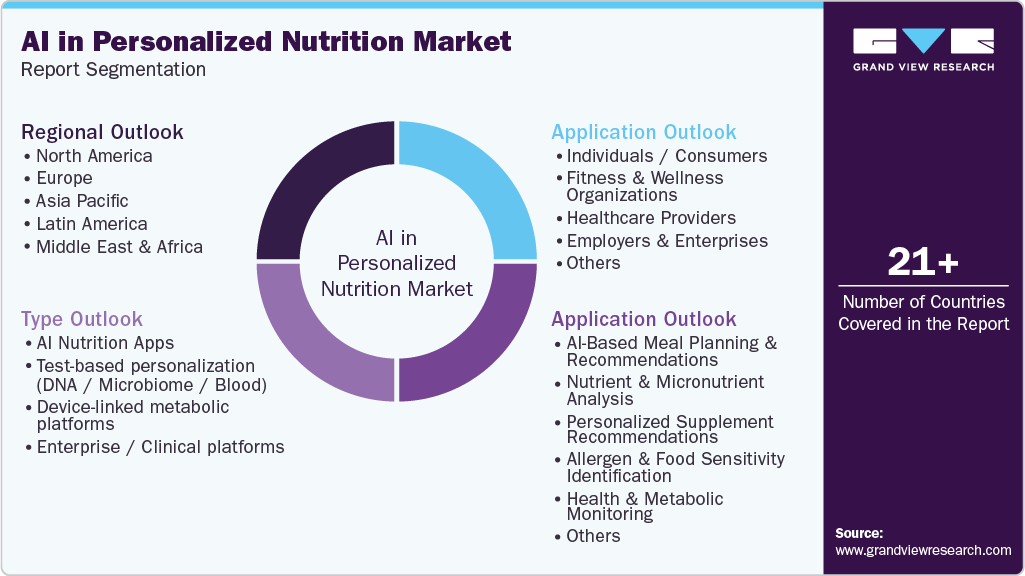
This report forecasts revenue growth at global, regional, and country levels and provides an analysis of the latest industry trends in each of the sub-segments from 2021 to 2033. For this study, Grand View Research has segmented the global AI in personalized nutrition market report based on type, application, end use, and region:
-
Type Outlook (Revenue, USD Million, 2021 – 2033)
-
AI Nutrition Apps
-
Test-based personalization (DNA / Microbiome / Blood)
-
Device-linked metabolic platforms
-
Enterprise / Clinical platforms
-
-
Application Outlook (Revenue, USD Million, 2021 – 2033)
-
AI-Based Meal Planning & Recommendations
-
Nutrient & Micronutrient Analysis
-
Personalized Supplement Recommendations
-
Allergen & Food Sensitivity Identification
-
Health & Metabolic Monitoring
-
Others
-
-
End Use Outlook (Revenue, USD Million, 2021 – 2033)
-
Regional Outlook (Revenue, USD Million, 2021 – 2033)
-
North America
-
Europe
-
Germany
-
UK
-
France
-
Italy
-
Spain
-
Denmark
-
Sweden
-
Norway
-
-
Asia Pacific
-
China
-
Japan
-
India
-
South Korea
-
Australia
-
Thailand
-
-
Latin America
-
MEA
-
South Africa
-
Saudi Arabia
-
UAE
-
Kuwait
-
-
Frequently Asked Questions About This Report
b. The global AI in personalized nutrition market size was estimated at USD 1.54 billion in 2025 and is expected to reach USD 1.89 billion in 2026.
b. The global AI in personalized nutrition market is expected to grow at a compound annual growth rate of 27.21% from 2026 to 2033 to reach USD 10.21 billion by 2033.
b. The AI nutrition apps segment held the largest market share of 48.81% in 2025.
b. Some key players operating in the AI in personalized nutrition market include Appinventiv; BetterMeal Al; BiteAI; Culina Health; DayTwo; EatLove; EIT Food; Habit; InsideTracker; January AI; LemonBox, Nourished; Nutrigenomix Inc.; Nutrify LLC; Nutrino Health ltd.; Persona Nutrition; Spur Fit; Suggestic Inc.; Viome Inc; and Zoe Ltd.
b. Key factors that are driving the AI in personalized nutrition market are rising prevalence of lifestyle-related and chronic diseases, advances in AI, data analytics, and omics integration, and growing consumer demand for preventive and personalized health solutions. Moreover, the expansion of digital health ecosystems and enterprise adoption is strengthening the market environment.
About the Author