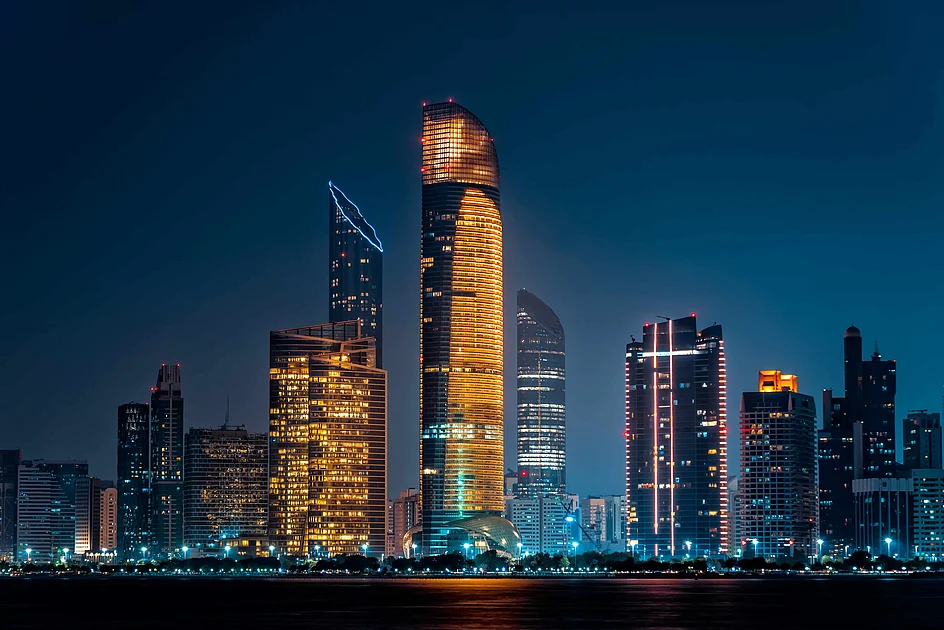
Abu Dhabi’s property market is entering 2026 with “stable macroeconomic foundations and positive market sentiment,” a backdrop that is “providing a supportive” environment across residential, commercial, industrial, retail and hospitality segments, according to ValuStrat’s latest Market Outlook.
Haider Tuaima, Managing Director & Head of Real Estate Research, frames the year ahead as one of resilience and measured growth. “Strong non‑oil activity and continued population growth underpin demand,” he writes, adding that “measured levels of upcoming supply position Abu Dhabi for another year of steady market performance and sustained investor interest.”
Apartments take the lead
Residential values are forecast to rise by 16 per cent in 2026, an acceleration from 13 per cent the year before, while rents are seen up 6 per cent on average. Notably, the report points to a turning point in performance: apartments are projected to outperform villas in capital appreciation. The drivers include buyers’ focus on “value, convenience and lifestyle features,” and the reality that villa rents are “approaching affordability ceilings.”
Supply dynamics remain supportive. While the pipeline is estimated at 16,362 units (roughly 64 per cent apartments and 36 per cent villas/townhouses), actual handovers are expected to be far lower—about 6,500 units—continuing a pattern of delayed deliveries and tight availability. The report pegs projected residential occupancy at 90 per cent, reinforcing upward pressure on prices and rents across several submarkets.
Tuaima sums up the residential mood: “The residential sector is set to continue its upward trajectory in 2026,” with resilience and improving confidence underpinning the trend.
Demand outstrips Grade A office supply
Abu Dhabi’s office market continues to experience strong demand momentum, as new entrants arrive and existing occupiers expand or consolidate. The imbalance is clearest at the top end: Grade A space remains constrained, with limited new supply scheduled this year. ValuStrat expects office prices to rise by 10 per cent and rental values to increase by more than 20 per cent, particularly in prime, well‑connected districts. Projected office occupancy sits at 93 per cent, and only 4,200 sq m (45,208 sq ft) of GLA is slated for addition in 2026, taking total stock to 3.99 million sq m (43 million sq ft).
As occupiers increasingly prioritise building quality, efficiency and location, competitive pressure for Grade A stock is “likely to remain elevated throughout the year,” Tuaima said.
On the tourism front, Abu Dhabi’s hotel sector is set for a positive year, supported by the opening of several four‑ and five‑star properties—including Mondrian Abu Dhabi, Olympia Resort Abu Dhabi and The Mangroves Abu Dhabi, LXR Hotels & Resorts. ValuStrat projects average occupancy at 82 per cent, ADR at Dh551 and RevPAR at Dh452 in 2026, with 309 new keys expected. The report highlights that Ramadan coincides with cooler months, which should lift occupancy in the typically slower season.
This hospitality momentum aligns with the Abu Dhabi Tourism Strategy 2030, which aims to attract 39.3 million visitors annually, expand hotel capacity to 50,000 rooms, and lift sector GDP contribution to Dh90 billion by decade’s end. Local guests remain vital to the affordable and mid‑affordable segments, while luxury and upscale hotels benefit from rising international arrivals.
Macro and other segments
The market outlook is underpinned by a supportive macro picture: the UAE economy is expected to grow around 5 per cent in 2026 with inflation near 2 per cent, aided by strong non‑oil sectors and a rebound in hydrocarbon output. Abu Dhabi’s population is projected to reach 4.5 million, while infrastructure plans—such as phased Etihad Rail passenger services and the Light Rail & Tram network (with Line 4 connecting Zayed International Airport to Yas Island, Al Raha and Khalifa City by 2030)—promise stronger connectivity.
Industrial and retail dynamics reflect broader structural shifts. Logistics assets in KEZAD continue to attract institutional capital, with limited new supply and e‑commerce demand pushing rents higher. At the same time, brick‑and‑mortar malls face pressure from a fast‑growing e‑commerce market, forecast to surpass Dh48.5 billion by 2028, contributing to softer rents and higher vacancies.
Taken together, Abu Dhabi’s real estate story for 2026 is one of disciplined growth, selective tightness and steady investor interest. As Tuaima concludes, “These structural drivers, combined with measured levels of upcoming supply, position Abu Dhabi for another year of steady market performance.”

About the Author