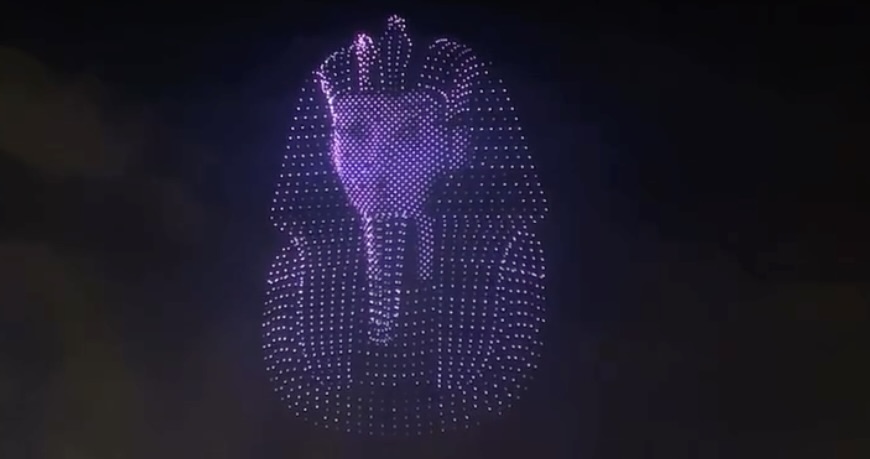

Light show rehearsals ahead of the Grand Egyptian Museum opening. Friday, October 31. Courtesy of @new_museum_guesthouse.
In Cairo, sidewalks have been repainted, screens set-up and security measures tightened. People living nearby say fireworks have been test-run in Giza.
These are the visible signs that the television countdown is over and that what President Abdel Fattah al-Sisi described as an “exceptional” event is about to begin — Egypt’s second in less than a month.
This time, it’s the long-anticipated opening of the Grand Egyptian Museum.
State dignitaries and foreign journalists have flooded into the capital over recent days to head toward the GEM — the outcome of more than two decades of work, interrupted by funding gaps — and to attend its opening ceremony, which has itself entailed intensive preparations overseen by the presidency.
While people gathered or pulled up in cars opposite the museum on Friday to celebrate GEM’s opening, Egyptians have been given the day off — a decision some see as a subtle (or not-so-subtle) signal to stay home, or at one of the designated viewing screens, and to avoid roads around the Pyramids, which are being secured for the ceremony. Citizens were offered alternative roads as major roads were dedicated to the ceremonial process, though the Interior Ministry denied claims these roads were closed off.
But don’t worry — you too can join the hype, virtually. Look at the top corner of your phone and you’ll see your network provider’s name replaced with “Egypt is proud – GEM” or “Egyptian and proud.” Social media platforms are flooding with posts from state-aligned figures, celebrities and users celebrating the “proud” national moment, with some even using Pharaonic-themed AI effects to portray themselves as ancient Egyptian royals inside the new museum.
This gleaming surface has required months of work behind the scenes to produce the museum’s grand opening. A special committee was formed to oversee four months of intensive preparations for the ceremony, an informed government official told Mada Masr on condition of anonymity.
The same source said Sisi personally supervised the process, including the plan for the event’s broadcast transmission, directed by high-profile advertising duo Mohamed al-Saadi and Ihab Gohar — known as Saadi-Gohar.
The duo, who run major advertising agency MediaHub, have increasingly taken over the production of major events held under the presidency’s auspices, most notably the 2021 Royal Mummies Parade — the ceremonial transfer of hundreds of burial masks and embalmed bodies from the old Egyptian Museum in Tahrir to the National Museum of Egyptian Civilization.
Back then, MediaHub was locked in competition for dominance over Egypt’s media landscape with United Media Services (UMS), a rivalry that subsided when Saadi joined UMS’s board of directors in 2021 and his company later became a subsidiary of the intelligence-managed media conglomerate.
MediaHub will manage the broadcast for screens in public squares nationwide, as well as in museums, cultural centers and embassies abroad.
At the same time, the ceremony will stream live on TikTok — the flagship of UMS’s newly announced strategic partnership with the platform, which the company says aims to harness the “reach and wide dissemination power” of digital media platforms.
TikTok’s official role in the state event marks a sharp chapter break from the loud concerns raised over the platform and its content creators over recent years, including when the National Telecommunications Regulatory Authority said in August that they met with TikTok’s regional director to address ethical concerns about content posted on the platform.
So complete is the state’s production and control of publicity around the event that the Tourism and Antiquities Ministry filed a legal report in August against the creator of an AI-generated promotional video of the GEM, citing “violations.” The video creator was arrested shortly afterward, sparking public criticism and calls for his release over how authorities handled the matter.
Meanwhile, the informed government official said a huge budget has gone into preparations, including crafting special invitations for attendees, namely world leaders: lavish velvet-lined gift boxes encasing miniature golden replicas of Tutankhamun’s sarcophagus.
Heads of state, Cabinet ministers and royal family members from nearly 75 countries have accepted the invitation, according to a statement issued Friday by the presidential spokesperson, including the president of the United Arab Emirates, the king of Spain and the president of Germany.
Sisi, who said the museum brings together the “genius of ancient Egyptians and the creativity of modern Egyptians,” welcomed world leaders on Saturday morning, calling the upcoming ceremony a “source of pride” for believers in the unity of humanity and in the values of “peace, love and cooperation among nations,” values he also emphasized at the Sharm el-Sheikh ceremony where he hosted regional and world leaders for the formal signing of the ceasefire agreement between Israel and Hamas.
While Sisi has highlighted peace and other universal values, state officials and Egyptology experts have emphasized the financial boon the GEM’s opening is expected to bring through tourism revenues.
Former antiquities minister and public figure Zahi Hawass argued in the lead-up to the ceremony that a country’s history requires “an inexhaustible source of funding,” saying Egypt’s archaeological heritage — museums and artifacts — are valuable state assets that risk “becoming a burden” unless transformed into a source of national income.
Picking up the point in another of his frequent public appearances earlier this week, he claimed in a televised interview that although GEM cost US$2 billion — a figure at variance with the more commonly cited $1.2 billion — the investment would be recouped within two years through tourism.
And the day’s festivities also serve that purpose. Antiquities Ministry official Ahmed Zain Abdel Rahman said in a post published on his personal channels that the GEM’s opening is not a mere celebration but rather “a massive marketing project for the entire country,” targeting individuals across the globe, including TikTok’s 1.5 billion users.
The GEM, he said, could allow the country to attract 50 million tourists per year instead of the current 10 to 15 million, adding that this “means jobs, it means money, it means stability, it means a better life for every Egyptian.”
But speaking as an Egyptologist, and celebrating the GEM’s role as the first ever museum to focus singularly on a specific civilization, Monica Hanna told Mada Masr that only time will tell what the museum’s impact on the field will be. We’ll have to wait and see,” she concluded.
About the Author