In a recent interview broadcast on the Saudi Al-Arabiya channel, former Culture Minister Farouk Hosni, the former official of the ancient regime who barely makes it to the public sphere today, spoke about the coincidental nature behind the establishment of the Grand Egyptian Museum.
Hosni, who said he was always concerned about how the Egyptian Museum in Cairo is filled to the brim, was at a dinner in Paris when someone asked what he planned to do with the countless artifacts still locked away in storage. Feeling attacked, he answered whimsically that they would be relocated to a big new museum beside the pyramids. He was then promised funding and support for a project that, at the time, existed nowhere outside that room.
Back in Cairo, Hosni rushed to make good on the project, securing a plot of land and a decree by speaking to now-ousted former President Hosni Mubarak, and the whim became reality. In 2002, Mubarak laid the foundation, and in a less lavish opening in 2010, former first lady Susanne Mubarak opened an earlier phase of the museum. The early phase consisted of the launch of an archaeological rehabilitation center and warehouse, a power station and launching the designs.

An archival image circulating on social media shows former President Hosni Mubarak and former Culture Minister Farouk Hosni laying the foundation stone for the Grand Egyptian Museum.
Today, Hosni’s whim and the ancient regime’s investment in the project are pushed to the background as the stage opens for the new protagonists: President Abdel Fattah al-Sisi and his own entourage. More than 20 years and a revolution set them apart. However, what stays on display, accompanying the ancient Egyptian artifacts, is an amalgam of identity politics, state craft, drive for profit and some politics of exclusion.

***
The museum funding was made possible through two Japanese loans worth US$750 million in 2006 and 2016, according to Ahmad Ghoneim, the museum director, while the Egyptian government covered the rest of the cost to reach a total of $1.2 billion. According to a diplomatic source in Cairo, ambassador Hesham Badr, who served in Japan between 2003 and 2007, played an important role in mobilizing the funding.
The same source said the museum fell squarely into Japan’s development funding priorities in Egypt, which include education — through, for example, the Japanese schools project — and culture, as seen in Japan’s role in the Cairo Opera House’s renovation, alongside ongoing support for health and infrastructure.

When the new museum’s construction was interrupted during the 2011 revolution, “Japan was very patient with the project implementation for fear of its complete collapse, especially by [reducing] any pressure [that could be caused] by setting deadlines,” the source said.
Japan’s funding of the project is seen by some as a gesture to de-Europeanize control over the monuments and remains of Egypt’s ancient civilization, many of which are still found in the British Museum, the French Louvre, the Egyptian Museum and Papyrus Collection of Berlin, and elsewhere.
Egypt has its own history of pushing back against foreign control of its heritage. Khaled Azab — former head of projects at Bibliotheca Alexandrina, with a doctorate in Islamic archaeology — points to early 20th-century efforts to reclaim Egyptological heritage from colonial capture as part of wider resistance to British occupation before 1952.
However, this quest was dragged into identity politics following independence.
Today, the political function of GEM, and specifically its opening, plays out as a familiar refrain that locates Pharoanic ancestry as core to the formation of modern Egyptian identity. The motif was clear in the opening ceremony, which took pains to restore credit for discovering King Tutankhamun’s tomb to Hussein Abdel Rasoul rather than British archeologist Howard Carter.
But it began years ago with the gradual dismantling of the Nasserite project of Arab nationalism, and the subsequent rise of an “Egypt first” ideology, marked by the signing of the 1979 peace accords with Israel, Egypt’s subsequent decade-long suspension from the Arab League, and the hastening of neoliberal policies. Azab says that it was former President Anwar al-Sadat, the peace and neo-liberalization champion, who started emphasizing Pharaonic Egypt over Egypt’s Arab history.
The parallel has been clear in state discourse over recent weeks, with drones flying past the pyramids on Saturday bearing streamers that declared Egypt the “land of peace.”
But for Pharaonic Egypt to truly stand tall, Azab feels there should be more discourse on its civilizational principles such as justice and fairness, for example, and not only all the spectacle. What we are seeing instead is something closer to a pride void of history, a ravishing of the material remnants and the spectacle mounted around it.

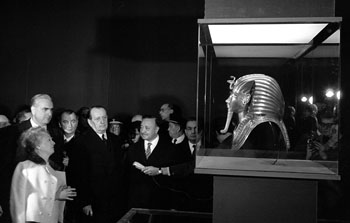
Egyptologist Campbell Price shared this photo of the late Queen Elizabeth of England in front of Tutankhamun’s mask in celebration of the Grand Egyptian Museum’s opening, and wrote: “I hope we can think more critically about how much of ourselves we see reflected in his golden face.”
Monica Hanna, the Egyptologist, captures the sentiment concretely by pointing to the questions surrounding the future of the old Egyptian Museum overlooking Tahrir Square, founded in 1902 under French colonial Egyptologist Gaston Maspero — now the country’s outgoing flagship museum.
Scholars and heritage enthusiasts are concerned that in the wake of the spectacle around GEM, the Tahrir museum could be neglected further. “It has been the beating heart of Egyptology for over a century,” Hanna says. A warranted upgrade could include better labs, research facilities, as well as better exhibition curation practices, she says. But we don’t know what will happen yet.
Salima Ikram, professor of Egyptology at the American University in Cairo, says the Tahrir museum will be refurbished now that GEM has opened, and that it will still be home to some of the more than 100,000 artifacts it used to house before around half were moved to GEM.
But according to Ahmad Saleh — head of academic publishing in the Antiquities Ministry’s Aswan Department — the Tahrir museum needs a complete overhaul if what remains of its collection is not to be overlooked. The issue, he says, isn’t only outdated display techniques but the entire concept. “As a tourist, if I don’t find something different, interesting and captivating, why would I go to Tahrir when I could go to GEM?” he asks.
At all rates, Hanna thinks the Egyptian Museum, overlooking the historical heart of modern Cairo, is part of Egypt’s soft power, and bears a political weight that deserves attention — even if the nature of the project is not yet clear.
The vision for GEM — beyond the glitz and ceremony of the opening — also lacks clarity, according to Azab, who says that the current administration has no coherent policy on archaeology or history.
It is “random,” he says, that the current moment is one of Egyptology, thrust into the spotlight by GEM.
But to what end? A theoretical concern, coined by sociologist Tony Bennet, is the idea of the “exhibitionary complex,” whereby the museum is curated less as a fertile site for public participation in knowledge production; more as a disciplinary tool for public instruction around ideas of national pride — an eventuality that would short-circuit the horizon for an introspection prompted by the endless mysteries of Ancient Egyptian civilization.
Nora Shalaby, an independent archaeologist, thinks similarly of the GEM. “Museums, including this one, are generally curated in a way to highlight and showcase achievements through the lens of the elite,” she says. “The past is treated as uninterrupted wealth, prestige and power — then connected to the present.”
Without careful policy and curation, the risk is that the instrumentalization of ancient Egyptian civilization flattens it into a one-dimensional monolith — even as GEM presents an opportunity to revitalize Egyptology at home. It’s a concern Azab raises, noting with sadness the political “polarization” and “squabbling” that can break out whenever different facets of Egypt’s historical identity are placed in parallel.
One element of the civilizational vitality that often gets pushed to the background is Egypt’s Coptic history and heritage. Atef Naguib, former director of the Coptic Museum and adjunct professor at Cairo University, says it is unfortunate that Coptic history receives so little attention, given its close relation to ancient Egyptian civilization. He points to three elements in particular where the connection is clear: the language, a mix of the old Egyptian language and Ancient Greek; the Coptic calendar, derived from the Ancient Egyptian calendar and still used by farmers today for their crops cycle; and music.
He laments that Coptic heritage is too often treated as solely a matter of religion rather than history — an assumption that, left unaddressed, can leave room for sectarianism to take hold.
Naguib hopes that, while sites like the Coptic museum are less popular among tourists at present, the GEM could be an opportunity to draw attention to it as well as other museums.
He also points to the silence around the history of Nubia and its people, another facet of Ancient Egypt often lost in the telling, though it was granted a nod in Saturday’s ceremony. Saleh, who is also former director of the Organization of the Salvage of the Monuments of Nubia and current head of academic publishing on Aswan for the Tourism and Antiquities Ministry, notes that intersection points between Nubia and Ancient Egypt remain the matter of live scholarly and popular debate, pointing for example to an ongoing dispute on the identity of Senenmut, the architect of the Hatshepsut Temple. Some claim him to have been ethnically Nubian, others make the opposite argument.
Regardless of claims around the individual, Salah says that Nubians were an important part of Pharaonic civilization in the 6th Dynasty, when Egypt had its first Nubian battalion. Down the years, a full dynasty, the 25th, that ruled Egypt for 108 years, was predominantly Nubian in character.
But references to Nubia and its communities today — whose visibility is often met with harsh suppression — rarely surface in conversations around Pharaonic history, a dynamic unfolding amid ongoing marginalization and erasure.
When we ask why the Nubian role in Egypt’s ancient history is not taught or celebrated, Saleh declines to answer.
He does comment on his hopes for the GEM project, however. “I don’t want this to be one festive occasion that will end when the festivities end, I want this to be a lifelong process of learning.”
But the move toward national sovereignty over Ancient Egyptian heritage also has to contend with GEM’s profit motive.
The cost and revenues policy direction is not new, emerging in 2011 when antiquities management was unified with the Tourism Ministry. Zahi Hawass, who was the first official to head the combined ministry argued in the lead-up to the opening ceremony that a country’s history requires “an inexhaustible source of funding,” saying Egypt’s archaeological heritage — museums and artifacts — are valuable state assets that should be transformed into a source of national income.
The museum itself is a public economic authority, whose bylaws allow it to establish companies and generate profits by renting out conference halls, run shops and restaurants, and sell tickets. The museum’s ticket prices range between LE1,450 for foreigners and LE200 for Egyptians — a high fee for most in the country. Souvenir shops and cafes have already opened.
More broadly, GEM is planned to contribute directly to a boost in tourism revenue which is already on the rise. State revenues rose 16.5 percent year-on-year to reach US$16.7 billion in FY 2024/25, the peak of a steady climb out of the pandemic years, when revenues bottomed out to record under $4 billion in 2020.
Rolling commentary on Saturday’s ceremonial opening across state-affiliated TV channels focused on design features meant to keep visitors inside the museum longer — a direction framed as encouraging more overnight stays in surrounding hotels. Commentators noted that these stays may increasingly benefit hotel projects initiated by businessmen closely affiliated with the state — such as Hesham Talaat Mostafa, who teased a new hotel development to the media at the opening — rather than the informal hotels that used to dominate the area.
Another Antiquities Ministry official, Ahmed Zain Abdel Rahman, writes that the GEM could allow the country to attract 50 million tourists per year instead of the current 10 to 15 million, adding that this “means jobs, it means money, it means stability, it means a better life for every Egyptian.”
And then, Azab points out that Ghoneim, the head of GEM, is an economist rather than an Egyptologist — a significant departure from the Egyptian Museum in Tahrir, which for more than a century has been led by specialists in Egyptology.
Appointed by Prime Minister Mostafa Madbuly in 2024 as GEM’s CEO, Ghoneim was an advisor to the Trade Ministry on international agreements, as well as to several organizations, including the World Bank, the World Trade Organization and the World Intellectual Property Organization. His expertise lies in trade policy, trade in services and multilateral trading systems.
The investment has already borne out some results. Ikram is optimistic about the opportunities the sheer opening of the GEM will create. She notes that it is the largest museum in the region — and the largest in the world devoted to a single civilization — and says the scale of its displays will spark new ideas and drive future research projects.
After working in GEM’s conservation labs on artifacts from Tutankhamoun’s burial chamber, she says the facilities are excellent and enable in-depth research on how an artifact is made, materiality, production techniques and provenance. She expects stronger scholarship to follow, yielding richer and more substantial findings.
Doubtless, an Egyptology project based in Egypt needs funding at scale, as Hanna points out. But it would also need a clear policy, she says, one that will enable researchers to undertake and engage with knowledge production and dissemination through GEM.
And at the very least, in Hanna’s view, GEM should appoint a chief curator to lead it alongside Ghoneim, an Egyptologist with a plan, and one that keeps decolonization at the forefront.
What kind of decolonization remains to be seen.
***
Correction: This piece was amended after publishing to remove a quotation attributed to Professor Salima Ikram in which she described museum artifacts displayed on the ground floor as offering “a condensed chronological overview, while the upper floor is organized thematically, illustrating daily life, religion and other facets of society across different eras, from the pre-dynastic to the Greco-Roman and others.”
The original version stated that Ikram was describing the Grand Egyptian Museum, whereas the American University in Cairo Egyptologist was providing an account of the exhibition at the Egyptian Museum in Cairo.
About the Author