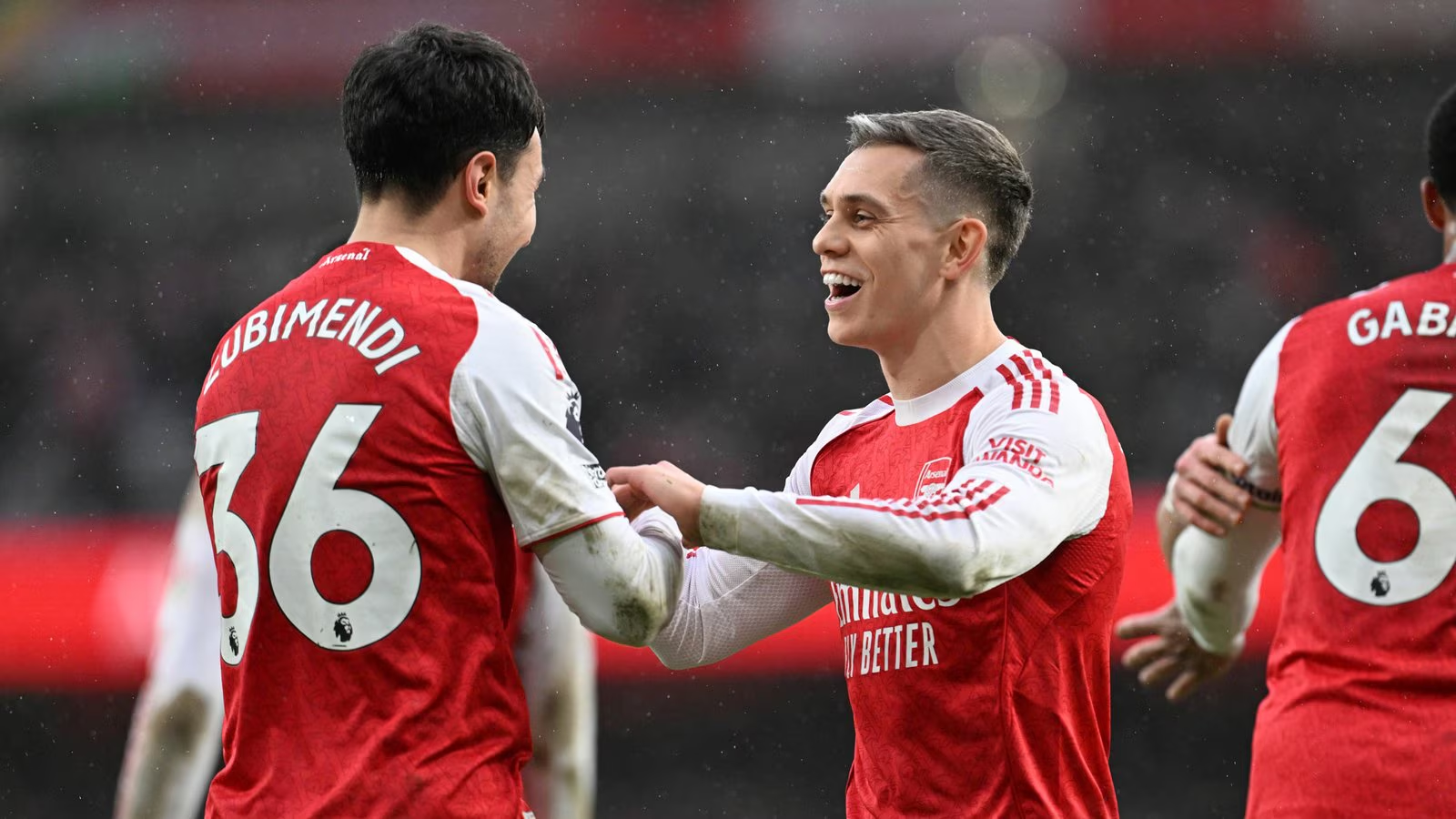
We maintained our six-point lead at the top of the Premier League with a convincing 3-0 win at home to Sunderland on Saturday.
Martin Zubimendi opened the scoring in style with half-time approaching, before Viktor Gyokeres’ second-half brace wrapped up the three points in N5.
Analyst Adrian Clarke has gone back through the footage to discover exactly what made us so clinical:
finding the spare midfielder
One of the key tactical patterns of this encounter was the way we allowed Declan Rice or Martin Zubimendi to become our ‘spare man’ inside the final third.
By pushing numerous players into Sunderland’s penalty area, including left back Riccardo Calafiori (circled) we occupied almost every blue shirt when the ball was in wide positions.
As shown below, Leandro Trossard was then able to attract two opponents towards him as Sunderland chose to provide cover for their right back Nordi Mukiele, who faced a 1v1.
This allowed Declan Rice to be free within shooting range, and from this move he whistled his shot inches past the top corner
Just minutes later we produced a near-identical situation, but this time it led to our crucial opening goal.
On this occasion, when Sunderland decided to double-up on Trossard, it was Martin Zubimendi that was left free.
Thanks to a beautifully weighted pass, the Spaniard hit the ball first time, cutting across the ball to swerve an unerring strike in off the post.
Tireless excellence in midfield
Playing as a pair, balancing off one another beautifully in terms of their box-to-box impact, it was central midfielders Zubimendi and Declan Rice who laid the foundation for this comfortable victory.
Taking turns to go forward they communicated very well, and they each largely (but not exclusively) stuck to their positions, with Rice to the left of centre, and the Spaniard to the right.
They both made three interceptions, reading play beautifully whenever we were out of possession; and between them the duo also recovered possession 13 times.
Rice (54) made more accurate passes than anyone else, while Zubimendi completed 47 of his 51 attempted passes, circulating the ball with ease and effortless excellence.
The duo worked tirelessly in pursuit of three big points too.
Zubimendi’s impressive 11.45km of distance covered was the most of anybody on the pitch.
| Arsenal player | distance |
|---|---|
| Martin Zubimendi | 11.45km |
| Declan Rice | 10.74km |
| Leandro Trossard | 10.01km |
| Jurrien Timber | 9.82km |
| Gabriel | 9.52km |
two up top?
From a tactical perspective this was as close to a 4-4-2 formation that we have seen from Mikel Arteta in over a year.
Kai Havertz was in essence a support striker for Gabriel Jesus, and later on Viktor Gyokeres, but for much of this fixture it was hard to differentiate between the German’s role and that of the centre forward.
Choosing to only drop into midfield on sporadic occasions to link play, Havertz stayed high, allowing the team to play a little more direct.
Whenever the ball was on the wings, he also ensured he was inside the danger zone trying to get on the end of a delivery.
He did so in the first minute, heading wide from Leandro Trossard’s gorgeous right wing cross.
When you study our average position map from the Sunderland game, it really does resemble a 4-4-2…
Touching the ball seven times inside the opposition box (a team-high) and taking on three shots (a joint-high), Havertz certainly impacted matters in this more advanced position.
Creating the key second goal, scored by Gyokeres, he impressed.
pattern of fewer passes continues
Not many would have expected us to enjoy less than 50% of possession at home to newly promoted Sunderland, but that was the case on Saturday afternoon.
Our successful pass count of 389 was in fact the fourth lowest we have recorded in 25 Premier League matches.
This follows on from unexpectedly low levels of distribution against Leeds United and Manchester United in our previous two matches.
| Opponent | fewest successful long passes |
|---|---|
| Manchester United (A) | 294 |
| Aston Villa (H) | 351 |
| Liverpool (A) | 371 |
| Sunderland (H) | 389 |
| Leeds United (A) | 395 |
| Manchester United (H) | 443 |
It appears there is a focus right now on getting the ball into forward areas a little faster than we have done at times in 2025/26.
Catching opposition rearguards off guard with earlier attacking intent, rather than showing bags of patience in a bid to wear them down, should in theory help Gyokeres’ style of play to flourish.
So, perhaps it is no coincidence the Swede has scored six goals so far in 2026, the most of any Premier League player across all competitions.
built to counter
There is a boldness about Sunderland, who like to commit players forward whenever they step onto the front foot.
While this makes them dangerous, especially from second balls, they can leave themselves light at the back on occasion.
Part of our game plan seemed to revolve around hurting them in this manner from breakaways.
This ploy tied in well with our low-possession tactics, meaning that many of our better chances stemmed from counter attacks.
In this example (below) David Raya saved a rare shot on target during the first half, before instantly throwing the ball out to Havertz in space…
With Sunderland stretched and backpedalling he carried the ball half the length of the pitch before curling a shot just wide of the far top corner.
Gabriel Jesus was also exceptionally unlucky not to win the Gunners a penalty from another classic breakaway.
After repelling a long free kick from the visiting keeper, the ball was hooked on to Trossard, who in turn slipped a pass to Havertz, who released Jesus with a classy one-touch through ball.
The narrowest of offside decisions went against the Brazilian, but the way we penetrated Sunderland was mightily impressive…
In injury time we sealed this handsome win with another brilliant goal on the break.
On this occasion, Christian Norgaard’s clearance fell to Gabriel Martinelli, who did remarkably well to loft the ball over the last defender, Reinildo, before unselfishly teeing up Gyokeres for a tap-in.
Our two-goal hero deserves credit for the way he stayed onside while Martinelli was bearing down on goal.
Gyokeres altered his stride pattern at the last moment to stay behind the ball, and that intelligence was rewarded with the easiest of finishes.
When you look back on this game now, the managers’ chosen approach was perfectly suited to this fixture.
The timing of his second half changes also gave the side fresh impetus at the right moment.
This was a professional, calm and well-thought-out performance.
Copyright 2026 The Arsenal Football Club Limited. Permission to use quotations from this article is granted subject to appropriate credit being given to www.arsenal.com as the source.
About the Author