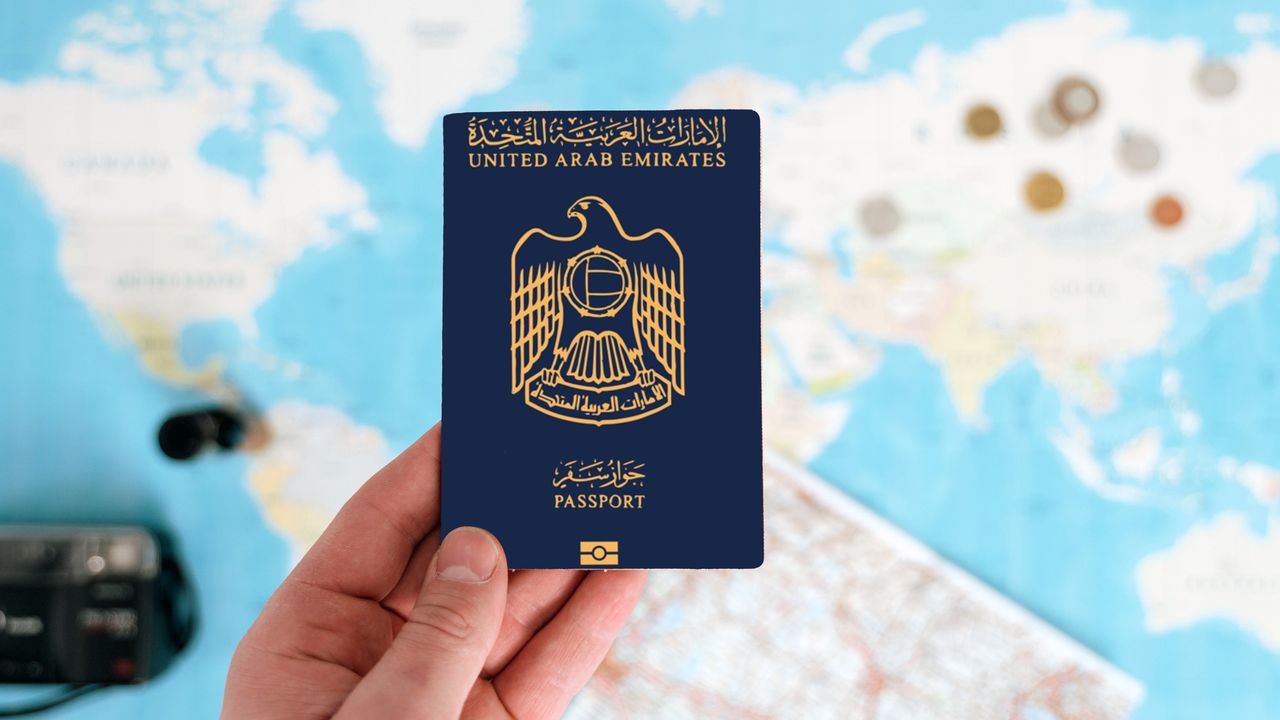
The UAE’s passport is more powerful than it’s ever been – climbing to fifth place in the 2026 Henley Passport Index, overtaking the US and the UK.
It’s the highest ranking the UAE passport has ever held on the bi-annual list, rising 57 places over the past 20 years – the biggest power shift of any global passport.
Compiled by UK-based consultancy Henley & Partners using data from the International Air Transport Association (IATA), the Henley Passport Index measures the power of a passport by the number of visa-free countries its holder is able to access.
For UAE passport holders, that’s 184 countries for 2026, placing it in joint fifth position alongside Hungary, Portugal, Slovakia and Slovenia. In 2025’s mid-year rankings, the UAE ranked in eighth position.
It remains the only Arab nation in the top 10, and ranks ahead of New Zealand (6th), the UK (7th), Canada (8th) and the US (10th). Singapore retains its title as the world’s most powerful passport, with 192 visa-free destinations available to holders, followed by Japan and South Korea tied in second place with 188.
In the 2026 Henley Passport Index, released on Tuesday, 13 January, the UAE was flagged as a strong performer, driven largely by its “sustained diplomatic engagement and visa liberalisation”. Over the past 20 years, 149 visa-free destinations have opened up to UAE passport holders.
The UAE passport’s power shift, tracked
January 2026: 5th – 184 countries
January 2025: 10th – 185 countries
January 2024: 11th – 183 countries
January 2023: 15th – 178 countries
January 2022: 15th – 175 countries
January 2021: 16th – 174 countries
January 2020: 18th – 170 countries
January 2019: 15th – 172 countries
January 2018: 21st – 161 countries
January 2017: 38th – 121 countries
January 2016: 38th – 122 countries
The rankings come ahead of what is predicted by IATA to be a bumper year in global travel, with more than 5.2 billion passengers expected in 2026. “A record number of people are expected to travel in 2026. The unequivocal economic and social benefits generated by this travel grow as it becomes more accessible. But while more people have the economic freedom to travel, many nationalities are seeing that a passport alone is no longer sufficient to cross borders,” says IATA Director General Willie Walsh. “As many governments look to more tightly secure their borders, technological advances such as digital ID and digital passports should not be overlooked by policymakers. Convenient travel and secure borders are possible.”
However, despite more people travelling than ever before, the global mobility gap – the countries available to passport holders at both ends of the Index – is only getting wider. “Passport power ultimately reflects political stability, diplomatic credibility, and the ability to shape international rules,” says Misha Glenny, journalist and rector of the Institute for Human Sciences in Vienna.
“As transatlantic relations strain and domestic politics grow more volatile, the erosion of mobility rights for countries like the US and UK is less a technical anomaly than a signal of deeper geopolitical recalibration.”
About the Author