The Golden Era of muscle cars and pony cars, which spanned from the mid-1960s to the early ’70s, is famous for producing some of the most iconic American cars of all time. The muscle car blueprint was formulated and perfected during this era, resulting in cars that combined aggressive designs, raw power, and affordability- a recipe that earned them worldwide fame and adoration and helped American automakers elevate their status across the globe.
However, there’s a problem that typically comes with international fame, success, and widespread acceptance among gearheads – price. Golden age cars have earned collector devotion over the years by delivering unfiltered power wrapped in instantly recognizable American design, and many of them now cost a lot more than they did when new. Some rare, top-spec muscle cars have already crossed the seven-figure mark at auction, and with modern muscle models being phased out, prices will likely keep going up even for less famous models from the era.
While looking at auction results may discourage gearheads who dream of adding a golden age muscle car or pony car to their dream garage, the good news is that, with meticulous research, you can still find great options from the era without breaking the bank. And that’s our focus here – golden age American classic cars you can still buy for relatively affordable prices. Granted, these cars may not have the groundbreaking engines, legendary trims, motorsports pedigree, or rarity that more expensive options have, but they still deliver ’60s-’70s Americana in its purest form.
Our Selection Criteria

Image Credit: Autorepublika.
Each golden age classic car was selected through a rigorous evaluation of its current prices using real-world pricing data from listings and auctions, and market reporting from respected sources like Hagerty and Classic.com. We then arranged them in order from most to least expensive.
Every car here can be yours for about the same price as a soulless 2026 crossover SUV, but it scores much higher on the kickass scale. The biggest trade-off here is power, as you won’t find a Hemi-powered Mopar monster, but the cars still evoke an emotion that few American cars built after the era have managed to capture.
1968 Dodge Dart GTS

Image Credit: Greg Gjerdingen from Willmar, USA – 1968 Dodge Dart GTS, CC BY 2.0/Wiki Commons.
Price: $45,500
When the Dodge Dart became a compact car in 1963, it was a budget car first and foremost, with Slant Sixes and lethargic V8s under the hood. This was acceptable for a while, and Dodge sold them in the hundreds of thousands, but when Ford built the Mustang and kicked off the pony car wars, the Dart’s power was no longer acceptable to speed freaks. Thankfully, Chrysler redesigned the A-body platform in 1967, which not only gave it a more muscular look but also allowed Dodge to fit bigger engines under the Dart’s hood. This move gave rise to the Dodge Dart GTS – a factory-built Dart model with serious performance credentials, especially for buyers who chose the optional 383 cubic-inch V8 with 300 hp on tap.
The 1968 Dart GTS is nowhere near as powerful or iconic as the Hemi-powered Darts of the era, but its sub-$50k price tag is far more palatable than what factory-built Hemi Dart package cars typically bring at major auctions. Recent online-auction results can land in the mid-$40,000 range for strong examples, while Hagerty’s valuation tool often pegs good-condition cars closer to the $30,000 range.
1968 Pontiac GTO

Image Credit: Calreyn88 – Own work, CC0/ Wiki Commons.
Price: $38,500
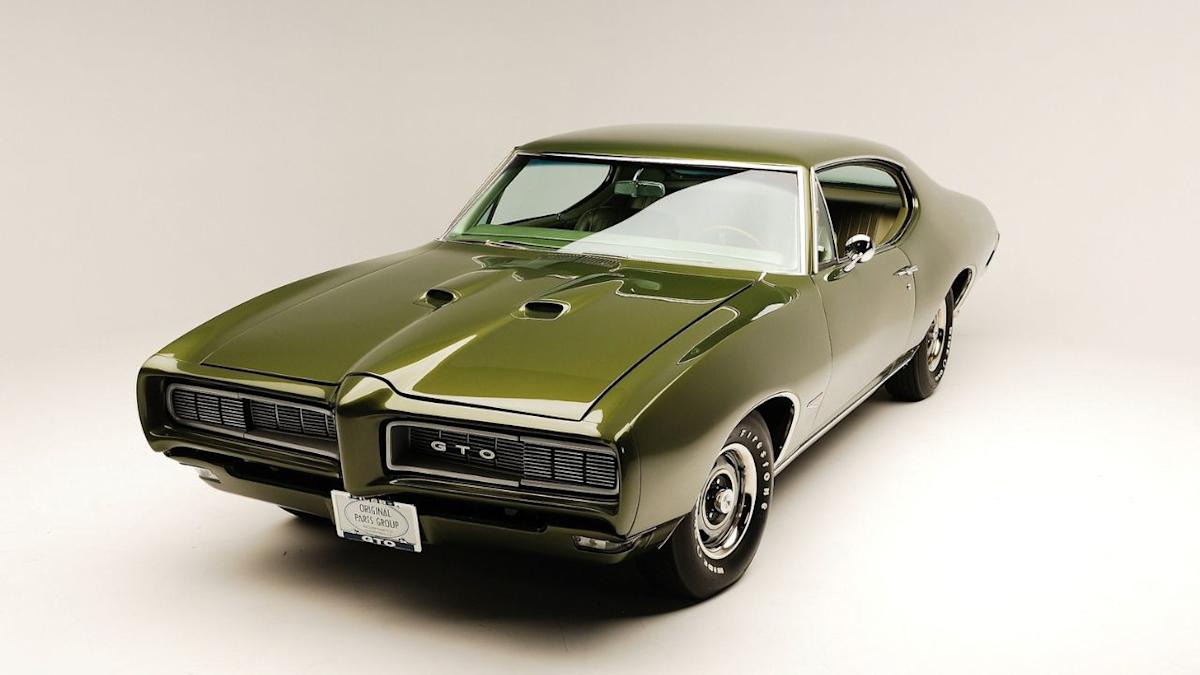
The Pontiac GTO is often credited as the first proper muscle car when it debuted in 1964. However, as important as the first-generation GTO was, the model reached its peak in design and power when the second-generation model launched in 1968. The 1968 GTO looked markedly different from its predecessor, adopting a more curvaceous, semi-fastback “Coke bottle” look that gearheads fell in love with.
The 1968 GTO also saw a power bump to 350 hp for the 400 cubic-inch four-barrel model, and this is our pick today. While collectors fight for the GTO “Judge” models that came in 1969, 1968 GTO values remain fairly grounded, but it will still impress muscle car enthusiasts. A red matching-numbers 1968 GTO Coupe with a 400 cubic-inch V8 sold for $38,500 at the 2025 Mecum Auctions Dallas/Fort Worth event.
1967 Pontiac Firebird 400

Image Credit: Jeremy from Sydney, Australia – 1967 Pontiac Firebird, CC BY 2.0/ Wiki Commons.
Price: $36,500
Midway through the Chevy Camaro’s development process – which was a rushed GM response to the highly successful first-generation Mustang – GM got wind that Ford was building an upscale version of the Mustang called the Mercury Cougar. At the same time, Pontiac wanted to develop a new two-seater sports car to solidify its position as a performance-oriented “youth” brand, but the GM top brass had denied the request as it didn’t want an internal rival for the Corvette. As such, GM found a compromise by allowing Pontiac to build their desired performance car, but it had to be a pony car based on the Camaro’s F-body platform for cost-effective development.
The Pontiac Firebird had a lot in common with the Camaro, including the platform and above-the-belt design, but it looked markedly different below the belt, adopting a more rounded design language compared to the Camaro’s more angular look. The Firebird also had a unique engine lineup, with the Firebird 400 trim getting a 400 cubic-inch V8 with 325 hp on tap. A 1967 Firebird 400 without the Ram Air option is still affordable today, with one having sold for $36,500 at a 2025 BaT auction.
1969 Chevrolet Camaro

Image Credit: Sicnag – 1969 Chevrolet Camaro 327, CC BY 2.0/ Wiki Commons.
Price: $36,000
It’s a widely accepted fact that the first-generation Chevy Camaro was rushed into production after the Mustang’s seemingly overnight success, going from concept to production in about two years. With such a hurried timeline, there wasn’t too much hope in the Camaro, but it ended up shattering expectations and creating an icon with a production run spanning almost six decades, with just a brief hiatus from 2003 to 2009.
All three first-generation Camaro years deliver on design and performance, but the 1969 model year is the most popular by far. The 1969 Camaro had a refreshed design that gave it a more aggressive look than earlier years, featuring sculpted lines, a wider stance, a V-shaped nose, and fender flares – it looked so good that it inspired the fifth-generation Camaro’s design decades later. 1969 is also when the first-generation Camaro achieved peak performance, particularly in the ultra-rare ZL1 trim with its race-sourced all-aluminum engine. However, ultra-rare ZL1 cars are valued well into six figures (and often into seven figures), so most budget-minded buyers are better off targeting a more common trim for the same first-gen look, such as the 632-powered 1969 Chevrolet Camaro Coupe that sold for $35,250 on Bring a Trailer on November 18, 2025. Unfussed-with examples command a premium, but they are hard to come by.
1966 Chevrolet Impala SS 396

Greg Gjerdingen from Willmar, USA – DSC00581, CC BY 2.0/ Wiki Commons.
Price: $35,500
The Chevrolet Impala is a car that has lived many lives over its 10 generations, but the fourth-gen variant stands tall as its greatest generation ever (arguably). The fourth-gen Impala debuted in 1965 and topped one million units sold for the model year, one of the biggest single-year totals any American passenger car has ever posted. Gearheads loved its Coke bottle shape, superior ride quality thanks to redesigned coil suspension and the switch to a full perimeter frame, and the wide variety of body styles and engine options.
Chevy also retained the high-performance “SS” trim and injected more power into it to make it competitive in the muscle car market. We’ve picked the 1966 Impala SS here, and the best part is, it packs a punch thanks to a 396 cubic-inch V8 with 325 hp on tap. A highly original 1966 Impala SS 396 with 66,000 miles on the odometer sold for $35,500 a few months ago.
1971 Plymouth Duster

Image Credit: Riley from Christchurch, New Zealand – 1971 Plymouth Duster, CC BY 2.0/ Wiki Commons.
Price: $35,200
When Plymouth moved the Barracuda from the A-body platform to the larger E-body platform in 1970, a big gap was created in the marque’s lineup, leaving room for a new affordable A-body sporty coupe. Plymouth needed to fill this gap quickly and affordably, so they raided the parts bin and created an unexpected winner – the Duster.
Plymouth only had a budget of $15 million to create the Duster, so they followed the “junkyard styling” design philosophy. The platform, front-end sheet metal, and most of the interior came from the Valiant, while other parts from the cowl back were sourced from various Chrysler coupes. Despite the rough start, the Duster became a huge success for Plymouth, selling 1.3 million units during its 1970-1976 production run.
There were multiple trims and special versions of the Duster, and if you want the most performance-oriented factory setup, the Duster 340 is the one to look for. For pricing context, a 1971 Plymouth Duster sold for $35,200 at Mecum Kissimmee 2026. Since Duster 340 horsepower figures in post-1971 models dropped due to the industry shift from SAE gross to SAE net ratings along with emissions-related tuning changes, the 1970 and 1971 models are the most desirable. Thankfully, they’re still within reach, with one selling for $35,200 at the 2026 Mecum Kissimmee auction. However, values can move quickly for clean, correctly optioned cars, so check recent sales and don’t assume today’s asking prices will hold.
1971 AMC Javelin AMX

Image Credit: CZmarlin — Christopher Ziemnowicz — a photo credit is required if this image is used anywhere other than Wikipedia. – Own work, CC BY-SA 4.0/ Wiki Commons.
Price: $29,120
As one of the small independent automakers, AMC put up a good fight during the golden era, building models that could hang with the Big Three but at discounted prices. One of those models was the Javelin. The Javelin ran from 1968-1974 across two generations, but the second-generation model (1971-1974) is considered to be the best thanks to its aggressive design and availability of the 401 cubic-inch V8. More specifically, 1971 is the best Javelin year as it came right before power figures dropped.
You have two options here, and both could be optioned with the top engine option – a 330-hp 401 cubic-inch V8. You can go with the more affordable luxury-oriented SST trim, but the better option is the performance-oriented AMX trim, and with a highly original example one having sold for $29,120 in an August 2025 auction, it’s an affordable and unique addition to any collection.
1969 Ford Mustang GT Convertible

Image Credit: Sicnag – 1969 Ford Mustang Convertible, CC BY 2.0/ Wiki Commons.
Price: $27,850
The first-generation Ford Mustang is easily one of the most important cars in history, as it is widely considered to be the car that kicked off the pony car craze in the mid-60s. This car was a smash hit when it debuted, and Ford took full advantage of its popularity by launching multiple trims and special editions, some of which exchange hands for millions today.
If you’re a budget-minded collector looking for something in the first-gen Mustang’s lineup, there are several options, but we picked the one that strikes a balance between aesthetics, performance, and price – the 1969 Mustang GT Convertible with the 290-hp 351 cubic-inch V8. Ford gave the Mustang a design refresh that made it look more aggressive and muscular than the 1968 model, and since it came just before the malaise era kicked in, it still offered some semblance of performance. A Lime Gold 351-powered single-family-owned 1969 Mustang GT Convertible sold for just $27,850 at a Bring a Trailer auction.
1967 Mercury Cougar

Image Credit: Sicnag – 1967 Mercury Cougar 2 door Hardtop, CC BY 2.0/ Wiki Commons.
Price: $27,500
While the first-generation Ford Mustang basks in endless acclaim, the Mercury Cougar doesn’t get the same recognition, even though both cars shared the same platform. This presents a great opportunity for those who know to get a killer pony car at a discount, which is why we’ve picked the 1967 Cougar.
The first-generation Cougar was actually quite popular when it debuted in 1967, becoming the only Mercury vehicle to ever clinch the prestigious Motor Trend Car of the Year award. Positioned as a premium pony car, the Cougar was slightly longer than the Mustang to increase cabin space and accommodate more upscale features, had a quieter cabin, and offered unique styling cues such as its hidden headlights and sequential taillights. Bring a Trailer sales results over the last few years show that the 1967 Cougar can sell for under $30k even with a 390 cubic-inch V8 dishing out 320 hp.
1969 Plymouth Barracuda 340

Image Credit: Bull-Doser at English Wikipedia – Own work., Public Domain/ Wiki Commons.
Price: $26,000
Whenever “Plymouth Barracuda” is mentioned, most gearheads instantly think of the insane Hemi ‘Cuda that ruled the streets in the early ’70s. Big, powerful, and rare, the Hemi ‘Cuda is a highly sought-after collectible today, and its stratospheric prices have pushed early third-generation Barracuda prices out of our budget. As such, we’ve settled for the less popular second-generation 1969 model.
The second-generation Barracuda was based on the Chrysler A-body platform and had multiple engine options, but we’ve chosen two – the 340 and the 383. Both cars are within our budget, but we went with the 340 since it’s lighter, cheaper, and even though its 275-hp output is less than the 383’s 330 hp, it offers nimble handling and high-revving fun. A 1969 Barracuda with the original 340 engine and three-speed automatic transmission sold for just $26,000 on BaT in 2025, proving that it’s attainable even for budget-minded gearheads.
Golden Age American Classics Will Always Be Cool

Image Credit: Gestalt Imagery / Shutterstock.
With the Chevy Camaro and Dodge Challenger discontinued in recent years, the muscle car segment is closer to extinction than ever. Sad as it may be, this presents an opportunity for collectors who know their stuff to find affordable and overlooked golden age classics that will not only grow in value but also serve as rolling pieces of the American auto industry’s rich history.
Regardless of their price, golden age muscle cars and pony cars have an aura that’s impossible to replicate, even when parked. Whether you drive the only surviving Shelby GT500 Super Snake with a monstrous race-spec V8 under the hood or a humble base first-generation Camaro, you’ll always attract the attention of lookie-loos whenever you pull up to a car show.
About the Author