POINT BLANK, Texas (KTRK) — Christina Mann says she moved from Cleveland, Texas, to Point Blank four years ago when she retired so she could be near the water.
But now, she said, it’s water that’s making her life difficult.
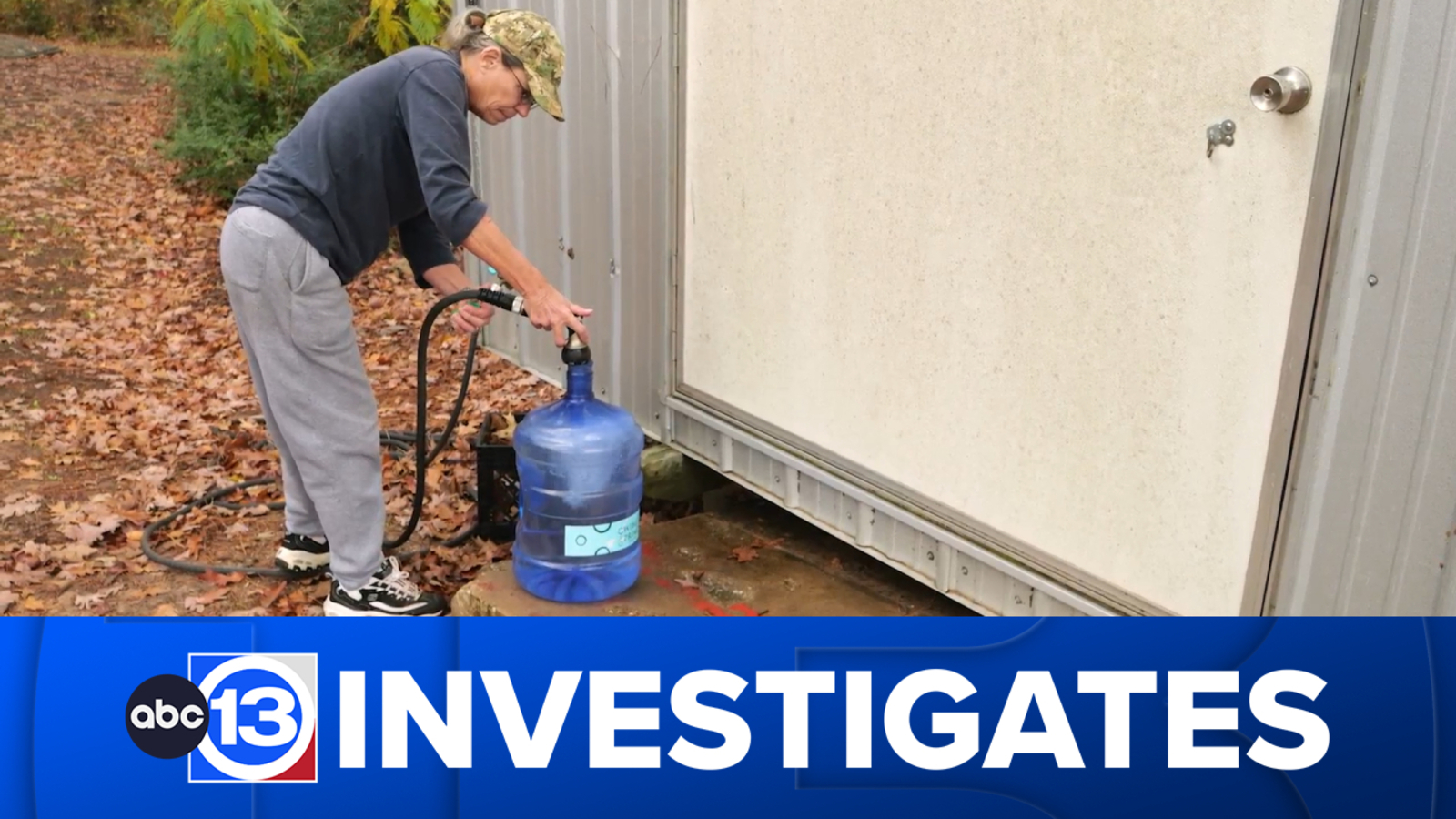
Mann said every other day she drives from her house to a friend’s home, who lives a few miles away so she can fill up large jugs of water with their garden hose.
“This is where it’s really heavy,” Mann said as she was carrying one of the five-gallon jugs she filled with water. “When it’s filled, it’s heavy and I’m out of breath.”
She said it’s her only source of water for washing dishes, washing her hands, and flushing her toilets, after she decided in November to cut off her water service with Texas Water Utilities.
Mann, who lives alone, said when she retired, she created a budget based on her monthly Social Security check. She said she had enough to pay her bills, but with very little wiggle room.
She said that it became problematic when the monthly base fees for water and sewage charged by her investor-owned water provider, Texas Water Utilities, kept going up, and she felt like there was nothing she could do to bring the cost down.
“I choose to eat, and I told them that every time you go up, that takes out of my money a month for my food,” Mann said about her decision to cut her water off.
She said she got behind on her water bill last year, and Texas Water Utilities sent her a termination notice.
“You don’t need to send me one. Just come cut my water off. I can’t afford it,” she said.
13 Investigates has reported on consumer concerns related to Texas Water Utilities in the past and the frustrations its customers across the state have with their bills.
According to a copy of Mann’s bills, it typically runs her about $160 a month for water and sewage, and that cost is mostly made up of fees.
The fees are set by Texas Water Utilities for both water and sewage. Her bill also shows pass-through fees and a state fee.
SEE ALSO: First-time homebuyer outraged by $138 utility base fees
In July, all of those fees totaled to $150.18, while her actual water and sewage usage for that July bill was $9.34.
In September 2025, the base fees for Mann’s bill went down slightly to $138.58.
The fees Mann is paying are not specific to her neighborhood. According to bills we received from customers across the state, the fees are what the majority of Texas Water Utilities customers pay every month. They are different from cities that also provide water charge.
Texas Water Utilities is an investor-owned utility company, meaning they are for-profit, and the company tells 13 Investigates they do not receive tax dollars for funding, so passing costs directly on to their customers is one of the ways they operate. An investor-owned utility operates differently than a city that provides water service to customers.
For example, one of Mann’s bills for Texas Water Utilities during a month where her usage was 2,000 gallons shows she was charged $169 for usage and fees, while a recent City of Houston bill for another customer who used 2,000 gallons was $57 in total.
According to its website, the private water company has about 60,000 customers in 32 counties. Its filings with the Public Utility Commission of Texas show the company is continuing to expand.
13 Investigates found Texas Water Utilities is in the process of acquiring at least four other companies. They’ve applied to be the provider in at least three new single-family home developments, including two in the greater Houston area.
The company has also filed to add a “system improvement charge” onto its bills, which would be $34 a month to recoup more than $80 million spent on infrastructure.
“Texas Water Utilities invested more than $81.8 million across the state in system improvements to ensure safe and clean drinking water as well as proper treatment and disposal of wastewater,” according to a statement from the company. “The System Improvement Charge customers are paying does not include new development construction. The system improvement charge allows Texas Water Utilities to begin recovering critical investment through the timely implementation of rates.”
Mann said she could pay her bill if it was in a range of what she was paying in Cleveland, which was about $60 a month.
“(The PUCT is) not regulating them. You’re letting them do what they want to do, and people are complaining, but basically they’re getting the same response that I’m getting it,” Mann said.
13 Investigates interviewed Mann last month. When we checked in with her recently, she said she’s since come out of retirement, mostly because of her water bill.
13 Investigates told Texas Water Utilities about Mann’s situation specifically and asked how customers can lower their bill, outside of applying for the company’s $40 per month financial assistance program.
They told us customers can manage their wastewater usage in the winter, because they average that amount, and that’s how much customers pay throughout the year. That portion of Mann’s bill is only $2 a month.
“Something to remember when reviewing our rates is that customers in this area are not paying municipal utility district (MUD) fees related to water and wastewater service. In other areas where a municipality provides utility service, rates are paid through utility bills, as well as MUD fees, taxes, etc. Texas Water Utilities’ monthly bill represents the full cost of service for customers and rates that are approved by the Public Utility Commission of Texas,” Texas Water Utilities said in a statement to 13 Investigates.
The Public Utility Commission of Texas tells us that investor-owned utilities are required to prove why a rate increase is necessary, and the commission only approves increases it finds just and reasonable.
Contact 13 Investigates
Have a tip? A problem to solve? Send a tip below. If you don’t have a photo or document to include, just hit ‘skip upload’ and send the details. (On mobile? You can open our form by tapping here.)
Copyright © 2026 KTRK-TV. All Rights Reserved.
About the Author